Myth-Busting the Five Forces: Separating Fact from Fiction

Myth-Busting the Five Forces: Separating Fact from Fiction

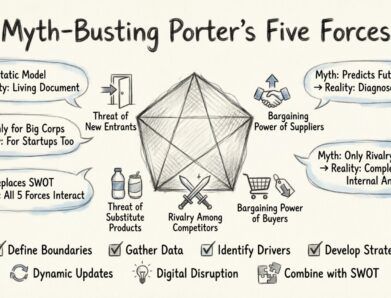
Michael Porter introduced a framework in 1979 that fundamentally changed how organizations assess their competitive environment. The model, known as Porter’s Five Forces, remains a cornerstone of strategic planning today. Despite its longevity, misconceptions persist regarding its application, scope, and predictive power. Many leaders treat the framework as a rigid checklist or a crystal ball. […]

Five Forces Model in the Age of AI and Automation

Five Forces Model in the Age of AI and Automation

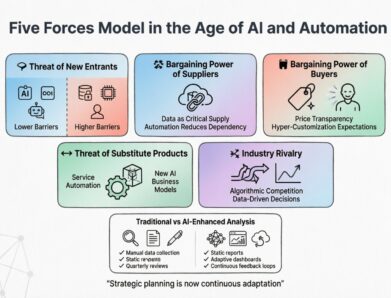
Porter’s Five Forces framework has long served as the cornerstone of strategic analysis. It provides a structured method for evaluating the competitive intensity and attractiveness of a market. However, the rapid integration of artificial intelligence and automation technologies is fundamentally altering the dynamics of these forces. Businesses can no longer rely on static models designed […]

Why Every Solution Architect Should Start with the C4 Model

Why Every Solution Architect Should Start with the C4 Model

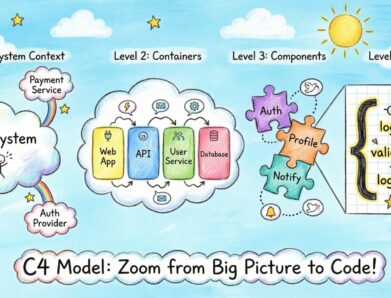
Designing complex software systems requires more than just technical expertise. It demands a shared language between developers, stakeholders, and business leaders. Without a standardized approach to visualization, architectural decisions often become isolated within individual minds. This is where the C4 Model provides a structured framework for understanding and communicating system design. By adopting this method, […]

Five Forces Model Checklist for Small Business Owners

Five Forces Model Checklist for Small Business Owners

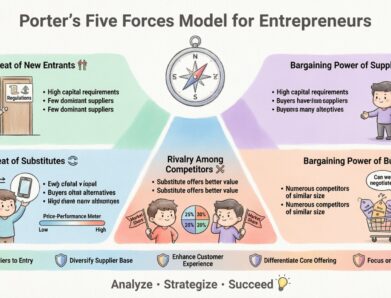
Strategic planning is not an activity reserved for large corporations with vast resources. Small business owners face unique challenges in their marketplaces, often competing against established giants or agile startups. To survive and grow, understanding the structural profitability of your industry is essential. The Five Forces Model, developed by Michael Porter, provides a structured framework […]

C4 Model Best Practices: Creating Clarity Without Overcomplicating

C4 Model Best Practices: Creating Clarity Without Overcomplicating

Software architecture is the backbone of any robust system. However, communicating that architecture effectively can be a significant challenge. Too often, diagrams become tangled webs of boxes and lines that confuse stakeholders rather than enlighten them. The C4 model offers a structured approach to visualizing software systems, breaking them down into manageable levels of abstraction. […]

The C4 Model Future Outlook: Where It’s Heading in 2026 and Beyond

The C4 Model Future Outlook: Where It’s Heading in 2026 and Beyond

Software architecture has always been the bridge between business requirements and technical execution. As systems grow in complexity, the need for clear, maintainable documentation becomes critical. The C4 model has emerged as a standard for visualizing software architecture, providing a hierarchical approach to diagramming. From high-level context to detailed code structures, it offers a shared […]