![Free eBooks of IT [BooksOfAll]](https://www.booksofall.com/wp-content/uploads/2022/06/booksofall-logo-2.png)
The AI-Augmented Architect: Modernizing UML for Agile Speed
For years, Unified Modeling Language (UML) suffered from a reputation crisis. In the fast-paced world of Agile development, heavy documentation was often viewed as bureaucratic overhead—a “waterfall” relic that slowed down shipping. However, as software systems grow increasingly complex with microservices, event-driven architectures, and distributed clouds, the need for visual clarity has never been higher.
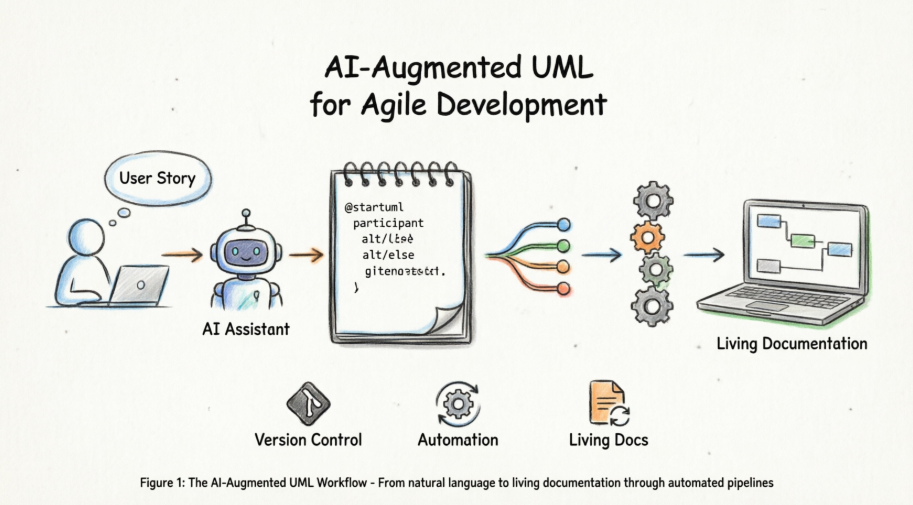
The solution isn’t to abandon modeling; it’s to modernize it. By combining text-based diagramming, comprehensive modeling platforms, CI/CD automation, and Generative AI, teams can transform UML from a static artifact into a living, breathing part of the development lifecycle.
Figure 1: The AI-Augmented UML Workflow – From natural language to living documentation through automated pipelines.
From Whiteboards to Code: The PlantUML Revolution
The first step in modernizing UML is treating diagrams as code. PlantUML allows developers to define diagrams using simple text syntax. This shift offers three critical advantages for Agile teams:
-
Version Control: Diagrams live in Git alongside source code. Changes are tracked, reviewed via pull requests, and branched just like application logic.
-
Maintainability: Updating a class name in a text file is infinitely faster than dragging boxes in a GUI tool.
-
AI Compatibility: Large Language Models (LLMs) excel at generating and interpreting structured text. Asking an AI to “generate a PlantUML sequence diagram for a user login flow” yields immediate, editable results.
Case Study: Automating the “Order Checkout” Flow
To illustrate this workflow, consider a mid-sized e-commerce team implementing a new “Express Checkout” feature. The requirement involves coordinating between the Frontend, API Gateway, Payment Service, and Inventory Service.
Step 1: AI-Assisted Drafting
Instead of spending hours in a whiteboard session, the Tech Lead uses an AI chatbot with the following prompt:
“Generate a PlantUML sequence diagram for an Express Checkout process. Actors: User, Frontend, API Gateway, PaymentService, InventoryService. Steps: User clicks checkout, Frontend sends request to Gateway, Gateway validates token, checks Inventory, processes Payment, and returns confirmation. Include error paths for ‘Insufficient Stock’ and ‘Payment Declined’.”
The AI returns the following PlantUML code:
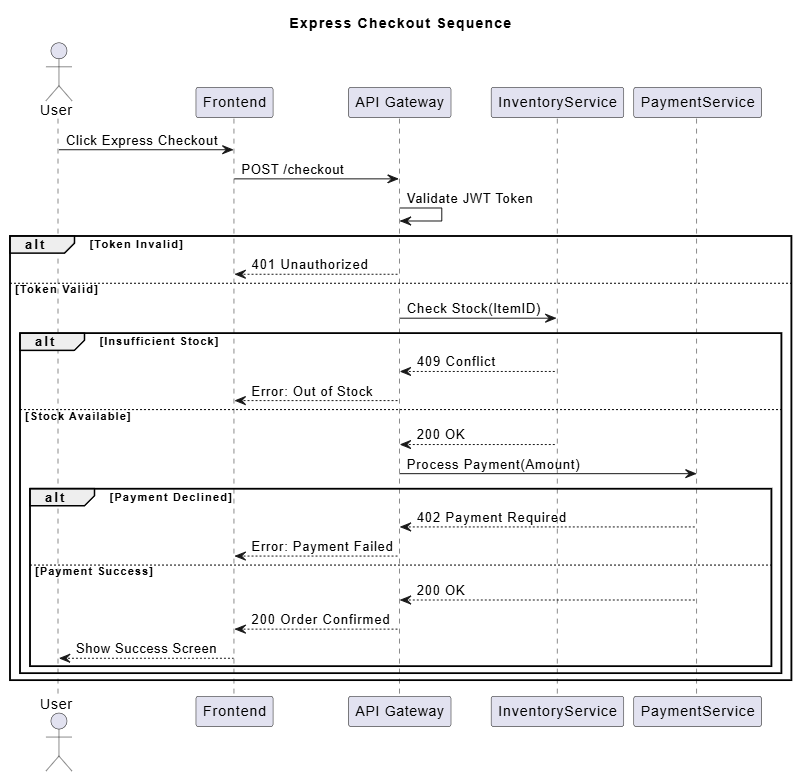
PlantUML
Edit PlantUML in VPasCode
@startuml
title Express Checkout Sequence
actor User
participant "Frontend" as FE
participant "API Gateway" as GW
participant "InventoryService" as Inv
participant "PaymentService" as Pay

User -> FE : Click Express Checkout
FE -> GW : POST /checkout
GW -> GW : Validate JWT Token

alt Token Invalid
    GW --> FE : 401 Unauthorized
else Token Valid
    GW -> Inv : Check Stock(ItemID)

    alt Insufficient Stock
        Inv --> GW : 409 Conflict
        GW --> FE : Error: Out of Stock
    else Stock Available
        Inv --> GW : 200 OK
        GW -> Pay : Process Payment(Amount)

        alt Payment Declined
            Pay --> GW : 402 Payment Required
            GW --> FE : Error: Payment Failed
        else Payment Success
            Pay --> GW : 200 OK
            GW --> FE : 200 Order Confirmed
            FE --> User : Show Success Screen
        end
    end
end
@enduml
Step 2: Human Refinement & Version Control
The developer reviews the AI-generated code, adds specific service IDs, and commits the .puml file to the repository. Because it is text, the team can see exactly what changed in the Git diff:
+ participant "FraudDetectionService" as Fraud
+ GW -> Fraud : Scan Transaction
Step 3: Pipeline Integration
Upon merging the pull request, the CI/CD pipeline automatically:
-
Renders the PlantUML code into an SVG image.
-
Embeds the image into the team’s internal documentation site (e.g., MkDocs).
-
Updates the “Living Documentation” portal, ensuring that when the QA team tests the feature, they are looking at the most current architectural flow.
This case study demonstrates how AI reduces the initial drafting time from hours to seconds, while PlantUML and CI/CD ensure the diagram remains accurate and accessible.
Visual Paradigm: Bridging the Gap Between Text and Enterprise
While PlantUML handles quick, agile sketches, enterprise-grade architecture often requires deeper rigor. Tools like Visual Paradigm (VP) provide a comprehensive platform for complex modeling, reverse engineering, and code generation.
Modern VP workflows integrate “VP as Code,” allowing models to be exported to JSON or YAML. This enables hybrid workflows where high-level architecture is maintained in VP for governance, while detailed implementation diagrams are managed in PlantUML for speed. AI enhancements in these platforms now allow users to generate initial model structures from natural language descriptions, significantly reducing the “blank canvas” friction.
The Living Documentation Pipeline
In traditional setups, documentation rots the moment it is written. In an AI-augmented Agile pipeline, documentation is living.
By integrating PlantUML and VP exports into CI/CD pipelines, teams can automate the generation of HTML documentation sites (using tools like MkDocs or Docusaurus). Every time code is merged, the pipeline:
-
Renders the latest PlantUML diagrams.
-
Validates model consistency against API specifications (OpenAPI/Swagger).
-
Publishes the updated docs to an internal portal.
This ensures that the architecture diagram a developer looks at today is an accurate reflection of the system running in production.
The AI Co-Pilot: Real-Time Modeling Support
The most transformative element of this new stack is the AI Chatbot. Integrated into IDEs or collaboration tools like Slack, these bots act as real-time modeling assistants.
-
During Sprint Planning: A product manager can paste user stories into a chatbot, which returns a draft Use Case or Activity diagram for team review.
-
During Code Reviews: An AI bot can analyze a Pull Request and suggest a Sequence diagram to explain the new data flow, helping reviewers understand context without reading every line of code.
-
Prompt Engineering: Effective use requires specific prompts. Instead of “Draw a diagram,” engineers use structured prompts like: “Generate a PlantUML class diagram for a payment service. Include interfaces for ‘PaymentProcessor’ and concrete classes for ‘StripeAdapter’ and ‘PayPalAdapter’. Show composition relationships.”
Best Practices for the AI-Empowered Team
To succeed, teams must avoid common pitfalls:
-
Avoid Over-Modeling: Only model what is complex or ambiguous. Simple CRUD operations rarely need a diagram.
-
Validate AI Output: LLMs can hallucinate syntax or logical flows. Always treat AI-generated diagrams as first drafts requiring human verification.
-
Secure Your Data: Be mindful of sending proprietary architecture to public AI models. Use enterprise-grade AI solutions with data privacy guarantees.
Conclusion
UML is not dead; it has evolved. By leveraging PlantUML for agility, Visual Paradigm for depth, CI/CD for automation, and AI for acceleration, modern software teams can achieve a level of architectural clarity that was previously impossible at Agile speeds. The result is not just better documentation, but better software—built on a foundation of shared understanding and continuous visual feedback.


Comments (0)