Navigating Visual Paradigm: Selecting the Right Modeling Edition for Your Enterprise
In the complex landscape of software development and enterprise architecture, the choice of tooling is just as critical as the methodologies you employ. Visual Paradigm offers a suite of desktop editions designed to cater to specific organizational needs, ranging from agile software teams to rigid government defense frameworks. This tutorial explores the strategic value of selecting the correct edition—Standard, Enterprise, Professional, or Community—to maximize your modeling efficiency.
The Standard Edition: The Agile Workhorse
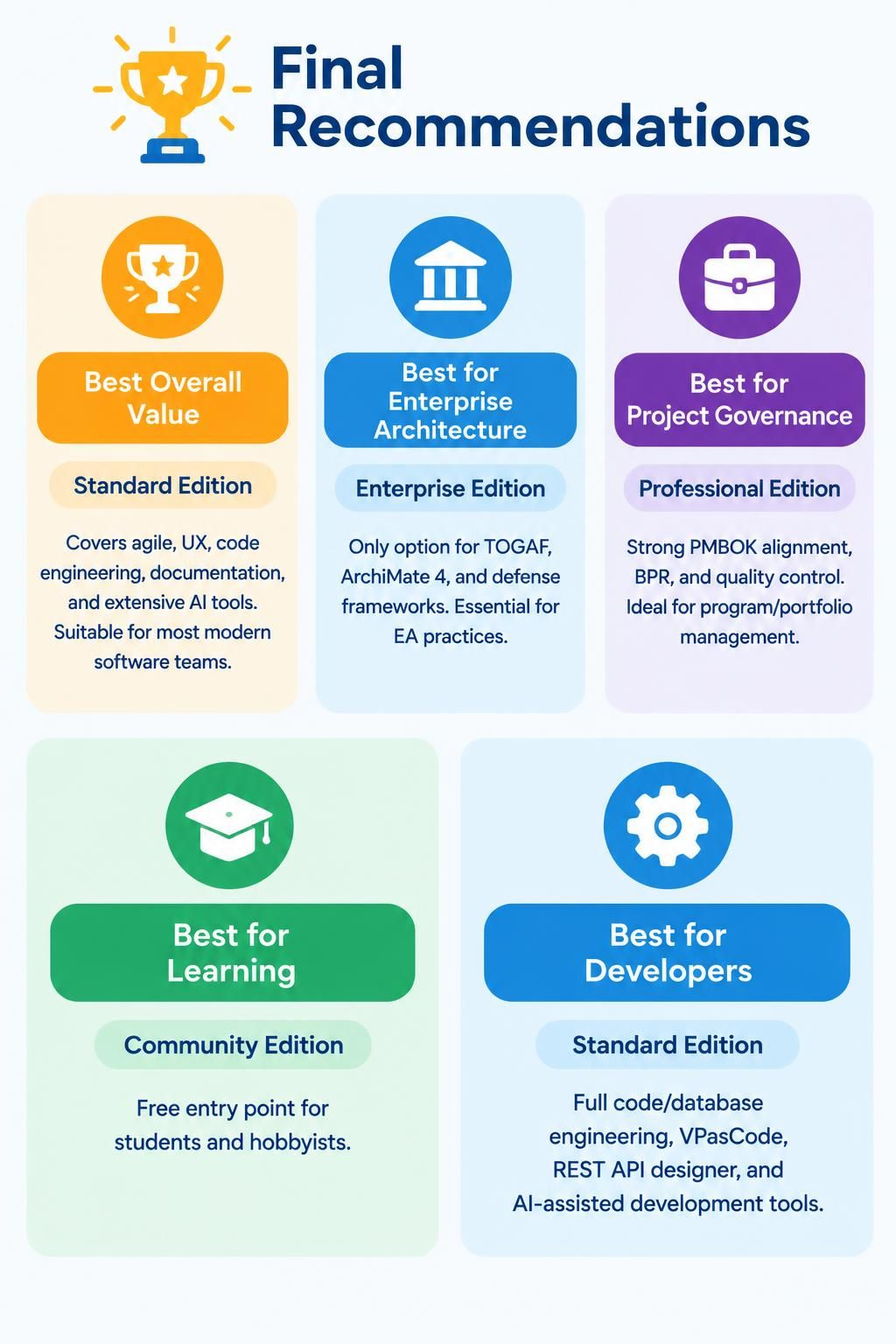
The Standard Edition stands as the most versatile option in the Visual Paradigm portfolio. It is engineered for modern software teams that require a blend of flexibility and power. This edition is particularly renowned for its comprehensive coverage of:
- Agile Methodologies: Built-in support for Scrum and Kanban workflows allows teams to manage sprints and user stories directly within the modeling environment.
- UX Design: It facilitates the creation of wireframes and user journey maps, ensuring the user experience is considered early in the design phase.
- Code Engineering: Developers benefit from round-trip engineering capabilities, allowing for the generation and reverse-engineering of code.
- AI Integration: Extensive AI tools are embedded to assist with documentation generation and code completion.
For most modern software teams, the Standard Edition provides the necessary breadth to handle the entire software development lifecycle (SDLC) without the overhead of heavy enterprise frameworks.
Enterprise Architecture: The Heavy Hitters
When organizations must adhere to strict international standards, the Enterprise Edition becomes the exclusive choice. It is the only edition that supports full compliance with major enterprise architecture frameworks.
This edition is essential for architects working in:
- TOGAF (The Open Group Architecture Framework): The industry standard for enterprise architecture, requiring specific artifacts and workflows.
- ArchiMate 4: The modeling language for enterprise architecture, which is fully supported here.
- Defense Frameworks: Specialized modeling standards required by government and defense sectors.
While the Standard Edition handles general engineering, the Enterprise Edition provides the rigorous structure needed for high-level strategic planning and governance.
Project Governance and Management
Beyond technical architecture, software delivery requires robust project governance. The Professional Edition is tailored for Program and Portfolio Managers who need to align technical delivery with business goals. Its strength lies in its strong alignment with the PMBOK (Project Management Body of Knowledge).
Key features include:
- BPR (Business Process Reengineering): Tools to analyze and optimize business workflows.
- Quality Control: Mechanisms to ensure deliverables meet defined standards.
- Portfolio Management: High-level views to manage multiple projects and resource allocation.
Community and Developer Tools
For those just starting their journey, the Community Edition offers a free entry point. It is ideal for students and hobbyists looking to learn the fundamental concepts of UML, BPMN, and system modeling without financial barriers.
Conversely, for the dedicated software engineer, the Standard Edition acts as a “Best for Developers” powerhouse. It features the VPasCode engine, a REST API designer, and AI-assisted development tools that allow developers to jump straight from diagrams to production-ready code structures.
Summary of Recommendations
Selecting the right tool is about matching the complexity of your project with the power of the software. If you are building a standard web application, the Standard Edition is your best value. If you are designing the infrastructure for a multinational defense contract, the Enterprise Edition is non-negotiable. By understanding these distinctions, teams can ensure they are utilizing the full potential of Visual Paradigm for their specific architectural and governance needs.