Mastering AI Flowcharts: From Visual Paradigm Prototypes to VPasCode Automation
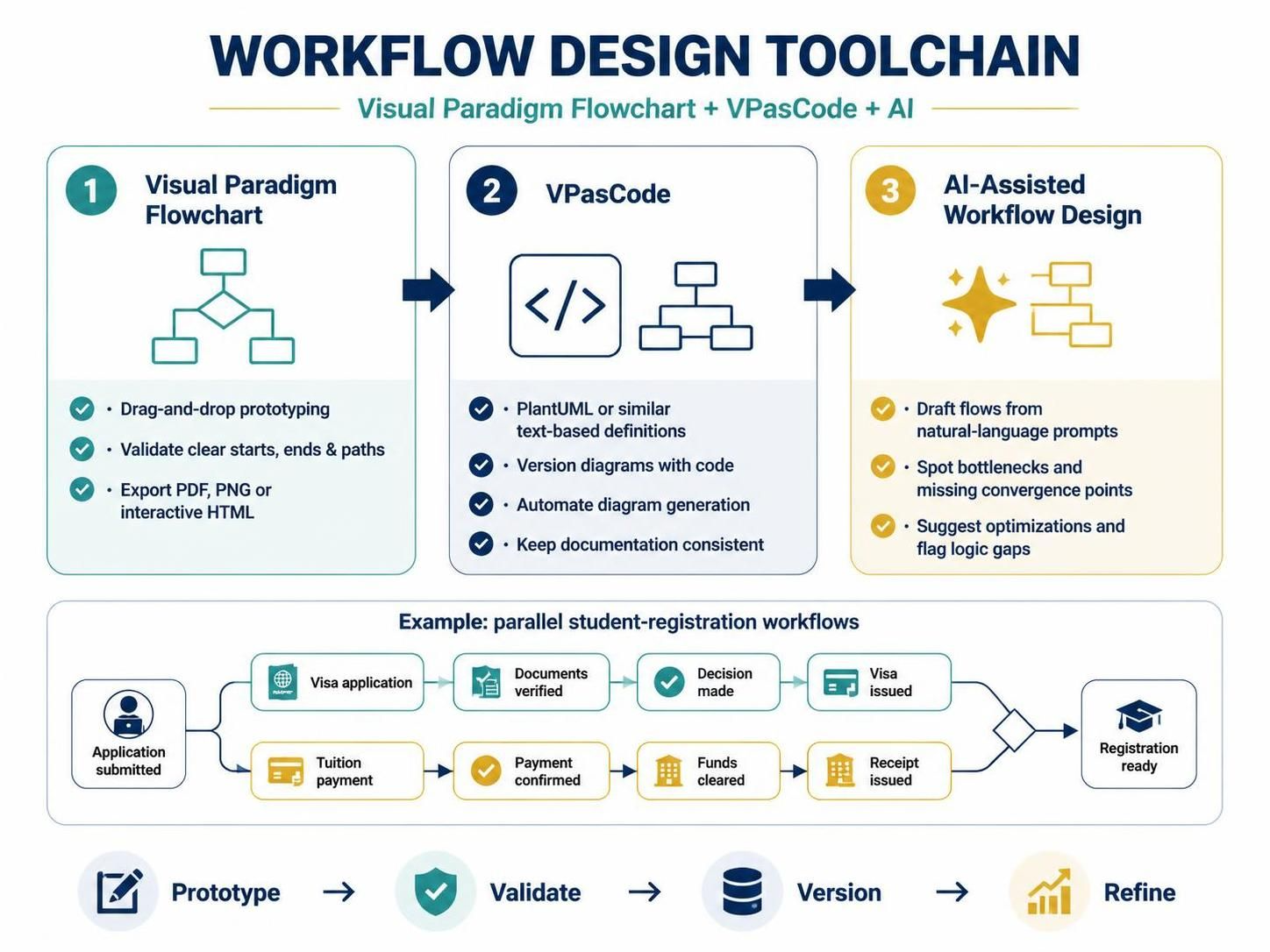
In modern systems analysis and product management, the gap between a high-level concept and a deployable system is often bridged by effective workflow modeling. This tutorial explores a robust, three-tiered approach to designing complex parallel processes, specifically focusing on the synergy between Visual Paradigm Flowchart, VPasCode, and AI-Assisted Design.
1. The Foundation: Visual Paradigm Flowchart
The process begins with rapid prototyping. For analysts and stakeholders, the most intuitive way to define logic is through visual interfaces. Visual Paradigm Flowchart serves as the primary canvas for this phase.
Key Capabilities for Rapid Prototyping
- Drag-and-Drop Interface: Users can instantly construct complex process flows without writing syntax. This is ideal for brainstorming sessions with non-technical stakeholders.
- Validation Checks: A common pitfall in manual design is “orphaned” logic. Visual Paradigm enforces structural integrity by validating that all paths have clear start and end points, preventing dead-end logic.
- Stakeholder Export: Once the logic is sound, the tool allows for flexible exportation. Whether you need a static PDF for a board meeting, a PNG for a presentation, or an interactive HTML file for a web portal, the model adapts.
2. The Bridge: VPasCode and Text-Based Definitions
Once a workflow is visually validated, it often needs to be maintained as a permanent artifact. This is where the VPasCode tool becomes essential. It bridges the gap between the visual world and the code world.
Why Use VPasCode?
In large-scale systems, managing diagrams via binary files (like .vpp or .png) can be cumbersome for version control systems like Git. VPasCode utilizes text-based definitions (such as PlantUML) to solve this.
- Version Control: Text files can be diffed and merged, allowing teams to track diagram changes alongside source code repositories.
- Automation: Diagrams can be generated automatically from textual descriptions, ensuring that the documentation never drifts from the actual code requirements.
- Consistency: By standardizing on a scripting language, teams ensure that all documentation sets adhere to the same visual grammar.
Example: Coding the Parallel Workflow
The student registration example shown in the reference material illustrates a classic parallel process. Below is how a system architect might define this logic in VPasCode/PlantUML syntax.
@startuml
skinparam backgroundColor #ffffff
skinparam packageStyle rectangle

title University Student Registration Process

start
:Application Submitted;

fork then
  :Visa Application;
  :Documents Verified;
  :Decision Made;
  :Visa Issued;
  fork again
  :Tuition Payment;
  :Payment Confirmed;
  :Funds Cleared;
  :Receipt Issued;
endif

join
:Registration Ready;
stop
@enduml
3. The Accelerator: AI-Assisted Workflow Design
The final layer of the toolchain leverages Artificial Intelligence to enhance productivity. AI tools are not just for generating text; they are powerful partners in system architecture.
AI in the Modeling Loop
- Natural Language to Diagram: Instead of manually drawing boxes, a product manager can prompt the AI: “Create a registration flow with parallel visa and tuition tracks.” The AI generates the initial draft structure instantly.
- Bottleneck Identification: AI can analyze existing diagrams to spot logical errors, such as missing convergence points where parallel threads should merge, or potential bottlenecks where resources might be overloaded.
- Optimization Suggestions: The tool can suggest refactoring redundant steps or highlighting gaps in conditional logic that were missed during manual review.
Conclusion: The Power of Decoupling
The University Student Registration Process is a prime example of why parallel workflow design is critical. By decoupling independent tasks—such as Visa application and Tuition payment—institutions can process these streams concurrently rather than sequentially.
This approach significantly reduces processing time and optimizes resource allocation. However, it introduces complexity regarding verification loops and convergence points. By utilizing a toolchain that includes Visual Paradigm for prototyping, VPasCode for maintenance, and AI for optimization, product managers and analysts can ensure that these complex systems remain clear, maintainable, and efficient.