BPMN for Insurance Claims: Mastering Complex Workflow Logic with Visual Paradigm
Building robust business process models requires more than just drawing boxes and arrows; it demands a deep understanding of control flow logic. In this tutorial, we will deconstruct a real-world Insurance Claim Processing scenario. This process illustrates how to combine parallel execution with hierarchical decision-making to handle complex business rules efficiently.
We will analyze the architecture of this workflow, focusing on the critical transition from simultaneous investigations to exclusive approval paths. By the end of this guide, you will understand how to model nested gateways effectively using Visual Paradigm’s BPMN tools.
The Architecture of the Claim Process
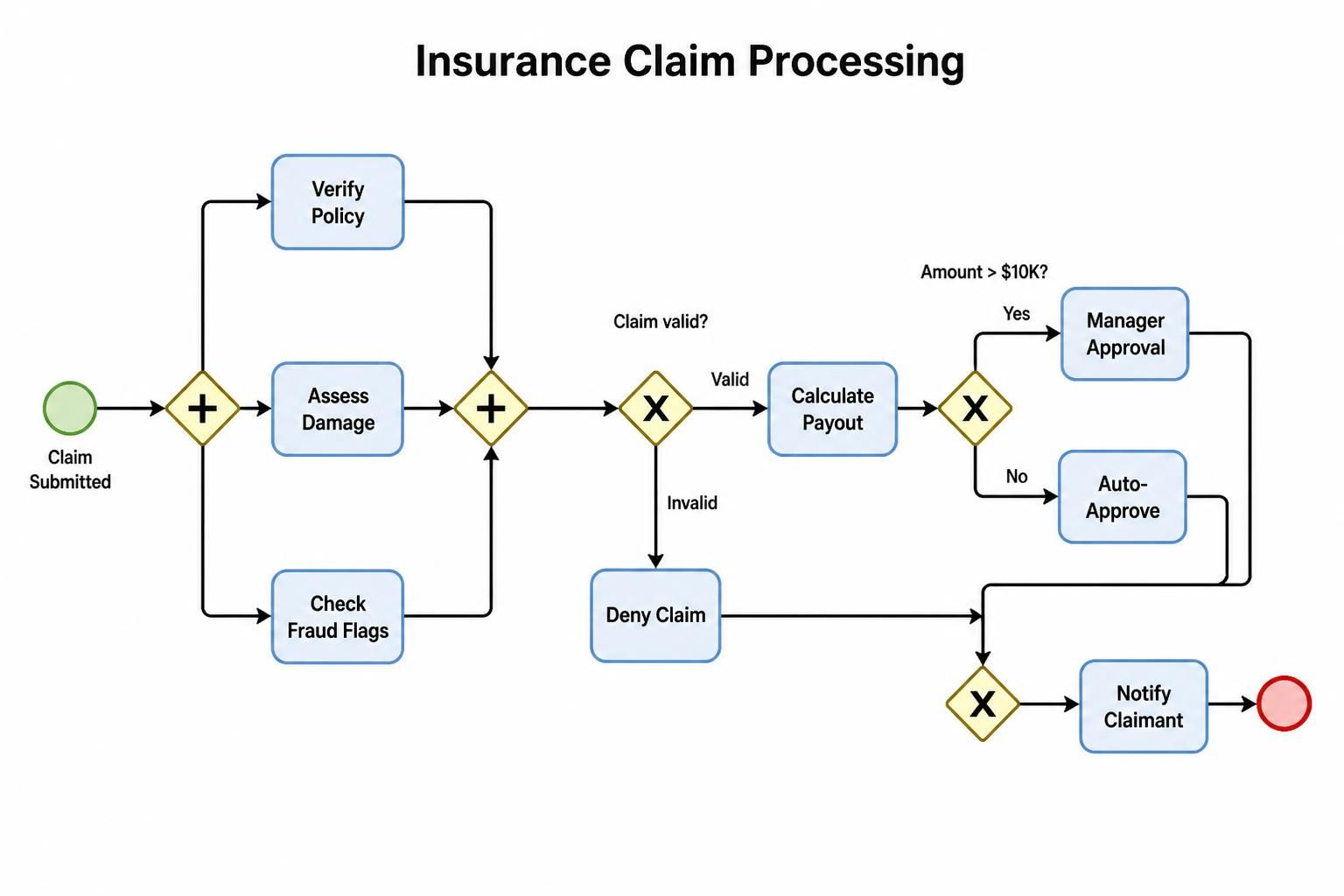
The diagram represents a lifecycle that begins when a customer submits a claim and ends when they are notified of the final decision. The flow is divided into three distinct phases: Investigation, Validation, and Payout/Resolution.
Phase 1: Parallel Investigation
The process initiates with a Start Event labeled “Claim Submitted.” Immediately, the flow encounters a Parallel Gateway (the diamond with a + sign). This is a crucial modeling concept. Instead of processing tasks sequentially (one after another), the engine splits the flow into three concurrent branches:
- Verify Policy: Ensures the claimant has active coverage.
- Assess Damage: Evaluates the physical extent of the loss.
- Check Fraud Flags: Scans historical data for suspicious patterns.
These tasks run simultaneously, optimizing the total time-to-resolution. Once all three branches are complete, they meet at a second Parallel Gateway, which acts as a join barrier. The process cannot proceed until all three checks are finished.
Phase 2: The Validation Gate
After the parallel checks, the workflow hits a Exclusive Gateway (the diamond with an X sign). This represents a binary decision point: Is the claim valid?
In BPMN, this gateway has two distinct outgoing paths labeled with conditions:
- Invalid: If the claim is denied, the flow immediately routes to “Deny Claim” and bypasses the payout logic entirely.
- Valid: If the claim passes validation, the flow proceeds to “Calculate Payout.”
Hierarchical Decision Making
One of the most powerful aspects of this diagram is how it handles financial thresholds. The system does not treat every valid claim the same way. It employs a nested logic structure:
- The process calculates the payout amount.
- It then encounters another Exclusive Gateway asking: Is Amount > $10K?
- Yes Path: Triggers a manual “Manager Approval” task, ensuring human oversight for high-value risks.
- No Path: Triggers an “Auto-Approve” task, streamlining the process for smaller, low-risk claims.
This hierarchy ensures that the business rule is enforced: High value requires human intervention; low value gets automated speed.
Reconverging the Flow
Notice that the “Manager Approval” and “Auto-Approve” paths, as well as the “Deny Claim” path, all eventually funnel into a final Exclusive Gateway. This is a common pattern in process modeling where different outcomes must synchronize before a final action can occur. From this final gateway, the process moves to “Notify Claimant” and concludes with an End Event.
Modeling Best Practices
When recreating this model in Visual Paradigm, keep the following structural rules in mind:
- Match Gateway Types: Always ensure your Parallel Gateway (Join) has a matching Parallel Gateway (Split). If you split into 3 paths, you must wait for all 3 to return.
- Label Your Conditions: Never leave an Exclusive Gateway without explicit labels (like “Valid”, “Invalid”, “Yes”, “No”) on the connecting lines. This is the only way the engine knows which path to take.
- Visual Hierarchy: Use the diagram layout to your advantage. Placing the nested decision logic (the $10K check) to the right of the validation logic helps the viewer understand the chronological progression.
By mastering these patterns, you can build sophisticated models that accurately reflect the complexity of real-world business operations.