Architecting a University Library System with AI and Visual Paradigm VPasCode
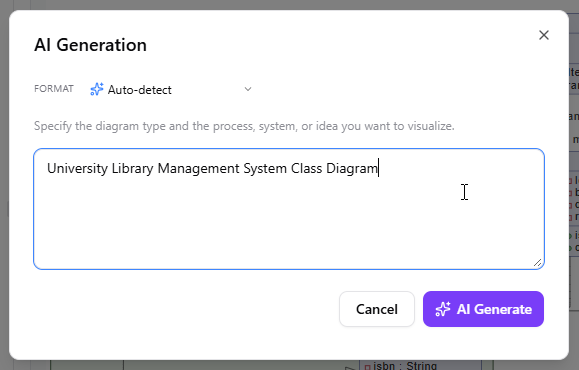
In modern software documentation, the gap between a high-level idea and a detailed technical specification can be bridged efficiently using diagram-as-code tools. Visual Paradigm VPasCode transforms this workflow by allowing users to leverage AI to generate complex system models from plain text. As demonstrated in the interface provided, a user can describe a “University Library Management System Class Diagram” and instantly visualize the underlying object-oriented structure.
This tutorial walks you through the architectural modeling of a University Library Management System (ULMS). We will explore how to define the system’s core entities, their relationships, and how VPasCode renders these textual descriptions into a professional class diagram.
Understanding the Core Entities
Before diving into the code, we must identify the primary actors and objects in our system. A robust class diagram for a library system typically revolves around the management of books, users, and the transactions between them.
- Book: The central asset. It requires attributes like ISBN, title, and author to be uniquely identified.
- User: The entity interacting with the library. This could be a generic user, a student, or a faculty member.
- BorrowingRecord: The critical link (association) between a User and a Book. This class tracks the transaction dates.
VPasCode supports multiple modeling languages, including PlantUML and Mermaid. For object-oriented modeling like class diagrams, PlantUML is often preferred for its readability and extensive support for standard UML syntax.
Step-by-Step: Writing the Class Diagram
To generate the diagram for the University Library system, we translate our conceptual entities into code. Below is a comprehensive PlantUML snippet that defines the structure shown in the AI generation prompt.
@startuml
' Define the class for Books
class Book {
  - isbn : String
  - title : String
  - author : String
  + search()
  + getAvailability()
}

' Define the class for Users
class User {
  - userId : String
  - name : String
  - email : String
  + borrowBook()
  + returnBook()
}

' Define the association class for Borrowing Records
class BorrowingRecord {
  - borrowDate : Date
  - dueDate : Date
  - status : String
}

' Define relationships
User "1" -- "0..*" BorrowingRecord : manages
BorrowingRecord "0..*" -- "1" Book : borrows

' Add visibility modifiers
Book {
  +isbn : String
  +title : String
}
@enduml
Decoding the Syntax
When using VPasCode or similar tools, understanding the specific syntax elements helps in refining the output:
classkeyword: Defines the shape of the object.-vs+: These symbols denote visibility.-means Private (internal only), while+means Public (accessible by other classes).- Colon
:: Used to separate the attribute name from its data type (e.g.,isbn : String). - Cardinality: The notation
"1" -- "0.."indicates a One-to-Many relationship. In this case, one User can manage zero or many Borrowing Records.
Refining the Model with AI
One of the key features of VPasCode is the ability to iterate on the design. If the initial AI generation produces a basic structure, you can refine it using natural language commands.
For example, if the diagram is missing a specific constraint, you might add a note to the code:
' Adding a constraint for maximum borrow limit
note right of User
  Users can borrow up to 5 books
  simultaneously.
end note
VPasCode will render this note directly onto the diagram, ensuring the documentation remains visual and clear.
Conclusion
By utilizing VPasCode, developers and architects can move away from manual drawing and towards a code-centric approach. This ensures that your diagrams remain version-controlled, easily editable, and always synchronized with your documentation.
The transition from the prompt “University Library Management System Class Diagram” to the final rendered visual model exemplifies how modern documentation platforms empower teams to build better systems faster.