![Free eBooks of IT [BooksOfAll]](https://www.booksofall.com/wp-content/uploads/2022/06/booksofall-logo-2.png)
Retail Loan Workflow: Architecting BPMN 2.0 Approval Processes
In the complex landscape of retail banking, process efficiency is not just a goal—it is a necessity. This tutorial explores the architecture of a standard Loan Application and Approval Workflow, demonstrating how organizations utilize advanced BPMN (Business Process Model and Notation) tools to streamline operations. We will break down the interaction between the Customer, Loan Officer, Credit Analyst, and Approval Committee, illustrating how these distinct roles collaborate to manage risk and deliver services.
Understanding the BPMN 2.0 Architecture
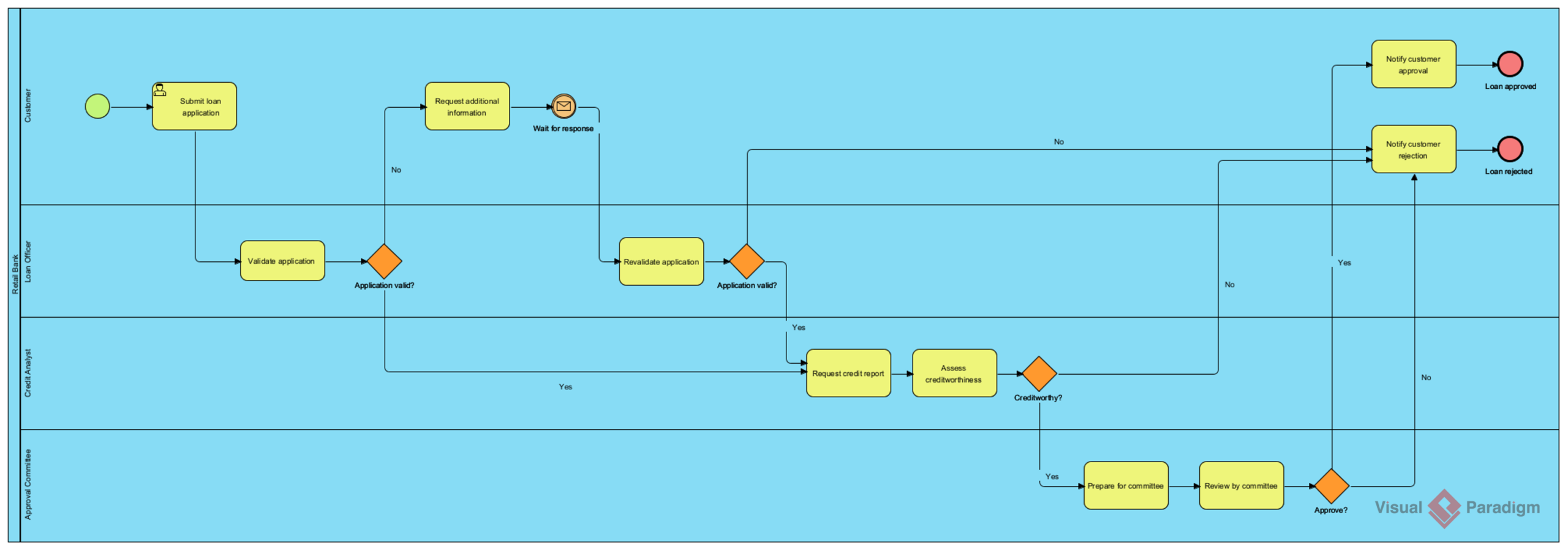
The diagram presented is a classic example of a BPMN 2.0 Swimlane diagram. This notation allows for the visualization of complex processes by separating activities into specific lanes, representing different roles, departments, or external entities. This separation is crucial for identifying bottlenecks and clarifying handoffs between different stakeholders.
The Four Key Roles
In this specific workflow, we observe four distinct swimlanes that dictate the flow of the loan application:
- Customer: The external entity initiating the request. Their primary actions involve submission and responding to inquiries.
- Loan Officer: The first line of defense within the bank, responsible for the initial validation of the application and managing client communication.
- Credit Analyst: The technical expert who evaluates the financial risk associated with the loan request.
- Approval Committee: The final decision-making body, required for high-value or complex loan approvals.
Step-by-Step Process Analysis
Let us walk through the logical flow of the diagram, examining how the process moves from initiation to conclusion.
1. Initiation and Initial Validation
The process begins with the Customer submitting a loan application. This triggers the first activity in the Loan Officer lane: Validate application. The Loan Officer performs a sanity check. If the application is incomplete or invalid, the process loops back to the customer via a Intermediate Message Event (envelope icon) to Request additional information. This creates a “wait state” until the customer responds.
2. The Credit Assessment
Once the application passes the initial validation, the flow moves to the Credit Analyst. Here, the process becomes more rigorous:
- Request credit report: Data is gathered from external bureaus.
- Assess creditworthiness: The analyst evaluates the financial health of the applicant.
- Decision Point: A gateway asks, Creditworthy?. If the answer is No, the process immediately branches to a rejection notification.
3. The Committee Review
If the applicant is deemed creditworthy, the process moves to the final stage involving the Approval Committee. The system prepares the case for review. The Committee then performs a Review by committee action. This is governed by a final decision gateway: Approve?.
4. Conclusion and Outcomes
The workflow concludes with one of two outcomes, represented by End Events:
- Loan Approved: If the committee approves, the customer is notified, and the process ends successfully.
- Loan Rejected: If the committee rejects the loan, or if the credit analyst finds the applicant uncreditworthy, a rejection notification is sent to the customer.
Strategic Value of AI-Driven Modeling
Traditionally, mapping these workflows required hours of manual drawing and formatting. However, modern tools like Visual Paradigm leverage AI to transform plain-English narratives into interactive, standards-compliant diagrams. This approach offers significant advantages:
- Reduced Time-to-First-Draft: Initial diagram creation shifts from hours to minutes, accelerating workshop follow-ups.
- Enhanced Consistency: AI application of BPMN 2.0 standards reduces manual errors and ensures diagrammatic uniformity across teams.
- Increased Analyst Capacity: Business analysts spend less time on mechanical drafting and more time on value-added activities like process analysis and optimization.
- Improved Collaboration: Rapid generation of visual models facilitates clearer communication between business stakeholders and technical teams.
Tooling: Visual Paradigm
To successfully implement and maintain complex workflows like the Loan Approval process, organizations require robust modeling software. Visual Paradigm serves as the comprehensive platform for this task.
Why Visual Paradigm?
Visual Paradigm is an all-in-one business process modeling tool that supports the full lifecycle of BPMN 2.0. It allows teams to not only draw diagrams but also simulate processes to identify bottlenecks before implementation.
Key Features for Banking Workflows
- BPMN 2.0 Compliance: Ensures that the Loan Approval workflow adheres to international standards, making it readable by any BPM engine.
- AI Diagram Generation: Utilizes AI to convert text descriptions into accurate diagrams, reducing the time spent on manual formatting.
- Collaboration: Supports real-time collaboration, allowing the Loan Officer and Credit Analyst to view and edit the process model simultaneously.
- Integration: Can integrate with other enterprise systems, allowing the modeled workflow to eventually be deployed as executable code.
By leveraging Visual Paradigm, banks can ensure that their process documentation is not just a static image, but a dynamic, actionable asset that drives operational efficiency and digital transformation.