Visual Paradigm’s Private AI for Enterprise: Bridging the Valley of Despair
Welcome to this high-level architectural overview of Visual Paradigm’s latest strategic evolution. As we transition from traditional modeling tools to comprehensive AI solutions, we are redefining how organizations—especially Small and Medium-sized Enterprises (SMEs)—approach Artificial Intelligence. This tutorial walks you through the “Private AI for Enterprise Knowledge” ecosystem, a system designed to remove technical barriers and integrate AI directly into your organizational workflow.
1. The Strategic Shift: Why Traditional AI Adoption Fails
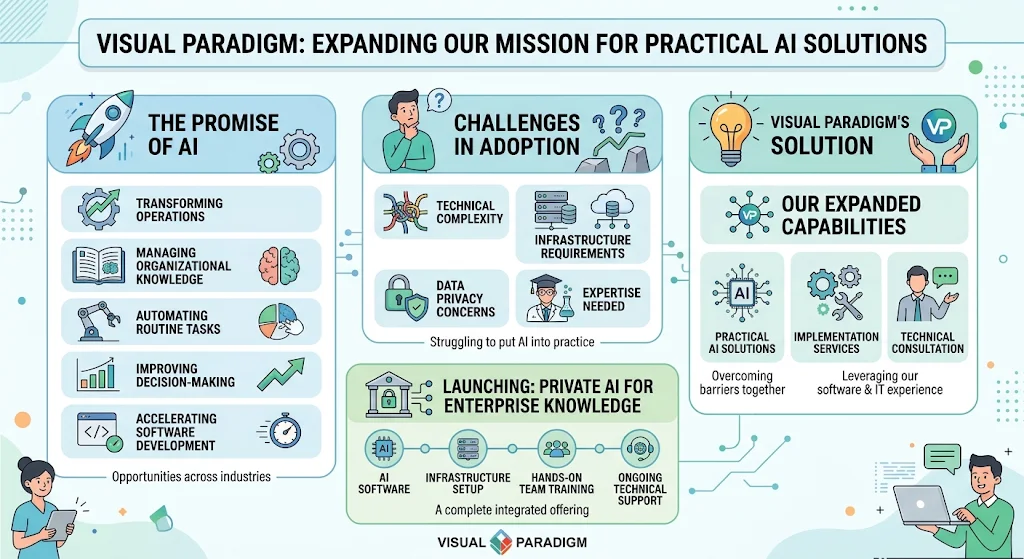
To understand the new architecture, we must first recognize the “Valley of Despair” that most organizations face when trying to adopt AI. The infographic identifies four primary architectural and operational friction points:
- Technical Complexity: Integrating AI models into existing legacy systems is often a nightmare of incompatible APIs and data silos.
- Infrastructure Requirements: Deploying AI often requires massive, expensive cloud infrastructure that SMEs cannot easily afford.
- Data Privacy Concerns: Organizations hesitate to send sensitive internal data to public, open-source AI models due to security risks.
- Expertise Needed: There is a significant shortage of data scientists and AI engineers capable of tuning and maintaining these systems.
The Visual Paradigm solution addresses these specific challenges by offering a “turnkey” architecture. Instead of building a custom pipeline, the organization adopts an integrated ecosystem that handles the heavy lifting.
2. The Core Architecture: The “Private AI” Ecosystem
The heart of this new offering is the Private AI for Enterprise Knowledge solution. This is not just a software update; it is a comprehensive architectural framework designed to keep your intellectual property (IP) secure while delivering practical value. The system is built upon four pillars:
A. Private AI Software (The Brain)
This component acts as the cognitive engine of the ecosystem. Unlike standard public LLMs (Large Language Models) that rely on external data, this software is configured to run locally or within a private cloud environment. This ensures that your enterprise knowledge—documents, databases, and internal processes—never leaves your secure perimeter.
B. Infrastructure Setup (The Foundation)
Visual Paradigm provides the necessary infrastructure setup. This abstracts away the complexity of hardware and cloud configuration. The system is pre-configured to handle the computational demands of AI inference, ensuring high availability and low latency without requiring you to manage complex server farms.
C. Hands-on Team Training (The Human Interface)
Technology is only as good as the people using it. A critical part of this architecture is the training component. It bridges the gap between technical complexity and business utility, empowering your staff to interact with the AI system effectively.
D. Ongoing Technical Support (The Maintenance Layer)
To ensure long-term viability, the solution includes continuous support. This ensures that as your data grows and your needs evolve, the system scales accordingly.
3. Visualizing the Solution: A Conceptual Data Flow
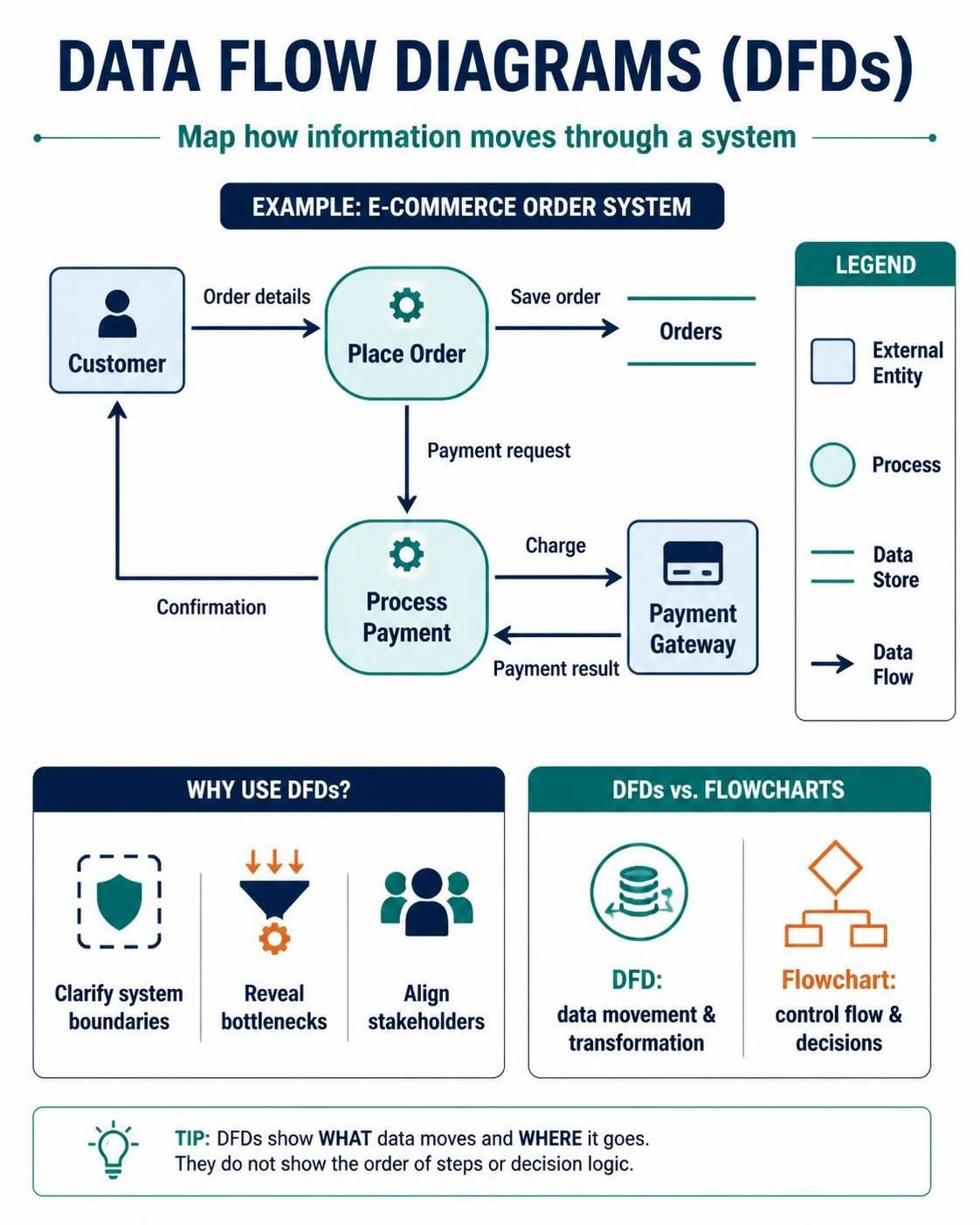
In systems architecture, we often visualize these flows using Data Flow Diagrams (DFD). Below is a conceptual representation of how the “Private AI for Enterprise Knowledge” interacts with an organization. This diagram illustrates the shift from a fragmented approach to an integrated one.
graph TD
    %% Define Styles
    classDef external fill:#f9f9f9,stroke:#333,stroke-width:2px;
    classDef internal fill:#e1f5fe,stroke:#0277bd,stroke-width:2px;
    classDef secure fill:#e8f5e9,stroke:#2e7d32,stroke-width:2px;

    %% External Entities
    User((Enterprise User)):::external
    OrganizationData((Internal Knowledge Base)):::external

    %% The Solution Block
    subgraph "Visual Paradigm Private AI Solution"
        direction TB
        Setup[Infrastructure Setup]:::internal
        Training[Team Training]:::internal
        Support[Ongoing Support]:::internal

        subgraph "Core AI Engine"
            AI_Software[AI Software]:::secure
            Security[Privacy & Security Layer]:::secure
        end
    end

    %% Flow Logic
    User -->|Interacts via| AI_Software
    OrganizationData -->|Securely Ingested| Security
    Security -->|Processes| AI_Software
    AI_Software -->|Generates Insights| User

    Setup -.->|Configures| AI_Software
    Training -.->|Enables| User
    Support -.->|Maintains| AI_Software

    %% Styling
    class AI_Software,Security fill:#c8e6c9,stroke:#2e7d32,stroke-width:2px;
4. The Value Proposition: From Complexity to Clarity
The ultimate goal of this architecture is to make AI adoption “easier, more accessible, and more practical.” By bundling software, infrastructure, training, and support into a single integrated offering, Visual Paradigm is effectively “productizing” the service of AI implementation.
This approach allows organizations to focus on the outcome—transforming operations, managing knowledge, automating routine tasks, and improving decision-making—rather than the process of building and debugging the underlying technology.
Conclusion
As we embark on this new chapter, the visual paradigm of AI shifts from “experimental technology” to “integrated utility.” By leveraging the combined power of Visual Paradigm’s ecosystem, infrastructure expertise, and training capabilities, organizations can now confidently harness the power of Private Enterprise AI to drive real-world innovation.