Mastering BPMN: Orchestrating vs. Choreographing Complex Business Processes
In the modern enterprise, business processes rarely happen in isolation. Whether it is a customer placing an order, an insurance claim being processed, or a new employee being onboarded, the workflow almost always spans multiple departments, systems, and sometimes even external organizations. This complexity necessitates a clear strategy for coordination.
This tutorial explores the two primary architectural patterns for coordinating these multi-party interactions: Orchestration and Choreography. We will analyze how to model these patterns using BPMN (Business Process Model and Notation) to ensure your processes are visible, manageable, and efficient.
Understanding the Core Concepts
The fundamental difference between these two patterns lies in the source of control and the nature of communication.
1. Process Orchestration
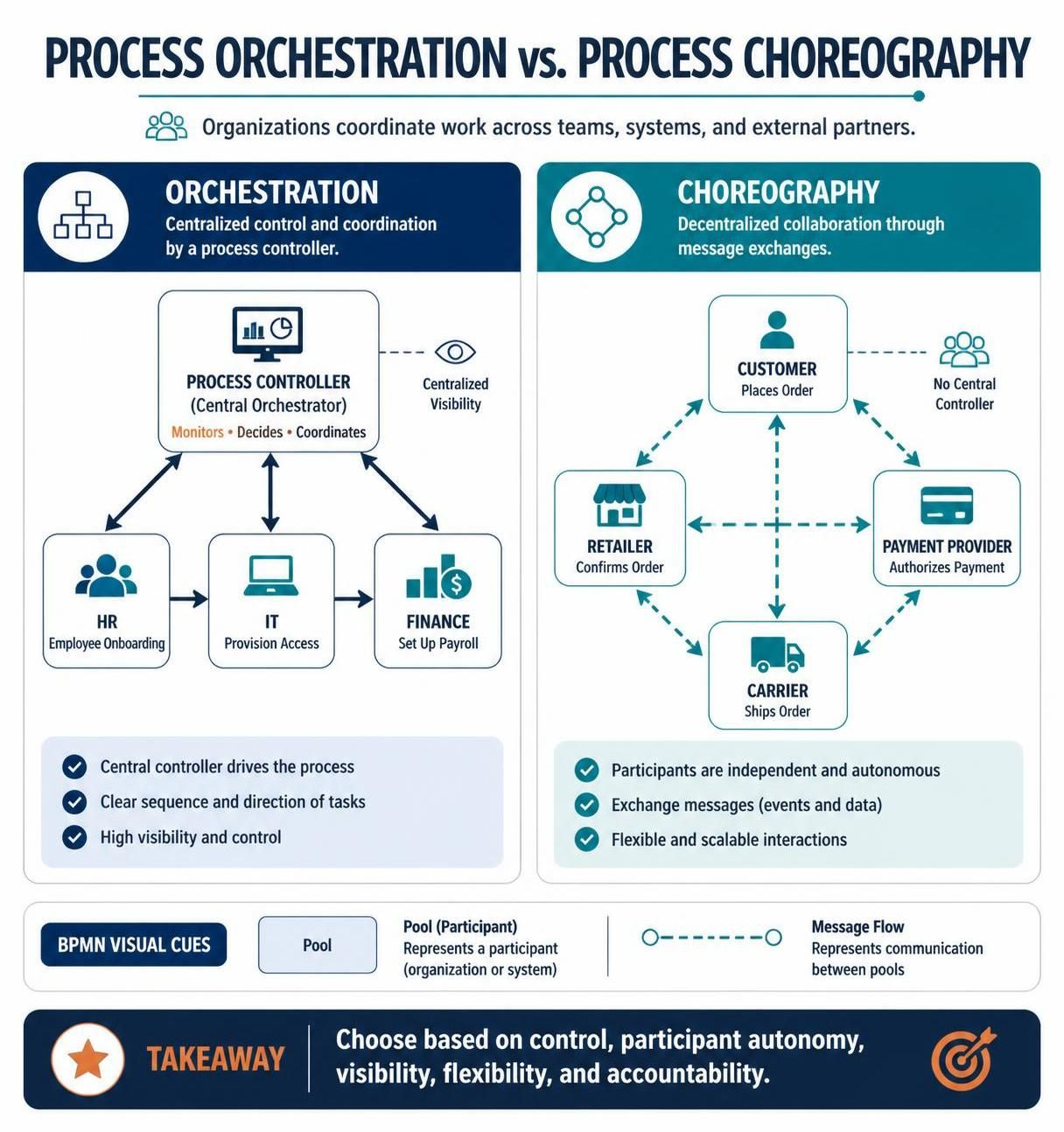
Orchestration is the architectural pattern of centralized control. In this model, a specific component, often called the “Process Controller” or “Orchestrator,” acts as the conductor of an orchestra.
- The Role of the Controller: The orchestrator is responsible for monitoring the state of the process, making decisions, and coordinating the activities of all other participants. It knows the entire flow of the process.
- Participant Interaction: Participants (such as HR, IT, or Finance) typically do not know the entire context of the workflow. They simply execute the task assigned to them by the controller.
- Benefits: This approach offers high visibility, a clear sequence of tasks, and strict control over the process flow.
2. Process Choreography
Choreography represents decentralized collaboration. Instead of a central director, the process is defined by the interactions and agreements between independent participants.
- Decentralized Control: There is no single central controller directing the entire process. Instead, participants act autonomously based on the messages they receive.
- Message Exchange: Coordination is achieved through the exchange of messages (events and data). For example, a Customer places an order, which triggers the Retailer to confirm it, which then triggers the Payment Provider to authorize payment.
- Benefits: This model is highly flexible and scalable. It allows participants to be independent, making the system more resilient to changes in individual components.
BPMN Visual Modeling Patterns
Business Process Model and Notation (BPMN) provides standardized visual cues to represent these architectural decisions clearly. Understanding the underlying notation is crucial for accurate modeling.
Modeling Orchestration in BPMN
In an orchestrated process, the model is typically contained within a single Process or Collaboration diagram. The central controller is often represented by a specific service task or a sub-process that orchestrates the flow.
Participants are often modeled as Call Activities (which call external services) or by using Swimlanes to separate responsibilities while maintaining a single control flow.
Modeling Choreography in BPMN
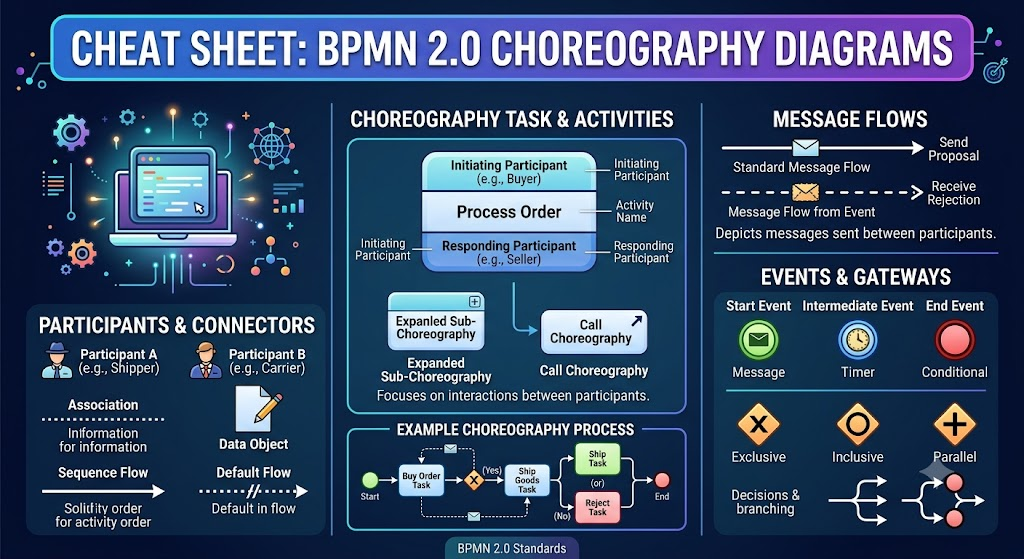
Choreography is best modeled using a dedicated BPMN Choreography Diagram. This diagram focuses exclusively on the interaction between participants.
Key elements in a Choreography diagram include:
- Pools: Each participant (Customer, Retailer, Carrier) is represented by a Pool.
- Message Flows: These are represented by dashed lines with open arrowheads, showing the communication between pools.
- Choreography Tasks: These tasks (represented by a rounded rectangle with a message icon) define the specific interaction where two participants exchange a message.
Decision Matrix: When to Use Which?
Selecting the right architecture is not a binary choice; it depends on your specific business requirements regarding control, autonomy, and visibility.
Choose Orchestration When:
- Central Control is Required: You need a single system of record to monitor and manage the entire workflow (e.g., complex loan approvals).
- Strict Sequencing is Needed: Tasks must happen in a specific order dictated by a central logic.
- Visibility is Critical: Stakeholders need a clear, end-to-end view of the process status.
Choose Choreography When:
- Autonomy is Key: Participants need to operate independently and should not be tightly coupled to a central controller.
- Scalability is Required: The system needs to easily add new participants without modifying a central process definition.
- Event-Driven Architecture: The process is driven by events (e.g., “Order Placed”) rather than a rigid sequence.
Summary
Whether you choose to orchestrate or choreograph your business processes, the goal remains the same: to coordinate work effectively across teams and systems. By leveraging BPMN’s visual capabilities, you can make these arrangements visible and discussable, ensuring that your technical implementation aligns with your business strategy.
Takeaway: Always choose your architecture based on the balance you need between control (Orchestration) and flexibility (Choreography).