![Free eBooks of IT [BooksOfAll]](https://www.booksofall.com/wp-content/uploads/2022/06/booksofall-logo-2.png)
Accelerating Digital Transformation: A Force Field Analysis for Smart Factory Automation
Are you ready to transform your manufacturing operations? The AI-Powered Force Field Analysis Framework from Visual Paradigm is the ultimate tool to rapidly analyze and plan for complex change initiatives. This powerful online software helps you systematically identify the driving forces pushing for change and the restraining forces resisting it, ensuring your strategy is data-driven and actionable. By leveraging AI, you can generate a comprehensive analysis in minutes, saving countless hours of brainstorming and manual work. This guide will walk you through a real-world example of using this tool to plan a smart factory automation project for a manufacturing company, demonstrating how it provides a clear, professional roadmap for success.
For leaders in manufacturing, digital transformation is no longer a choice but a necessity. The competitive landscape is shifting, and companies must adapt to survive. The Force Field Analysis Framework provides a structured approach to navigate this complexity. It forces you to look at both the positive and negative influences on a change, leading to a more realistic and balanced assessment. With Visual Paradigm’s tool, you can use AI to generate a complete analysis based on your business context, then refine it with your team’s insights to create a robust plan.
Quick Summary: Key Takeaways
-
AI-Powered Analysis: Generate a complete Force Field Analysis in seconds by describing your business and proposed change.
-
Structured 5-Step Workflow: A guided process to define the change, identify forces, and develop an action plan.
-
Quantify Your Forces: Assign a strength rating (1-5) to each driving and restraining force to prioritize your efforts.
-
Professional Final Report: Create a polished, shareable document summarizing your entire analysis.
-
Full Data Privacy: Your analysis is saved locally to your computer, ensuring your strategic data remains confidential.
Step 1: Define the Change with AI
The journey begins with a clear definition of the proposed change. In this example, the user has provided the following context to the AI-powered tool:
Business Name: IronClad Manufacturing
Industry / Context: Industrial Equipment Manufacturing
Proposed Change: Implement smart factory automation
Change Description: Adoption of IoT-enabled machinery, real-time production monitoring, and automated quality inspection to improve efficiency and reduce defects.
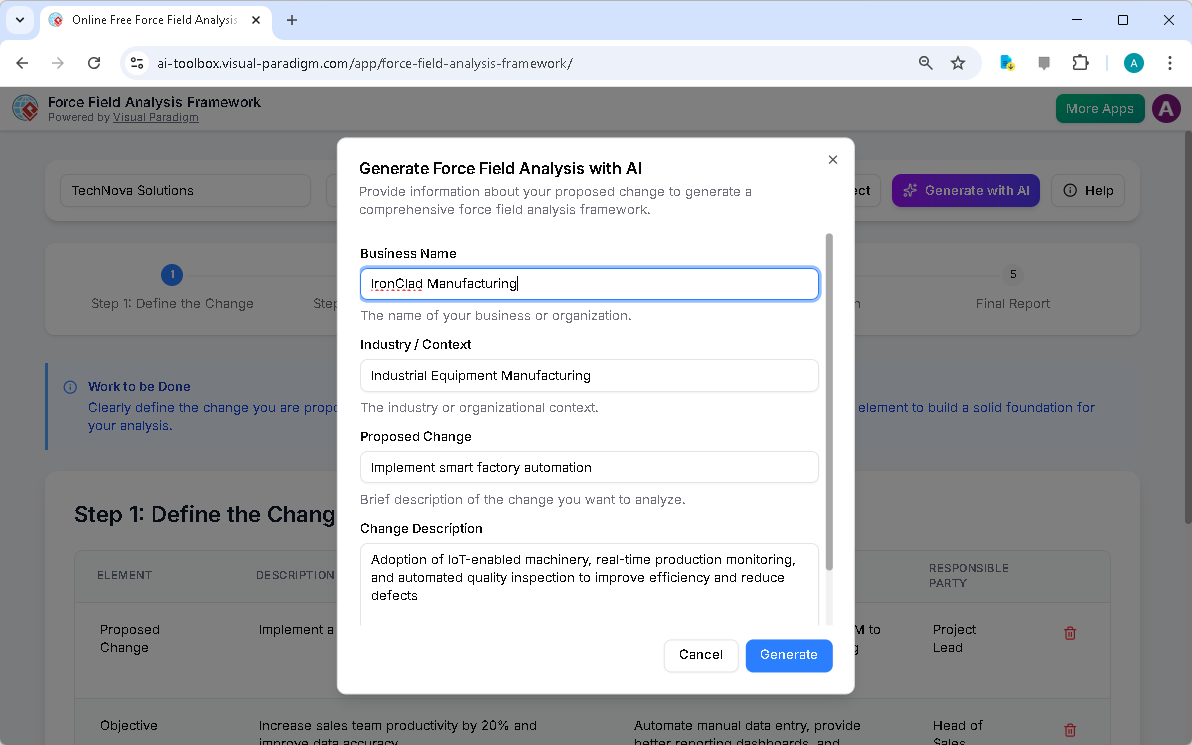
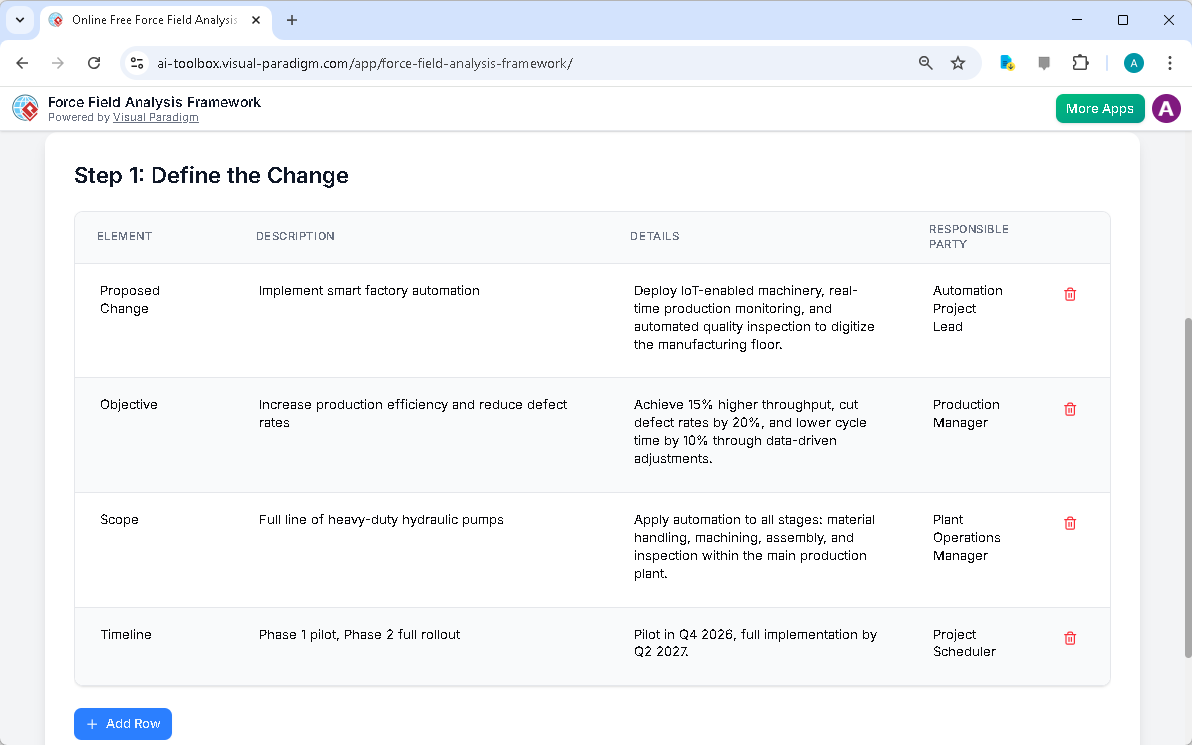
After inputting this information, the user clicks “Generate with AI.” The tool then populates the first step of the analysis, “Define the Change,” with a structured table. This table breaks down the change into key components: the proposed change itself, its objective (e.g., increase production efficiency), the scope (e.g., a full line of heavy-duty hydraulic pumps), and the timeline (e.g., a pilot in Q4 2026). This initial AI-generated framework provides a solid foundation for the analysis.
Step 2: Identify Driving Forces
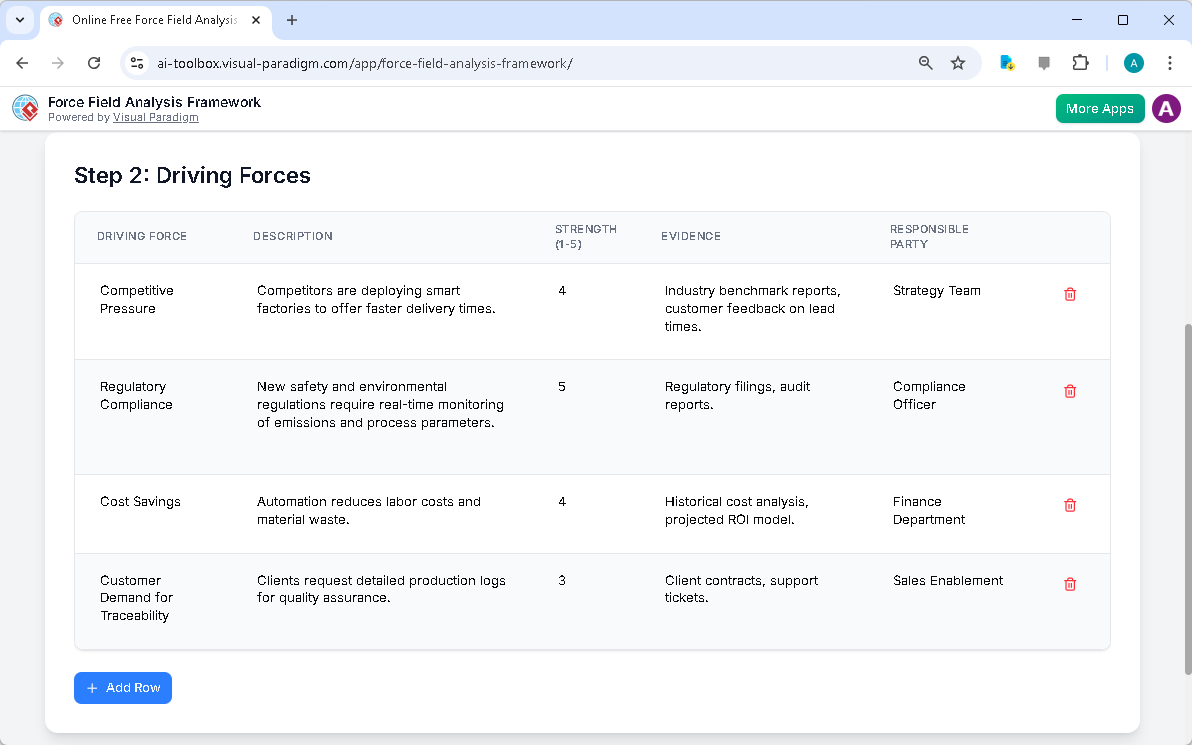
Once the change is defined, the analysis moves to identifying the driving forces—factors that support and push for the change. The AI generates a list of potential driving forces based on the provided context. In this case, the AI suggests:
-
Competitive Pressure: Competitors are deploying smart factories to offer faster delivery times.
-
Regulatory Compliance: New safety and environmental regulations require real-time monitoring of emissions and process parameters.
-
Cost Savings: Automation reduces labor costs and material waste.
-
Customer Demand for Traceability: Clients request detailed production logs for quality assurance.
Each driving force is assigned a strength rating (1-5) to quantify its impact. For example, “Regulatory Compliance” is rated a 5, indicating it is a very strong driver. This quantification helps prioritize which forces to focus on in the action plan. The user can easily edit or add new forces to ensure the analysis reflects their unique situation.
Step 3: Identify Restraining Forces
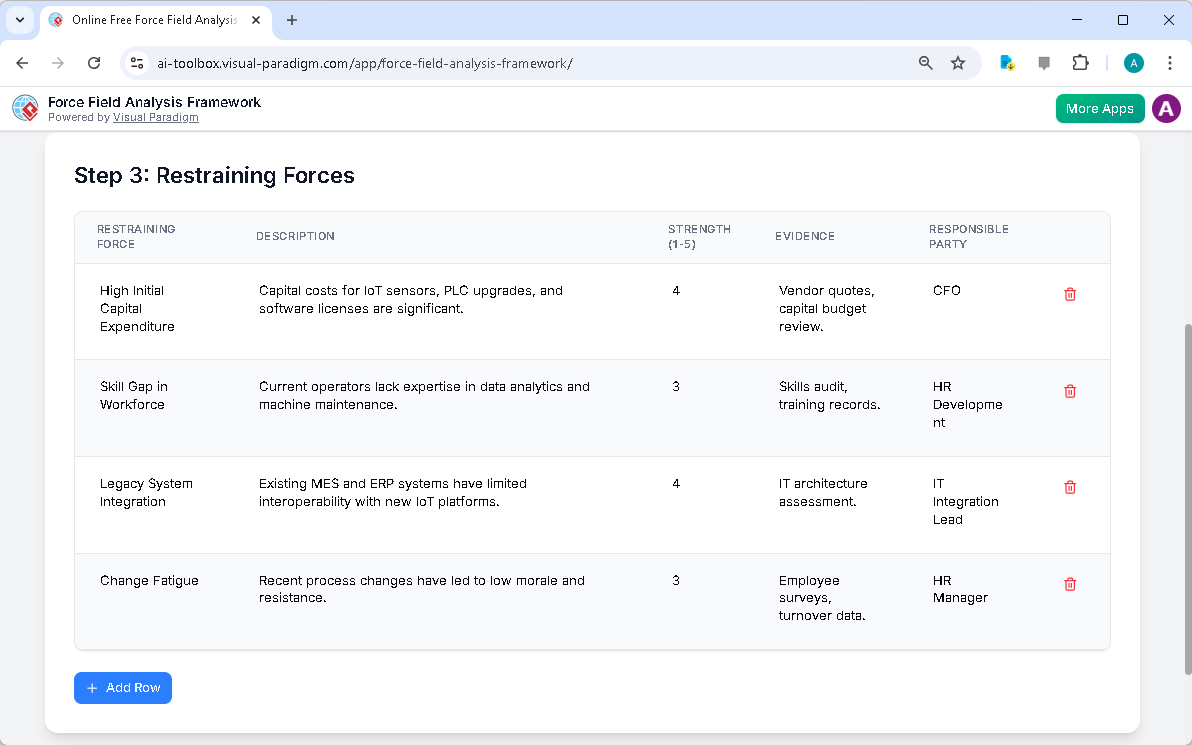
Equally important is identifying the restraining forces—factors that resist or oppose the change. The AI generates a list of potential obstacles, such as:
-
High Initial Capital Expenditure: The significant cost of IoT sensors, PLC upgrades, and software licenses.
-
Skill Gap in Workforce: Current operators lack expertise in data analytics and machine maintenance.
-
Legacy System Integration: Existing MES and ERP systems have limited interoperability with new IoT platforms.
-
Change Fatigue: Recent process changes have led to low morale and resistance.
These forces are also assigned strength ratings. For instance, “High Initial Capital Expenditure” is rated a 4, showing it’s a significant barrier. This step is crucial for understanding the full landscape of the change initiative and preparing for potential roadblocks.
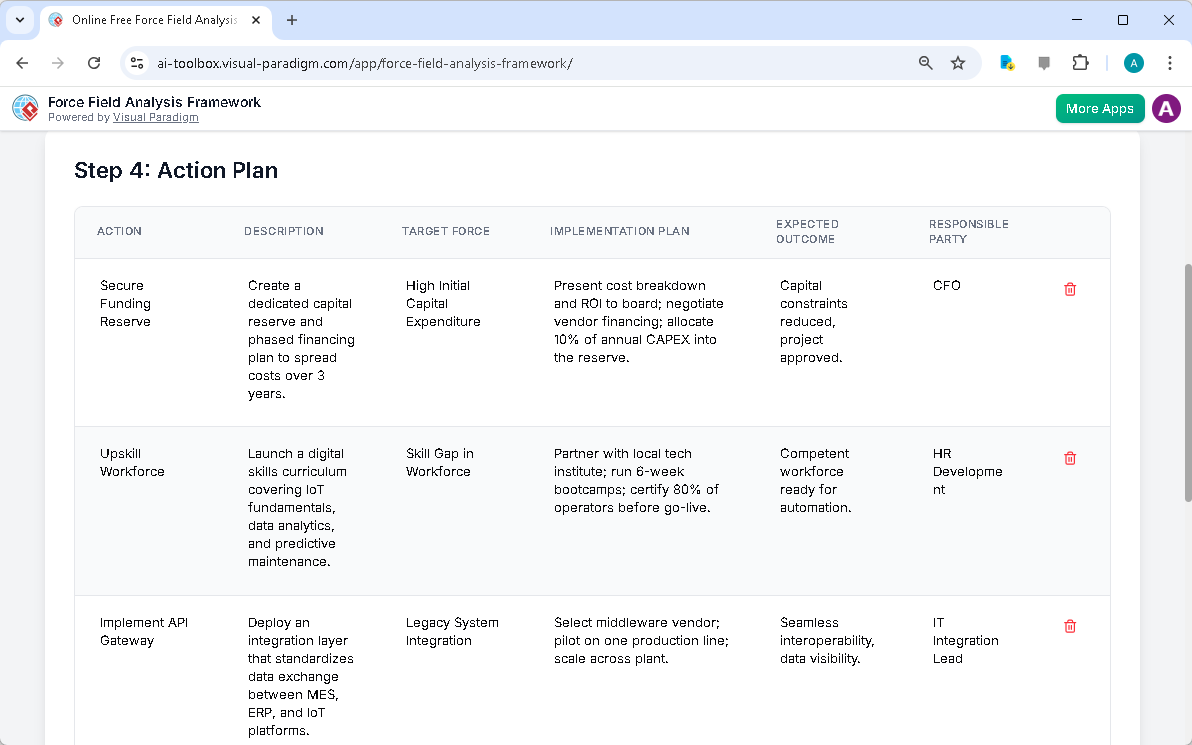
Step 4: Develop a Strategic Action Plan
With the driving and restraining forces identified, the next step is to develop a strategic action plan. The tool guides you to create specific actions designed to strengthen the driving forces and weaken the restraining forces. The AI suggests actions such as:
-
Secure Funding Reserve: Create a dedicated capital reserve and phased financing plan to address high initial costs.
-
Upskill Workforce: Launch a digital skills curriculum covering IoT, data analytics, and predictive maintenance.
-
Implement API Gateway: Deploy an integration layer to ensure seamless data exchange between legacy systems and new IoT platforms.
Each action is linked to a specific force, has a detailed implementation plan, and identifies a responsible party. This turns the analysis into a clear, executable roadmap for managing the change.
Step 5: Generate the Final Report
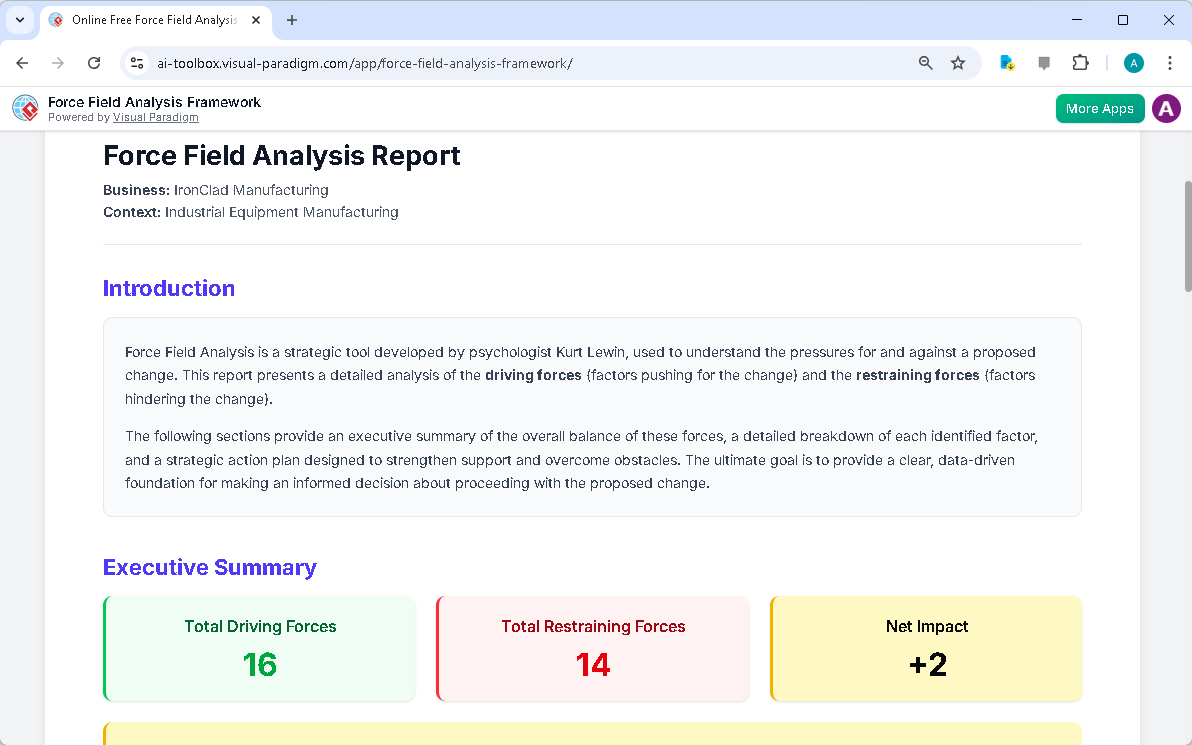
The final step is to consolidate all the analysis into a professional, shareable report. The tool automatically compiles the data from the previous four steps into a single document. The report begins with an introduction explaining the Force Field Analysis framework and its purpose. It then presents an Executive Summary with key metrics: Total Driving Forces (16), Total Restraining Forces (14), and a Net Impact of +2, indicating that the forces pushing for change are stronger than those resisting it.
This final report is a powerful communication tool. It provides a clear, data-driven foundation for making an informed decision about the proposed change. It can be printed or saved as a PDF and shared with stakeholders, executives, and team members to ensure everyone is aligned and understands the strategic rationale behind the initiative.
Transform Your Change Management with Visual Paradigm
The AI-Powered Force Field Analysis Framework from Visual Paradigm is a game-changer for anyone leading or managing change. It transforms a complex, often overwhelming process into a simple, guided workflow. By using AI to generate a comprehensive analysis and providing a structured environment for refinement, it accelerates your strategic planning and increases the likelihood of success. Whether you’re a project manager, business leader, or consultant, this tool provides the clarity and confidence you need to navigate change effectively.
Ready to streamline your change management process? Try the AI-Powered Force Field Analysis Framework today and see how it can help you achieve your strategic goals with greater speed and confidence.
Related Links
-
Force Field Analysis Tool: Perform Force Field Analysis fast. Creating force field model has never been easier. Visual Paradigm force field analysis tool provides a wide range of unique templates and features to help you create beautiful and professional force field diagrams in minutes.
-
Visual Paradigm AI vs. General LLMs: Comprehensive Modeling Guide: Visual Paradigm AI (VP AI ): A specialized AI engine integrated directly into the Visual Paradigm software suite.VP AI Advantage: Visual Paradigm ’s AI is constrained by a built-in rules engine. It validates outputs against official specifications before presenting them to the user.
-
Visual Paradigm’s AI Strategic Analysis Tool for Force Field Analysis: 12 Sept 2025 · Visual Paradigm helps you list each of these, describe them, and even assign a strength score. This step transforms vague ideas into concrete …
-
Force Field Analysis Framework – Visual Paradigm AI: Use our free Force Field Analysis framework to evaluate driving and restraining forces of change. Build clarity, assess risks, and create actionable …
-
Free AI Force Field Analysis Tool for Change Management – Visual …: This intelligent wizard helps you identify the forces pushing for and resisting change, allowing you to develop effective strategies for successful …
-
Force Field Analysis Framework | A Change Management Tool – Visual Paradigm: The Force Field Analysis Framework is a strategic web-based tool used to understand the pressures for and against a proposed change.
-
How It Works – Force Field Analysis Framework – Visual Paradigm AI: This free tool is designed to guide you through a proven four-step workflow, turning your real-world insights into a concrete action plan. But before you even …


Comments (0)