![Free eBooks of IT [BooksOfAll]](https://www.booksofall.com/wp-content/uploads/2022/06/booksofall-logo-2.png)
Tags:
Threat of Substitutes: Analyzing Alternatives with Five Forces
Understanding the competitive landscape requires looking beyond direct rivals. In the strategic framework developed by Michael Porter, the Threat of Substitutes stands as a critical component of industry analysis. This force examines products or services from outside the immediate industry that can satisfy the same customer need. Ignoring this force often leads to strategic blind spots where companies lose market share not to competitors, but to entirely different categories of solutions.
This guide provides a deep dive into analyzing substitute products, evaluating their potential to disrupt profitability, and formulating robust defenses. We will explore the mechanics of substitution, identify key indicators, and review real-world scenarios without relying on specific software tools. The goal is to equip you with a clear, authoritative understanding of how alternatives shape industry dynamics.
🔍 Defining the Threat of Substitutes
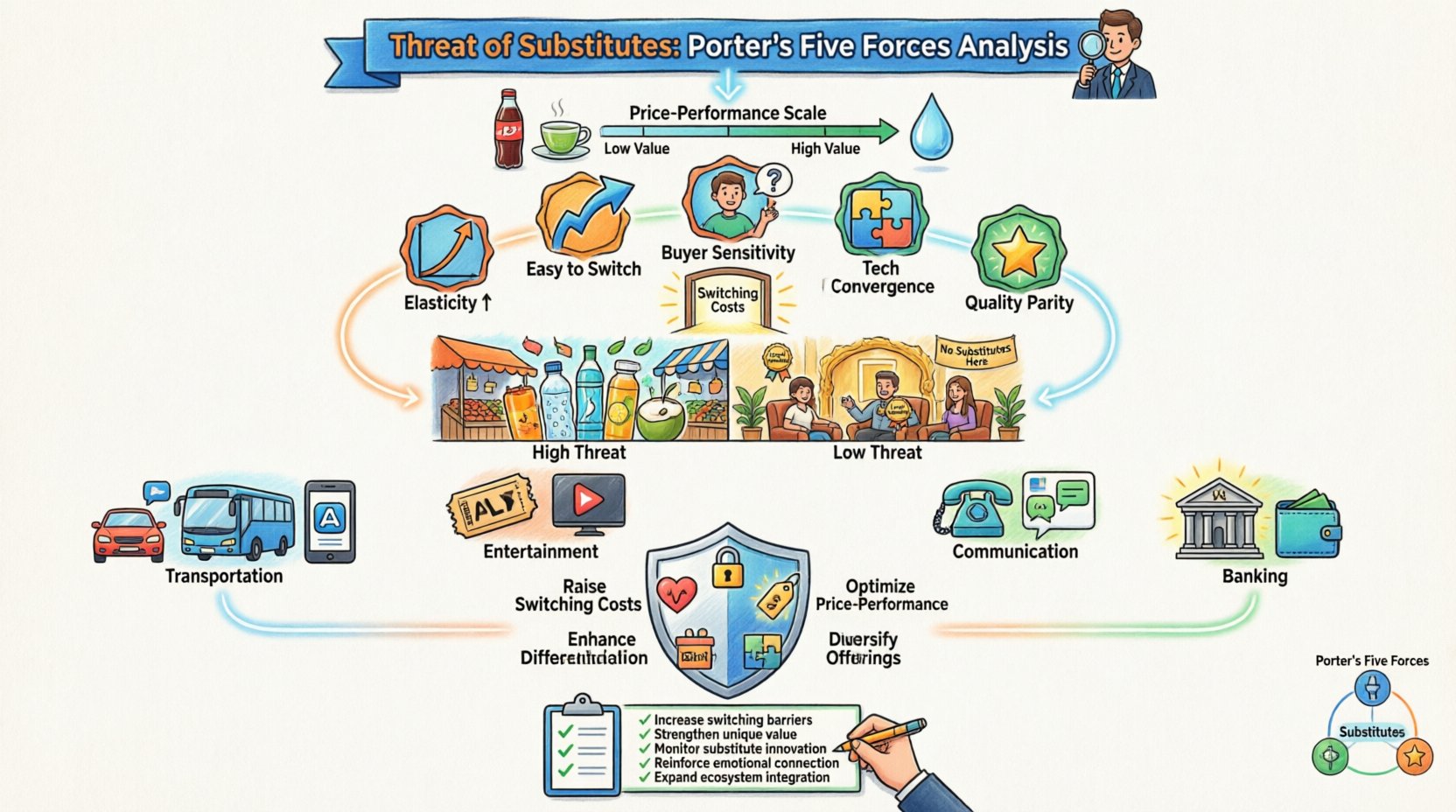
A substitute is not merely a competitor. A competitor sells a similar product within the same industry. A substitute solves the same problem using a different mechanism. For example, in the beverage industry, a competitor might be another brand of cola. A substitute is tea, water, or energy drinks. While the product differs, the underlying consumer need—hydration or a caffeine boost—remains the same.
The threat level depends on two primary factors:
- Price-Performance Ratio: Is the substitute cheaper or better than the industry product?
- Switching Costs: How difficult is it for the buyer to move from the current product to the alternative?
When substitutes offer a better price-performance trade-off, the industry faces a ceiling on its pricing power. If prices rise too high, buyers migrate to the alternative. This limits the profitability of all firms in the sector, regardless of their efficiency.
⚙️ Key Indicators of High Substitute Threat
Identifying when a substitute poses a genuine risk requires examining specific market signals. Not all alternatives are created equal. Some are niche, while others represent existential threats to the entire business model. The following indicators suggest a high threat level:
- High Cross-Price Elasticity: When the price of the primary product increases, demand for the substitute increases significantly.
- Low Switching Costs: If customers can easily change providers or products without financial or psychological penalty, the threat is elevated.
- High Buyer Propensity: Some customers are naturally inclined to seek alternatives for cost, convenience, or status reasons.
- Technological Convergence: When technology allows different industries to overlap (e.g., streaming vs. cable), the threat accelerates.
- Perceived Quality: If the substitute is viewed as “good enough” compared to the industry standard, the gap narrows.
Organizations must assess these indicators regularly. Markets evolve, and what was once a low threat can become critical within a short timeframe.
📊 Comparing High vs. Low Threat Environments
To clarify the variance in this force, consider the following comparison table. This structure helps in quickly assessing the position of an industry.
| Factor | High Threat Environment | Low Threat Environment |
|---|---|---|
| Availability | Substitutes are abundant and accessible | Substitutes are rare or specialized |
| Performance | Substitutes match or exceed functionality | Substitutes are inferior in key metrics |
| Cost | Substitutes are significantly cheaper | Substitutes are more expensive or equal |
| Switching Barriers | Minimal financial or learning curves | High investment or training required |
| Brand Loyalty | Low attachment to existing products | Strong emotional or functional loyalty |
🏭 Industry Examples of Substitution
Real-world context makes this concept tangible. Below are examples across different sectors where the threat of substitutes has reshaped business strategies.
1. Transportation 🚗
The automobile industry faces substitutes ranging from public transit to ride-sharing services. In dense urban areas, the cost of ownership (parking, fuel, maintenance) often outweighs the convenience of private driving. Furthermore, the rise of electric vehicles has introduced substitutes that address environmental concerns more effectively than traditional internal combustion engines.
2. Entertainment 🎬
Traditional cinema and television broadcasting have faced intense pressure from video-on-demand platforms. The substitute here is not just another movie studio, but a shift in consumption habits. Consumers can now access content at home, on their own schedule, often for a lower cost per hour of viewing than a movie ticket. This shift fundamentally altered the revenue models of studios and theaters.
3. Communication 💬
Telecommunications companies providing voice calls and SMS services faced a massive substitute threat from internet-based communication apps. These substitutes offered free or near-free messaging and voice capabilities over existing data connections. The threat was so high that legacy revenue streams for voice services declined rapidly, forcing companies to pivot towards data infrastructure.
4. Banking 💳
Traditional banks have seen account holders move towards digital wallets and fintech solutions. These substitutes offer streamlined user experiences, faster transactions, and often lower fees. While the core function (moving money) remains, the delivery mechanism has changed, challenging the traditional brick-and-mortar model.
📉 Impact on Pricing and Profitability
The primary economic impact of the threat of substitutes is the limitation of price increases. In an industry with low substitution threats, a company might raise prices by 10% without losing significant market share. In an industry with high substitution threats, a 5% increase could drive customers to alternatives.
This dynamic compresses profit margins across the board. When substitutes are available, firms compete on value rather than exclusivity. They must constantly justify their pricing through differentiation, brand strength, or superior service. If they fail to do so, the substitute captures the demand.
Additionally, profitability is affected by the volume of sales. If substitutes erode the total market size, existing firms must fight harder for a shrinking pie. This can lead to price wars, increased marketing spend, and reduced R&D investment, creating a downward spiral for industry returns.
🛡️ Strategies to Mitigate the Threat
Once the threat is identified, strategic action is required to defend market position. The following approaches help reduce the appeal of substitutes:
- Increase Switching Costs: Design products that integrate deeply into customer workflows. If leaving requires significant retraining or data migration, customers stay longer.
- Enhance Differentiation: Focus on unique features, quality, or brand prestige that substitutes cannot easily replicate.
- Improve Price-Performance: Innovate to offer better value for the money. If your product is the best value, the substitute becomes less attractive.
- Build Brand Loyalty: Cultivate an emotional connection. When customers identify with the brand, they are less likely to switch for a marginal price saving.
- Diversify Offerings: Enter the substitute market yourself. Acquire or develop the alternative technology to control the transition.
- Bundle Services: Combine your product with complementary services to increase the total value delivered, making a standalone substitute less appealing.
Each strategy requires investment. The key is to ensure the cost of defense is lower than the potential loss of revenue from substitution.
📏 Measuring the Threat (Quantitative Approach)
Qualitative assessment is useful, but quantitative metrics provide a clearer picture. Here are methods to measure the threat level objectively:
- Market Share of Substitutes: Calculate the percentage of the total demand satisfied by alternatives. A rising trend indicates increasing threat.
- Price Gap Analysis: Compare the price of the industry product against the substitute. A narrowing gap signals higher risk.
- Customer Survey Data: Ask buyers what would cause them to switch. Look for triggers like price hikes or feature gaps.
- Adoption Rates: Track how quickly new substitute technologies are being adopted by the target demographic.
- Elasticity Coefficients: Use historical data to determine how demand changes relative to price changes in the substitute market.
Regularly updating these metrics ensures that strategic plans remain relevant. Static analysis leads to outdated strategies.
🔄 Integration with Other Five Forces
The Threat of Substitutes does not operate in isolation. It interacts with other forces in the framework:
- Competitive Rivalry: High rivalry often distracts firms from substitute threats. If competitors are fighting on price, they may ignore the external alternative that is eating their lunch.
- Buyer Power: Powerful buyers are more likely to seek substitutes to leverage their negotiating position. They actively look for alternatives to keep suppliers in check.
- Supplier Power: If suppliers have alternatives, they may push for lower prices, which could inadvertently make the industry product more vulnerable to external substitutes.
- Threat of New Entrants: New entrants often introduce substitutes. They do not necessarily build better versions of the existing product but solve the problem differently.
Understanding these interactions helps in creating a holistic strategic view. A weakness in one force can amplify the threat from another.
🚀 Future Trends and Evolution
The landscape of substitution is constantly shifting. Several trends are influencing this force today:
- Digitalization: As processes move online, physical products face more intense substitute threats from digital solutions.
- Sustainability: Eco-friendly substitutes are gaining traction. Products that ignore environmental impact face growing pressure from green alternatives.
- Customization: Mass customization allows substitutes to offer personalized experiences that traditional mass-produced goods cannot match.
- Convenience Culture: Consumers increasingly prioritize ease of use over traditional quality metrics. Substitutes that offer superior convenience win the market.
Forward-looking analysis must account for these macro trends. A strategy valid today may be obsolete tomorrow if it fails to anticipate these shifts.
⚠️ Common Pitfalls in Analysis
Even experienced analysts make mistakes when evaluating substitution. Avoid these common errors:
- Defining the Industry Too Narrowly: If you define your industry as “soft drinks,” you miss the substitute threat of “water” or “coffee.” Define by customer need, not just product type.
- Ignoring Indirect Substitutes: Don’t just look for direct functional replacements. Consider solutions that solve the underlying problem differently.
- Overestimating Brand Loyalty: Loyalty is fragile. It can vanish quickly if a substitute offers a significant advantage.
- Underestimating Technology: Technological breakthroughs can render entire categories obsolete overnight. Do not assume current technology is permanent.
- Neglecting Buyer Psychology: Price is not the only driver. Status, habit, and risk aversion play major roles in substitution decisions.
✅ Strategic Checklist for Substitutes
Use this checklist to ensure your analysis is comprehensive.
- ☐ Have we identified all potential substitutes, direct and indirect?
- ☐ Have we calculated the price-performance gap between our product and alternatives?
- ☐ Have we assessed the switching costs for our customers?
- ☐ Have we monitored the adoption rates of substitute technologies?
- ☐ Have we evaluated the impact of substitutes on our pricing power?
- ☐ Do we have a plan to respond if a substitute gains significant market share?
- ☐ Have we considered how digital trends affect our specific sector?
- ☐ Is our differentiation strong enough to justify a premium over substitutes?
📝 Summary
The Threat of Substitutes is a fundamental force that dictates the profitability and longevity of an industry. It forces companies to innovate continuously and remain customer-centric. By understanding the mechanics of substitution, analyzing indicators, and implementing defensive strategies, organizations can navigate the risks associated with alternatives. This analysis is not a one-time exercise but an ongoing process that requires vigilance and adaptability. Keeping a close watch on the price-performance ratio and switching costs will ensure that your strategic plans remain resilient against the constant pressure of new solutions entering the market.
Remember, the most dangerous competitor is often the one you do not see. Proactive analysis of substitutes provides the clarity needed to maintain a competitive edge in a dynamic economy.


Comments (0)