![Free eBooks of IT [BooksOfAll]](https://www.booksofall.com/wp-content/uploads/2022/06/booksofall-logo-2.png)
Tags:
Five Forces Model Explained: Key Components and Breakdown
Strategic planning requires more than intuition. It demands a structured approach to understanding the competitive landscape. The Five Forces Model, developed by Michael E. Porter in 1979, remains a cornerstone of business strategy. This framework helps organizations assess the attractiveness of an industry and identify potential profitability. By analyzing specific market dynamics, businesses can formulate strategies that withstand competitive pressures.
Understanding the forces at play allows leaders to make informed decisions about market entry, pricing, and resource allocation. This guide provides a deep dive into each component, offering actionable insights for analysts and strategists.
📜 Historical Context and Framework Origins
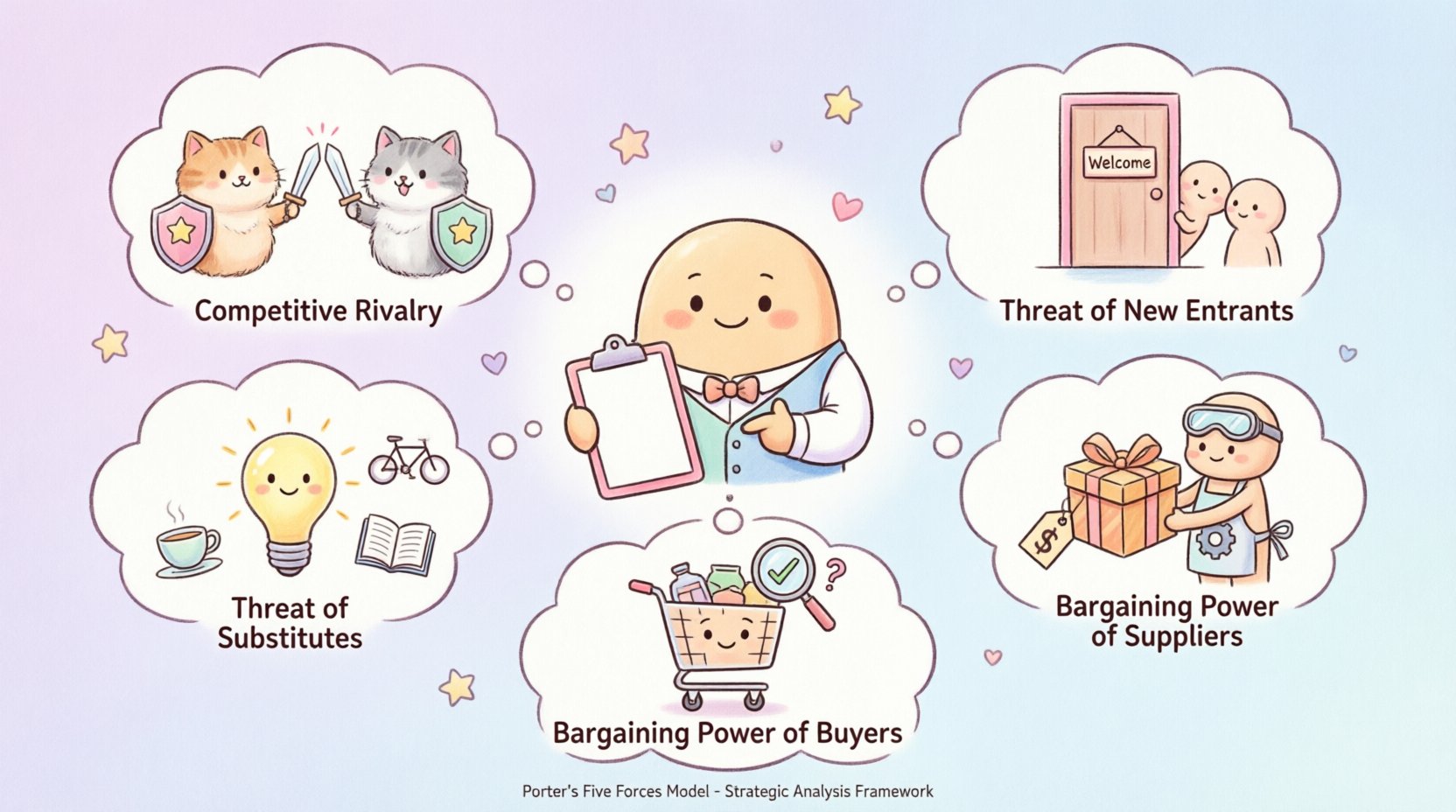
Michael Porter introduced this model in his book Competitive Strategy: Techniques for Analyzing Industries and Competitors. Before this framework, strategy often focused heavily on internal capabilities. Porter shifted the focus outward, arguing that industry structure dictates profitability. The model posits that five fundamental forces shape every market.
- Competitive Rivalry: How intense is the competition?
- Threat of New Entrants: How easy is it for new players to enter?
- Threat of Substitutes: Are there alternatives to the product?
- Bargaining Power of Suppliers: Can suppliers drive prices up?
- Bargaining Power of Buyers: Can customers drive prices down?
This analysis provides a holistic view of industry dynamics. It moves beyond simple competitor tracking to examine the structural forces that determine profit potential.
🔍 The Five Forces Breakdown
To apply this model effectively, each force must be examined individually. The interaction between these forces determines the intensity of competition and the ultimate profit potential of an industry.
1️⃣ Competitive Rivalry
Competitive rivalry refers to the intensity of competition among existing firms in an industry. High rivalry often leads to price wars, increased marketing costs, and innovation pressure. When rivalry is intense, profitability tends to decrease.
- Number of Competitors: A market with many equally sized competitors usually sees higher rivalry.
- Industry Growth Rate: Slow growth forces firms to fight for market share.
- Fixed Costs: High fixed costs encourage price cutting to maintain utilization.
- Differentiation: Low differentiation leads to price-based competition.
- Exit Barriers: High exit barriers trap firms in unprofitable industries.
For example, in the airline industry, rivalry is exceptionally high. Margins are thin, and fuel costs are volatile. Airlines compete aggressively on price and schedule frequency. This environment requires extreme efficiency to maintain viability.
2️⃣ Threat of New Entrants
New entrants bring fresh capacity, ambition, and resources. They can disrupt established market dynamics. The threat depends on the barriers to entry. High barriers protect incumbents, while low barriers invite competition.
- Capital Requirements: Industries requiring heavy investment deter new players.
- Regulatory Policies: Licenses and patents can block entry.
- Brand Identity: Strong customer loyalty makes it hard for newcomers to gain traction.
- Access to Distribution: Securing shelf space or channels can be difficult.
- Economies of Scale: Incumbents with lower costs can undercut new entrants.
Consider the pharmaceutical industry. Patents and clinical trial costs create significant barriers. However, once a patent expires, generic manufacturers can enter rapidly, impacting profitability.
3️⃣ Threat of Substitutes
Substitutes are products from outside the industry that satisfy the same need. They limit the price a company can charge. If a substitute is cheap and effective, the industry cap on prices is lower.
- Price-Performance Trade-off: If substitutes offer better value, demand shifts.
- Switching Costs: Low costs to switch make substitution easier.
- Buyer Propensity: Some customers are more open to trying new solutions.
- Product Uniqueness: Unique products face less substitution threat.
In the telecommunications sector, traditional landlines faced a massive substitute threat from mobile phones and VoIP services. Companies that ignored this shift suffered significant revenue declines.
4️⃣ Bargaining Power of Suppliers
Suppliers can squeeze profitability by raising prices or reducing quality. Supplier power is high when there are few alternatives. It is low when buyers can easily switch sources.
- Supplier Concentration: Few suppliers mean more power.
- Uniqueness of Product: Specialized components give suppliers leverage.
- Switching Costs: High costs to change suppliers increase supplier power.
- Threat of Forward Integration: Can suppliers become competitors?
- Importance of Volume: If the supplier relies heavily on the buyer, power decreases.
Automakers often face pressure from battery manufacturers. As demand for electric vehicles rises, the scarcity of battery components gives suppliers significant leverage over pricing.
5️⃣ Bargaining Power of Buyers
Buyers exert power by demanding lower prices or better quality. They can play competitors against each other. Buyer power increases when they have information and alternatives.
- Buyer Concentration: Few large buyers can dictate terms.
- Volume Purchases: Large orders increase leverage.
- Price Sensitivity: High sensitivity forces competitive pricing.
- Availability of Information: Informed buyers make better decisions.
- Threat of Backward Integration: Can buyers become suppliers?
In the retail sector, major chains often dictate terms to manufacturers. Their volume allows them to negotiate significant discounts, squeezing the margins of the producers.
📊 Summary of Key Components
The following table summarizes the core factors influencing each force. Use this as a quick reference during analysis.
| Force | Key Driver | Impact on Profitability |
|---|---|---|
| Competitive Rivalry | Number of competitors, growth rate | High rivalry lowers margins |
| Threat of New Entrants | Barriers to entry, capital needs | Low barriers increase competition |
| Threat of Substitutes | Price-performance, switching costs | High substitutes cap prices |
| Power of Suppliers | Concentration, uniqueness | High power raises input costs |
| Power of Buyers | Concentration, information | High power lowers selling prices |
🛠️ Conducting a Strategic Analysis
Applying the Five Forces requires a systematic process. It is not enough to guess; data and observation are necessary. Follow these steps to conduct a thorough assessment.
- Define the Industry: Clearly specify the market boundaries. What products and services are included?
- Gather Data: Collect information on competitors, suppliers, and customers. Use public reports and interviews.
- Assess Each Force: Rate the strength of each force as low, medium, or high.
- Identify Trends: Look for changes in technology or regulation that might shift the balance.
- Formulate Strategy: Develop actions to mitigate high threats or exploit weak forces.
During the assessment phase, prioritize depth over speed. Understanding why a force is strong is more valuable than simply labeling it. For instance, if supplier power is high, determine if it is due to patents, scarcity, or lack of alternatives.
Example Application: The Coffee Industry
Let us apply this to the coffee shop industry. Rivalry is high, with many local and global chains. The threat of new entrants is moderate, as opening a shop requires capital but no heavy patents. Substitutes include tea, energy drinks, or home brewing. Supplier power is moderate, depending on bean sourcing. Buyer power is high, as customers can easily switch to a competitor down the street.
This analysis suggests that differentiation is key. A generic coffee shop faces too much pressure from rivalry and buyer power. Specialized sourcing or unique experience becomes the strategic focus.
⚠️ Limitations and Considerations
While powerful, the model is not without flaws. It is important to understand where it falls short to avoid misinterpretation.
- Static Nature: The model captures a snapshot in time. Markets change rapidly.
- Focus on Profit: It emphasizes profitability but ignores social responsibility.
- Complementors: It does not explicitly account for companies that add value to the product.
- Non-Linear Interactions: Forces often influence each other in complex ways.
- Global Context: Localized analysis may miss global supply chain dynamics.
Modern strategists often combine this model with other tools, such as SWOT analysis or PESTLE analysis, to get a complete picture. Use the Five Forces as a foundation, not the entire structure.
🔄 Adapting to Modern Dynamics
The digital age has shifted some industry structures. Platform economies and network effects introduce new variables. Traditional barriers to entry may be lower, but network effects can create new moats.
- Technology: Digital tools reduce some costs but increase others.
- Globalization: Supply chains now span multiple continents.
- Customer Expectations: Speed and personalization have become standard.
When analyzing a tech company, the threat of substitutes might come from a completely different industry. For example, streaming services substituted traditional cable TV, not just other video formats.
❓ Frequently Asked Questions
Common questions arise when implementing this framework. Addressing them clarifies the application.
Q: How often should I perform an analysis?
Industry conditions evolve. A review should happen annually or when significant market shifts occur. Regulatory changes or new technologies can alter the force balance quickly.
Q: Can I use this for a startup?
Yes. Startups need to understand who they are competing against, even if it is an indirect competitor. It helps in positioning and funding pitches.
Q: Is the model outdated?
The core principles remain valid. However, application requires nuance regarding digital platforms and ecosystem dynamics. It serves as a diagnostic tool rather than a prescriptive solution.
Q: How do I measure supplier power?
Look at the number of available suppliers. If there is only one source for a critical component, power is high. If there are many alternatives, power is low. Assess the cost of switching as well.
Q: What if two forces are high?
This indicates a difficult market. You may need to find a niche or differentiate heavily. Entering such an industry requires a robust competitive advantage to survive.
📈 Synthesizing Findings for Strategy
Once the analysis is complete, the data must inform action. A high threat does not mean avoidance; it means preparation. Strategies might include vertical integration to reduce supplier power or product innovation to reduce substitution.
- Cost Leadership: Focus on efficiency to withstand price pressure.
- Differentiation: Create unique value to reduce buyer sensitivity.
- Niche Focus: Target a specific segment with lower competition.
- Alliances: Partner to increase bargaining power.
Strategy is about making trade-offs. You cannot be everything to everyone. The Five Forces help identify where the industry is vulnerable and where the pressure points lie.
🎯 Final Thoughts on Competitive Analysis
Competitive strategy is a continuous process. The landscape is never static. Leaders must remain vigilant and adapt their frameworks to changing realities. By understanding the structural forces, organizations can navigate uncertainty with greater confidence.
This model provides a language for discussing industry dynamics. It facilitates clear communication among stakeholders. When everyone understands the forces, decision-making becomes more aligned and effective.
Use this guide as a reference for your next strategic planning session. Ensure you gather accurate data and challenge assumptions. The goal is clarity, not certainty. With a solid grasp of these forces, you can build a resilient business model capable of enduring market shifts.


Comments (0)