![Free eBooks of IT [BooksOfAll]](https://www.booksofall.com/wp-content/uploads/2022/06/booksofall-logo-2.png)
Tags:
The Five Forces Model Simplified: One-Page Overview
Understanding the competitive landscape is fundamental to building a sustainable business strategy. The Porter Five Forces framework provides a structured method to analyze industry profitability and competitive intensity. Developed by Michael Porter in 1979, this model remains a cornerstone of strategic management. It allows organizations to identify the sources of competitive pressure and assess the attractiveness of a market before committing resources.
This guide breaks down the five forces into actionable insights. It covers the mechanics of each force, how to gather data, and how to interpret the results for strategic planning. There are no software recommendations or hype here. Just clear, authoritative analysis designed to help decision-makers navigate complex market dynamics.
Why This Framework Matters 🧠
Many businesses fail because they underestimate the hostility of their environment. They focus solely on their own products or internal operations without looking outward. The Five Forces model forces a shift in perspective. It moves the focus from direct competitors to the broader ecosystem of threats and opportunities.
By applying this analysis, you can determine:
- Whether an industry is profitable in the long term.
- Where power lies within the supply chain.
- If barriers to entry protect your current market share.
- How susceptible you are to substitutes or new technologies.
It is not a crystal ball. It is a diagnostic tool. It helps you understand the structural drivers of profit. Once you understand these drivers, you can position your organization to defend against threats or exploit weaknesses in the competition.
The Five Forces Explained 🔍
The model consists of five distinct forces that shape industry competition. Each force represents a different type of threat or pressure. The combined intensity of these forces determines the overall profit potential of the industry.
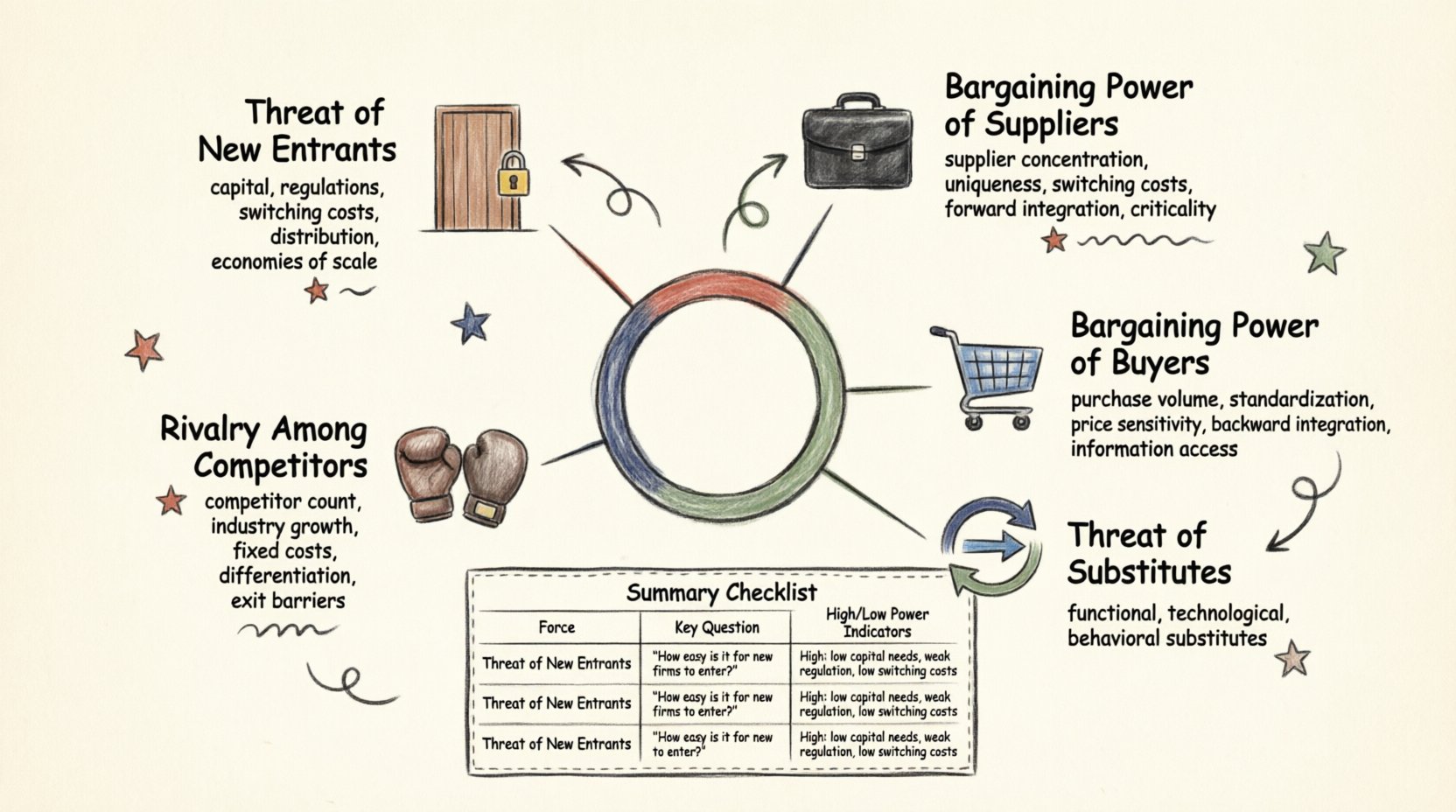
1. Threat of New Entrants 🚪
This force measures how easy or difficult it is for new competitors to enter the market. If entry is easy, existing companies face constant pressure to lower prices or improve offerings. If entry is difficult, incumbents enjoy higher margins and stability.
Barriers to entry are the key factor here. High barriers protect existing players. Low barriers invite disruption. Common barriers include:
- Capital Requirements: Does starting a business require significant investment in machinery, facilities, or inventory?
- Regulatory Hurdles: Are there licenses, permits, or legal restrictions that limit who can operate?
- Switching Costs: How difficult is it for customers to switch from your product to a new entrant’s product?
- Access to Distribution: Can new players easily get their products to customers, or are channels controlled by incumbents?
- Economies of Scale: Do established players have cost advantages due to volume that new entrants cannot match?
When evaluating this force, ask: If I were to start a competitor tomorrow, what would stop me? If the answer is “very little,” the threat is high. If the answer is “a lot of capital and time,” the threat is low.
2. Bargaining Power of Suppliers 💼
Suppliers can exert pressure on an industry by raising prices or reducing the quality of goods and services. When supplier power is high, it squeezes the margins of companies in the industry. When supplier power is low, companies have more flexibility to set prices.
Supplier power depends on several factors:
- Number of Suppliers: Are there many suppliers, or is the market concentrated among a few large ones?
- Uniqueness of Product: Are the inputs generic commodities, or are they specialized and proprietary?
- Switching Costs: How costly is it for a company to change suppliers? Are there technical dependencies?
- Threat of Forward Integration: Can the supplier potentially start making the final product themselves?
- Criticality of Supply: Does the input make up a significant portion of the buyer’s costs or is it essential for quality?
In an industry where raw materials are scarce or controlled by a monopoly, suppliers hold the power. In an industry with many generic vendors, buyers hold the power.
3. Bargaining Power of Buyers 🛒
Buyers (customers) can drive down prices or demand higher quality. This force is the mirror image of supplier power. It focuses on the customer’s ability to influence the industry.
Buyer power increases when:
- Volume of Purchase: The buyer purchases a large volume relative to the seller’s total sales.
- Product Standardization: The product is undifferentiated, making it easy for the buyer to switch.
- Price Sensitivity: The product is a significant cost for the buyer, making them very sensitive to price changes.
- Threat of Backward Integration: Can the buyer potentially start producing the product themselves?
- Availability of Information: Does the buyer know exactly what the market price is and what alternatives exist?
If your customers are large corporations or government entities, they often have significant leverage. If you sell to individual consumers in a fragmented market, your leverage is usually higher.
4. Threat of Substitute Products 🔄
This force looks at products from outside your industry that solve the same problem. Substitutes limit the price you can charge. If a substitute is cheaper or better, customers will leave.
Examples of substitution include:
- Functional Substitutes: Video conferencing software substituting for business travel.
- Technological Substitutes: Streaming services substituting for cable television.
- Behavioral Substitutes: Home cooking substituting for restaurant dining.
The threat is high when:
- The performance-to-price ratio of the substitute is favorable.
- Switching costs for the customer are low.
- Customer loyalty to the original product is weak.
- The substitute industry is growing rapidly.
Do not look only at direct competitors. Look at what your customer is doing to solve the underlying need. If they can solve that need with a different method entirely, that is a substitute threat.
5. Rivalry Among Existing Competitors 🥊
This is the most visible force. It describes the intensity of competition between current players. High rivalry leads to price wars, advertising battles, and product launches.
Rivalry intensifies when:
- Number of Competitors: There are many firms of similar size and power.
- Industry Growth: The market is stagnant or shrinking, so fighting for market share becomes aggressive.
- Fixed Costs: High fixed costs create pressure to fill capacity, often leading to price cuts.
- Lack of Differentiation: Products look the same, forcing competition on price alone.
- Exit Barriers: It is hard to leave the industry, so firms stay and fight even if profitability is low.
When rivalry is high, industry profits tend to be low. When rivalry is low, profits are generally higher. The goal is to find a position where you are less affected by these competitive pressures.
Summary of Competitive Forces 📋
The following table summarizes the key drivers for each force. Use this as a checklist during your analysis.
| Force | Key Question | High Power Indicator | Low Power Indicator |
|---|---|---|---|
| New Entrants | How hard is it to start? | Low barriers, low capital needs | High barriers, high regulation |
| Suppliers | How hard is it to switch them? | Few suppliers, unique input | Many suppliers, commoditized input |
| Buyers | How hard is it to lose them? | Few buyers, high volume | Many buyers, low volume |
| Substitutes | What else solves this? | Low cost, high performance | High cost, lower performance |
| Rivalry | How aggressive are they? | Stagnant growth, high differentiation | Rapid growth, clear differentiation |
Conducting the Analysis Step-by-Step 🛠️
Applying the model requires a systematic approach. It is not enough to guess. You need data and evidence. Follow these steps to ensure a robust analysis.
Step 1: Define the Industry Scope
Before analyzing, define what constitutes the industry. Is it the entire automotive sector, or just electric vehicles? Is it coffee shops, or specifically premium espresso bars? A broad definition dilutes the analysis. A narrow definition makes it actionable.
Step 2: Gather Data
Collect information from public records, financial reports, customer interviews, and supplier conversations. Look for:
- Market concentration ratios.
- Barriers to entry statistics.
- Customer satisfaction trends.
- Supplier pricing trends.
- Substitute adoption rates.
Step 3: Assess Each Force
Rate each force as Low, Medium, or High. Be specific about why. For example, instead of saying “Supplier power is high,” say “Supplier power is high because there are only three certified vendors for the core component.”
Step 4: Identify Strategic Implications
Translate the ratings into action. If the threat of entry is low, invest in scaling. If supplier power is high, look for alternative sources or integrate backward. If rivalry is high, focus on differentiation rather than price.
Step 5: Monitor Changes
The forces are not static. Technology changes barriers. Regulations shift. Customer preferences evolve. Review the analysis regularly. A snapshot from five years ago is likely obsolete today.
Common Pitfalls to Avoid ⚠️
Even experienced strategists make mistakes when using this framework. Being aware of these common errors helps you avoid them.
- Confusing Industry with Company: This model analyzes the industry, not the specific company. A company can perform well in a bad industry, but the industry limits the upside.
- Ignoring Complements: While Porter focused on five forces, some modern analyses include the role of complements (products that increase the value of your own). Think of software and hardware.
- Static Analysis: Treating the industry as frozen in time. Growth and decline cycles change the balance of power significantly.
- Overlooking Global Factors: Supply chains are often global. A local analysis might miss international supplier leverage.
- Neglecting Internal Capabilities: The model tells you where the pressure is. It does not tell you if you have the capability to withstand it. Match the external analysis with an internal resource audit.
Integrating with Other Strategies 🤝
The Five Forces analysis is rarely used in isolation. It pairs well with other strategic tools. Combining them provides a more complete picture.
SWOT Analysis
Use the Five Forces to inform the Threats and Opportunities sections of a SWOT analysis. The external forces are the threats and opportunities. The internal capabilities form the Strengths and Weaknesses.
Value Chain Analysis
Once you know where the pressure comes from, look at your value chain. Can you adjust your operations to reduce the impact of supplier power? Can you build a brand that reduces buyer power? The Five Forces tell you where to attack.
Scenario Planning
Use the forces to build scenarios. What happens if a new entrant appears? What happens if a substitute drops in price? Model these outcomes to prepare contingency plans.
Case Study: The Airline Industry ✈️
Consider the airline industry. It is often cited as a classic example of high rivalry and low profitability. Let’s apply the forces.
- New Entrants: High capital requirements create high barriers. However, low-cost carriers have eroded some protection.
- Suppliers: Aircraft manufacturers (Boeing, Airbus) have high power due to duopoly status. Fuel suppliers also have significant influence.
- Buyers: Individual travelers have high power due to price comparison websites. Corporate contracts offer some stability.
- Substitutes: High-speed rail and video conferencing are substitutes for short-haul flights.
- Rivalry: Extremely high. Margins are thin, capacity is high, and exit barriers are significant.
This analysis explains why airline profitability is historically volatile. Strategic moves often focus on cost leadership or loyalty programs to mitigate these forces.
Final Thoughts on Strategic Planning 🧭
Strategic planning is a continuous process, not a one-time event. The Five Forces model offers a lens to view the competitive environment clearly. It helps you move beyond intuition and base decisions on structural realities.
By understanding where the power lies, you can position your organization to thrive. You can choose industries where the forces are favorable. You can build defenses where they are not. The goal is not to eliminate competition, but to manage it effectively.
Use this overview as a foundation. Dive deeper into your specific market data. Engage your team in the discussion. A shared understanding of the competitive landscape aligns the organization toward common goals. This alignment is often more valuable than the analysis itself.
Keep the framework in mind. Review it annually. Adapt your strategy as the forces shift. This disciplined approach separates sustainable businesses from those that fade away.


Comments (0)