![Free eBooks of IT [BooksOfAll]](https://www.booksofall.com/wp-content/uploads/2022/06/booksofall-logo-2.png)
Tags:
Five Forces Model for Service-Based Industries
The service economy has transformed how value is created and delivered globally. Unlike tangible goods, services rely heavily on human interaction, expertise, and intangible processes. This distinction changes the dynamics of competition significantly. Traditional strategic frameworks must be adapted to fit this landscape. The Five Forces Model, originally designed for manufacturing, offers a robust lens for service providers. This guide breaks down how each force operates within service-based contexts.
Understanding competitive pressure is essential for sustainable growth. Service organizations face unique challenges regarding customer retention, talent acquisition, and differentiation. By analyzing the industry structure, leaders can identify where margins are likely to be squeezed and where opportunities for value creation exist. This analysis moves beyond surface-level competition to examine the underlying structural forces.
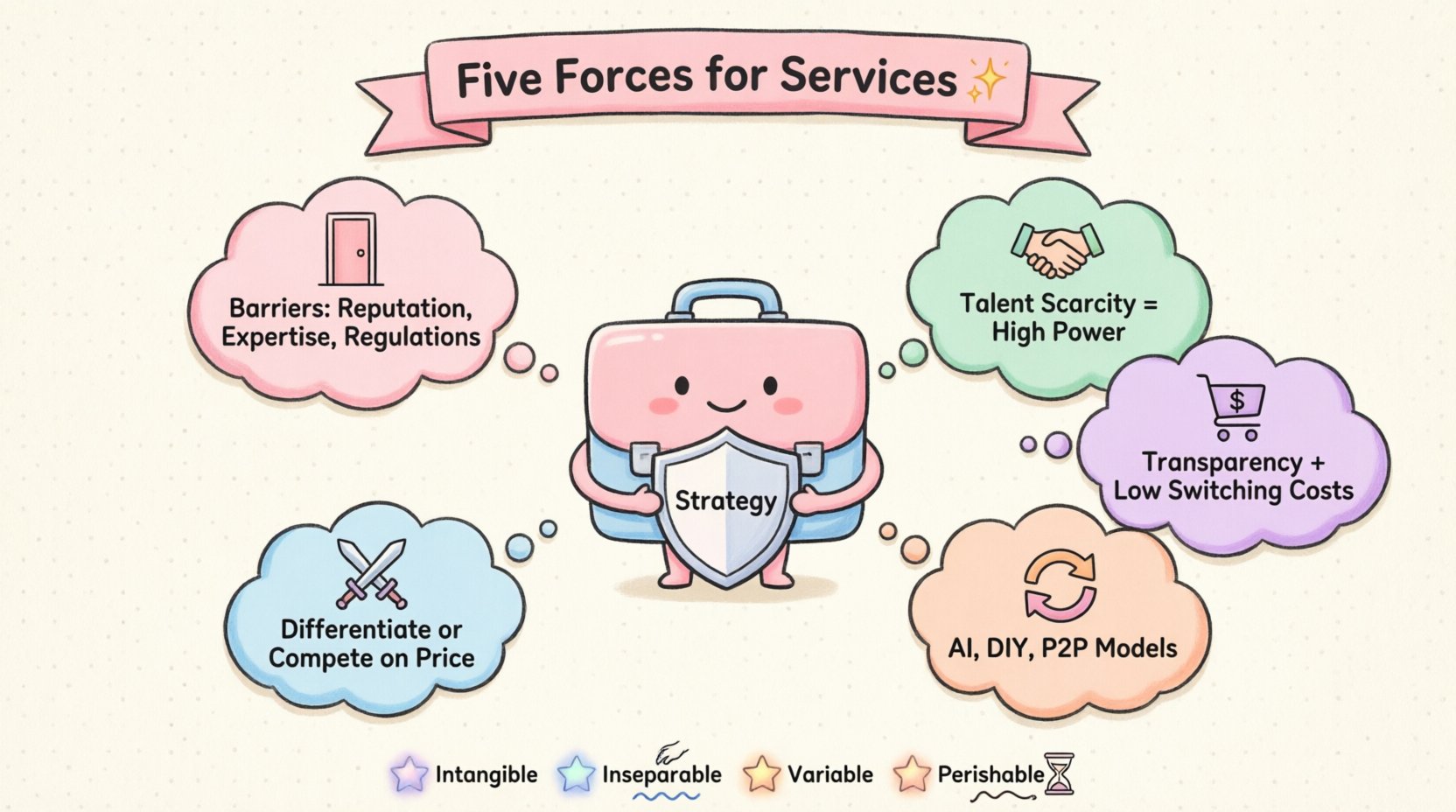
📊 Understanding the Framework in a Service Context
Porter’s Five Forces framework evaluates the intensity of competition and profitability within an industry. For service industries, the intangible nature of the offering shifts the weight of certain forces. The core forces remain the same, but their specific drivers differ from product-based sectors.
- Threat of New Entrants: How easy is it for a competitor to start offering similar services?
- Bargaining Power of Suppliers: Who controls the inputs needed to deliver the service?
- Bargaining Power of Buyers: How much leverage do customers have to drive prices down?
- Threat of Substitutes: Are there alternative ways to solve the customer’s problem?
- Rivalry Among Existing Competitors: How intense is the fight for market share?
The following table summarizes how these forces manifest specifically in service sectors.
| Force | Service Industry Specific Driver | Impact on Margins |
|---|---|---|
| New Entrants | Specialized talent availability, regulatory licensing, brand trust | High impact if barriers are low |
| Supplier Power | Skilled labor scarcity, proprietary software access | High if labor is specialized |
| Buyer Power | Price transparency, low switching costs, demand for customization | Very high in commoditized services |
| Substitutes | DIY solutions, automation, peer-to-peer models | High if technology enables self-service |
| Rivalry | Service differentiation, reputation management, capacity utilization | Intense in saturated markets |
🚪 1. Threat of New Entrants in Service Sectors
The barrier to entry varies widely across service industries. In some sectors, physical capital is not the main hurdle. Instead, the hurdle often lies in reputation, specialized knowledge, or regulatory compliance. A new competitor does not need a factory; they need access to talent and a way to build trust.
Key Barriers to Entry
- Brand Reputation and Trust: Clients often hire based on past performance and reliability. New entrants must overcome skepticism to secure their first major contracts.
- Specialized Expertise: High-end consulting or healthcare services require certifications and years of experience. This limits the pool of potential competitors.
- Regulatory Compliance: Industries like finance, law, and healthcare face strict legal requirements. Navigating these regulations takes time and resources.
- Client Relationships: Long-term contracts and embedded workflows make it difficult for new players to displace incumbents.
Conversely, low-barrier services like general cleaning or basic administrative support face high threat from new entrants. Digital platforms have lowered the cost of finding clients, increasing the risk of new competition. Service providers must continuously innovate to maintain their moat.
Strategic Response
Organizations can mitigate this threat by deepening client relationships. Creating switching costs is a common strategy. This might involve integrating service delivery into the client’s internal processes so that changing providers becomes operationally difficult. Additionally, investing in continuous training ensures the workforce remains ahead of the curve, making it harder for new entrants to match quality.
🤝 2. Bargaining Power of Suppliers
In manufacturing, suppliers provide raw materials. In services, the primary “supplier” is often human capital. The availability of skilled labor directly impacts the ability to deliver value. If a specific type of expertise is scarce, those providers hold significant power.
Factors Influencing Supplier Power
- Scarcity of Talent: If only a few professionals possess the required skills, they can demand higher compensation.
- Unique Knowledge: Proprietary methodologies or niche certifications give suppliers leverage.
- Interdependence: If a service relies on a specific technology platform or infrastructure provider, that vendor gains power.
- Substitutability: If skilled workers are easily replaced by automation or less experienced staff, supplier power decreases.
In knowledge-based services, the risk of high supplier power is significant. A firm might lose its ability to deliver if key staff members leave. This creates volatility in service delivery and cost structures. Organizations must manage this risk through knowledge management systems and cross-training programs.
Strategic Response
To reduce dependency on individual suppliers, companies should invest in training internal talent. Building a pipeline of skilled workers ensures a steady supply of labor. Furthermore, diversifying the supplier base prevents over-reliance on a single source. For technology-driven services, using open standards rather than proprietary platforms can reduce vendor lock-in.
💰 3. Bargaining Power of Buyers
Buyer power is often the most intense force in service industries. Clients frequently have many options to choose from. The intangible nature of services makes comparison difficult, but price transparency has increased with the internet. Buyers can easily research reviews, compare pricing, and switch providers.
Drivers of Buyer Power
- Price Sensitivity: In commoditized services, clients focus primarily on cost.
- Switching Costs: If it is easy to move to a competitor, buyers hold the power.
- Information Availability: Access to online reviews and case studies empowers buyers to make informed decisions.
- Volume of Purchase: Large clients with significant budgets can demand discounts and custom terms.
Service buyers often perceive risk higher than product buyers. They fear that a service failure could disrupt their own operations. Therefore, they scrutinize providers heavily. High buyer power forces service providers to compete on value rather than just price. They must demonstrate clear ROI and reliability.
Strategic Response
Reducing buyer power requires differentiation. Generic services are easily compared on price. Specialized, high-touch services are harder to benchmark. Building strong relationships and understanding client goals deeply creates value that cannot be easily replaced. Offering guarantees or performance-based pricing can also shift the risk balance back toward the provider.
🔄 4. Threat of Substitute Products or Services
Substitutes are not just direct competitors. They are alternative solutions to the same problem. In service industries, this often comes from technology or internal capabilities. A customer might choose to solve a problem themselves rather than hiring a professional.
Common Substitutes in Services
- Automation and AI: Software can now handle tasks previously done by human agents, such as basic support or data entry.
- DIY Solutions: Platforms that allow users to manage their own logistics or finances reduce the need for external help.
- Peer-to-Peer Models: Gig economy platforms allow individuals to offer services directly to consumers, bypassing traditional agencies.
- Internalization: Large clients may bring functions in-house to save costs and gain control.
The threat of substitution grows as technology advances. What was once a human-only service today has digital alternatives. Service providers must anticipate these shifts. Focusing on areas where human empathy, complex judgment, or physical presence is required helps mitigate this threat.
Strategic Response
Providers should integrate technology rather than fight it. Using tools to enhance service delivery can make human intervention more efficient. Alternatively, shifting focus to high-complexity areas where automation cannot yet replicate human nuance protects against substitution. Continuous monitoring of technological trends is necessary to stay ahead of potential substitutes.
⚔️ 5. Rivalry Among Existing Competitors
Competition in service industries is often fierce. Many players vie for the same client base. Since services are often standardized in their basic form, price becomes a primary battleground. However, service delivery varies based on the people involved, creating a space for differentiation.
Factors Intensifying Rivalry
- Number of Competitors: A crowded market leads to aggressive tactics.
- Industry Growth: In slow-growth markets, companies fight for existing share.
- Fixed Costs: High capacity utilization is often needed to cover costs, leading to price cuts.
- Exit Barriers: Difficulty leaving the market (due to specialized assets or contracts) keeps competitors in the fight.
Price wars can erode profitability quickly. Instead of competing on cost, successful firms compete on service quality, responsiveness, and expertise. Reputation becomes a key asset. A single negative experience can damage a brand in a service context more than in a product context.
Strategic Response
Differentiation is the primary defense against intense rivalry. Focusing on niche markets allows a company to become the leader in a specific segment rather than a generalist. Investing in customer experience ensures higher retention rates. Building a strong culture ensures consistent delivery, which is crucial for maintaining a competitive edge.
🛠️ Implementing the Analysis
Conducting this analysis requires a structured approach. It is not a one-time exercise but an ongoing process. The market conditions change, and so do the forces. Leaders should follow a systematic process to gather data and derive insights.
Step-by-Step Implementation
- Gather Data: Collect information on competitors, pricing, customer feedback, and industry trends.
- Assess Each Force: Rate each force from low to high intensity based on the collected data.
- Identify Weaknesses: Determine which forces are squeezing margins the most.
- Develop Strategies: Create actions to counter high-intensity forces.
- Monitor Changes: Regularly review the analysis as market conditions evolve.
Data sources should include internal financial records, customer surveys, competitor websites, and industry reports. Quantitative data provides the baseline, while qualitative insights from frontline staff add context. Frontline employees often see competitive threats before they appear in financial reports.
⚠️ Challenges in Service Analysis
Applying this framework to services comes with specific difficulties. The intangible nature of the output makes measurement harder. Unlike a product, a service cannot be easily inventoried or tested before purchase.
Common Pitfalls
- Overlooking Intangibility: Focusing only on physical assets ignores the value of brand and expertise.
- Ignoring Internal Factors: Service delivery is heavily dependent on internal culture and processes.
- Static Analysis: Treating the analysis as a snapshot rather than a dynamic view.
- Homogenizing the Market: Assuming all services in a sector are identical when they are not.
To avoid these pitfalls, organizations must look at the ecosystem surrounding the service. This includes partners, regulators, and the broader economic environment. A holistic view ensures that the strategy accounts for all variables affecting performance.
🔍 Deep Dive: Service Characteristics and Competitive Dynamics
The four key characteristics of services—intangibility, inseparability, variability, and perishability—directly influence the Five Forces.
Intangibility
Services cannot be touched or seen before purchase. This increases the perceived risk for buyers. It also makes it harder for new entrants to prove their quality immediately. Incumbents with established reputations hold an advantage here.
Inseparability
Production and consumption happen simultaneously. The customer is often part of the production process. This means quality control is harder. It also limits scalability compared to manufacturing. Rivalry often focuses on the quality of the interaction between provider and client.
Variability
Service quality can vary depending on who provides it and when. This creates inconsistency. Standardization is a goal for many firms to reduce this variability. High variability can increase buyer power, as customers can demand better performance.
Perishability
Services cannot be stored for later use. An empty seat on a plane or an unused hour of a consultant’s time is lost revenue. This drives the need for demand management. Rivalry can be intense during low-demand periods as firms try to fill capacity.
📈 Long-Term Strategic Implications
Understanding these forces helps in planning for the future. It informs decisions about investment, hiring, and market expansion. Companies that ignore structural forces often find themselves reacting to crises rather than shaping their destiny.
Investment Priorities
- Technology: Invest in tools that reduce variability and improve efficiency.
- People: Allocate budget for training and retention to manage supplier power.
- Brand: Build reputation to lower the threat of new entrants and buyer power.
- Process: Standardize delivery to ensure consistency and scalability.
Strategic alignment is crucial. The analysis should inform the overall business strategy. If the threat of substitutes is high, the strategy might shift toward innovation. If buyer power is high, the strategy might focus on loyalty programs.
🔎 Conclusion on Application
The Five Forces Model provides a clear structure for analyzing competitive dynamics in service industries. It highlights the specific pressures that service providers face compared to product manufacturers. By understanding these forces, organizations can make informed decisions about where to compete and how to defend their position.
Service success depends on managing relationships and delivering consistent value. The analysis helps identify where value is being eroded and where it can be enhanced. Continuous monitoring ensures that the strategy remains relevant as the market evolves. Leaders who apply this framework rigorously are better positioned to navigate complexity and achieve sustainable growth.


Comments (0)