![Free eBooks of IT [BooksOfAll]](https://www.booksofall.com/wp-content/uploads/2022/06/booksofall-logo-2.png)
C4 Model for Legacy Modernization: Mapping the Path Forward
Legacy systems form the backbone of countless organizations. They hold critical business logic, customer data, and operational workflows. Yet, they often exist as shadowy structures, understood only by a few individuals who have been there for decades. Modernization is not merely about rewriting code; it is about understanding the architecture before attempting to transform it. This is where the C4 model becomes an essential tool for clarity.
When teams approach modernization without a clear map, they risk creating new systems that replicate old problems or break existing dependencies. The C4 model provides a standardized way to visualize software architecture at different levels of detail. By applying this hierarchical approach to legacy environments, organizations can systematically document, analyze, and plan their transition strategies.
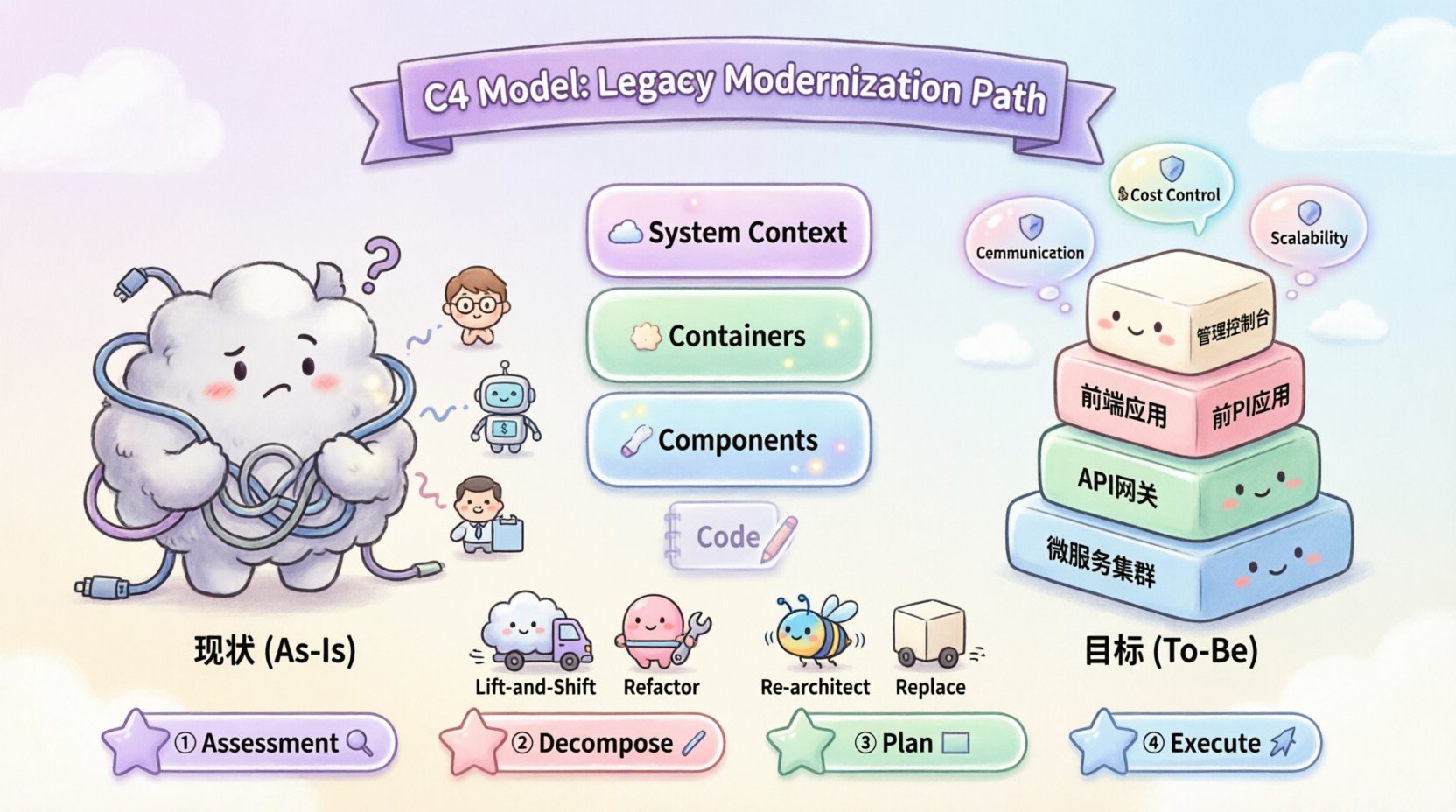
🧭 Understanding the C4 Model Hierarchy
The C4 model organizes architectural documentation into four distinct levels. Each level serves a specific audience and purpose. For legacy modernization, this structure helps break down complex monoliths into manageable pieces.
- Level 1: System Context 🌍 — Shows the system as a whole and how it interacts with external entities.
- Level 2: Containers 📦 — Defines the high-level building blocks like web servers, databases, and mobile apps.
- Level 3: Components 🧩 — Breaks down containers into logical groups of functionality.
- Level 4: Code 📝 — Maps components to specific classes and methods (rarely needed for high-level strategy).
During a modernization effort, you rarely start at the bottom. You begin at the top. The goal is to establish a baseline of the current state, often called the “As-Is” architecture.
🕵️♂️ Phase One: The As-Is Landscape Assessment
Before planning a move, you must know where you stand. Legacy systems often suffer from “architectural drift.” The code has evolved over years, but the documentation has not. Relying on memory or scattered wikis leads to errors.
🔹 Step 1: Defining the System Context
The first diagram in the C4 model places your legacy application within the broader ecosystem. You must identify every person, system, or process that interacts with this software.
- External Entities: These could be third-party payment gateways, internal HR systems, or end-users.
- Relationships: Define how data flows between the legacy system and these entities.
- Boundaries: Clearly mark the system boundary to understand what is inside and what is outside.
This step is crucial for modernization because it highlights integration points. When you migrate a system, these connections must be preserved or redesigned. If you miss an external dependency, the new system will fail to function correctly upon deployment.
🔹 Step 2: Identifying Containers
Containers represent the high-level runtime environment. In a legacy context, this might mean:
- A mainframe application.
- A monolithic Java or .NET application running on a Windows server.
- A set of stored procedures in a SQL database.
- A legacy web application built with outdated frameworks.
| Legacy Container | Modern Target | Migration Consideration |
|---|---|---|
| Monolithic JAR/WAR | Containerized Microservices | Requires service boundary definition |
| On-Premise Database | Cloud Native DB | Schema migration and data integrity checks |
| Desktop Application | Web Application | UI/UX redesign and protocol changes |
Documenting these containers helps you understand the infrastructure costs. Are you paying for servers that are idle? Are you running databases that can be consolidated? This level of visibility is the first step toward cost reduction.
🧩 Phase Two: Decomposing Components
Once the containers are mapped, the next step is to understand what is inside them. This is where the Component level comes into play. In legacy systems, components are often hidden deep within large codebases.
🔹 The Problem of the “Big Ball of Mud”
Many legacy systems are described as a “big ball of mud.” Code is tightly coupled, making changes risky. Using the C4 model, you can force a separation of concerns.
- Identify Responsibilities: What does this module actually do? Is it handling authentication? Processing payments? Generating reports?
- Trace Dependencies: Which other components does this rely on? Which components rely on it?
- Identify Orphans: Are there components that no longer serve a purpose?
This decomposition is vital for the Strangler Fig pattern. You cannot migrate a massive system in one go. You need to identify specific components that can be extracted and replaced independently.
🔹 Visualizing Data Flows
At the component level, you should also document data flows. Legacy systems often have data sitting in odd places. Some data is in the database, some in files, and some in memory. Mapping these flows helps you design the data architecture for the new system.
Key questions to answer at this stage:
- Where is the source of truth for customer data?
- How is data validated before it enters the system?
- Are there batch processes that need to be converted to real-time events?
📅 Phase Three: Planning the Modernization Strategy
With the “As-Is” architecture documented using C4, you can now design the “To-Be” architecture. This is not just a technical exercise; it is a business strategy.
🔹 Choosing a Migration Pattern
Different architectures require different migration paths. The C4 model helps you select the right one.
- Rehosting (Lift and Shift): Moving the existing containers to a new environment. Good for quick infrastructure updates.
- Refactoring: Changing the internal structure without altering external behavior. Useful for fixing technical debt.
- Re-architecting: Moving from a monolith to microservices. This requires significant component-level changes.
- Replacing: Swapping the system for a new off-the-shelf solution. The C4 model helps define the requirements for the new vendor solution.
🔹 Defining the Target State
When drawing the “To-Be” C4 diagrams, keep these principles in mind:
- Separation of Concerns: Ensure that authentication is separate from business logic.
- Scalability: Can the new containers handle increased load?
- Resilience: What happens if one component fails? Are there fallback mechanisms?
- Observability: How will you monitor the new system? Logging and tracing should be built-in.
Visualizing the target state allows stakeholders to see the end goal. It reduces anxiety about the unknown and aligns the business with the technical reality.
🚧 Phase Four: Execution and Iteration
Documentation is useless if it sits in a folder. The C4 diagrams must be living artifacts that guide the development process.
🔹 Iterative Refinement
As you migrate components, update the diagrams. If a container is removed, update the Context diagram. If a new service is added, update the Container diagram. This ensures the documentation always reflects reality.
🔹 Collaboration Tools
Teams need a shared space to view and edit these diagrams. Using version control for architecture diagrams ensures that changes are tracked and reviewed. This prevents “diagram drift” where the visual map no longer matches the code.
⚠️ Common Pitfalls in Legacy Modernization
Even with a solid model like C4, projects can fail. Here are common issues to avoid.
🔹 Over-Engineering the Documentation
Do not create detailed diagrams for every single class. This creates maintenance overhead. Focus on the levels that matter for decision-making. Context and Containers are usually sufficient for management. Components are for developers. Code is for onboarding.
🔹 Ignoring the Human Element
Architecture is not just code; it is people. The System Context diagram should include teams or departments, not just software systems. Understanding who owns which data is as important as knowing the database schema.
🔹 Static Diagrams
Static images that are never updated become misleading. Use tools that allow for dynamic updates or integrate diagramming into the CI/CD pipeline where possible. If a diagram is not accurate, developers will stop reading it.
🔄 Maintaining the Architecture Over Time
Modernization is not a one-time event. Systems evolve. The C4 model supports this evolution by providing a consistent language for discussion.
- Onboarding: New hires can understand the system landscape by reviewing the Context and Container diagrams.
- Auditing: Compliance teams can verify data flows and security boundaries using the diagrams.
- Planning: Product owners can see the impact of new features on the existing architecture.
📊 Summary of Benefits
Why invest time in this approach? The return on investment comes from clarity and reduced risk.
- Better Communication: A shared visual language reduces misunderstandings between business and technical teams.
- Risk Reduction: You know exactly what you are touching before you change it.
- Cost Control: Identifying unused components helps reduce infrastructure and maintenance costs.
- Scalability: A clear architecture makes it easier to scale specific parts of the system without affecting others.
🛠️ Implementation Checklist
Before starting your modernization journey, ensure you have the following ready:
- ✅ Stakeholder buy-in for documentation efforts.
- ✅ Access to legacy code and infrastructure.
- ✅ A defined set of tools for diagramming.
- ✅ A clear definition of success for the modernization project.
- ✅ A timeline that allows for documentation and analysis.
Legacy modernization is a marathon, not a sprint. The C4 model provides the map. It does not run the race for you. It simply ensures you do not walk into walls while moving forward. By documenting the current state and designing the future state with precision, you create a path that is visible, understandable, and achievable.
Start with the Context. Understand the boundaries. Then peel back the layers. The complexity of legacy systems can be tamed through structured visualization. This approach turns a daunting task into a series of manageable steps.
Remember, the goal is not perfection. The goal is understanding. Every diagram you create adds to the collective knowledge of the organization. Use this knowledge to make better decisions, reduce risk, and build systems that serve your business for the next decade.


Comments (0)