![Free eBooks of IT [BooksOfAll]](https://www.booksofall.com/wp-content/uploads/2022/06/booksofall-logo-2.png)
The C4 Model Future Outlook: Where It’s Heading in 2026 and Beyond
Software architecture has always been the bridge between business requirements and technical execution. As systems grow in complexity, the need for clear, maintainable documentation becomes critical. The C4 model has emerged as a standard for visualizing software architecture, providing a hierarchical approach to diagramming. From high-level context to detailed code structures, it offers a shared language for developers and stakeholders.
Looking ahead to 2026 and the subsequent years, the landscape of system design is shifting. Cloud-native technologies, artificial intelligence, and distributed computing are reshaping how we document and understand software. This guide explores the trajectory of the C4 model, analyzing where it fits in the evolving ecosystem of software development and what changes are on the horizon.
🏗️ Understanding the Foundation: Why C4 Endures
Before projecting into the future, it is essential to acknowledge why the C4 model remains relevant. Traditional methods of diagramming often resulted in overly complex charts that were difficult to maintain. The C4 model simplifies this by focusing on four levels of abstraction:
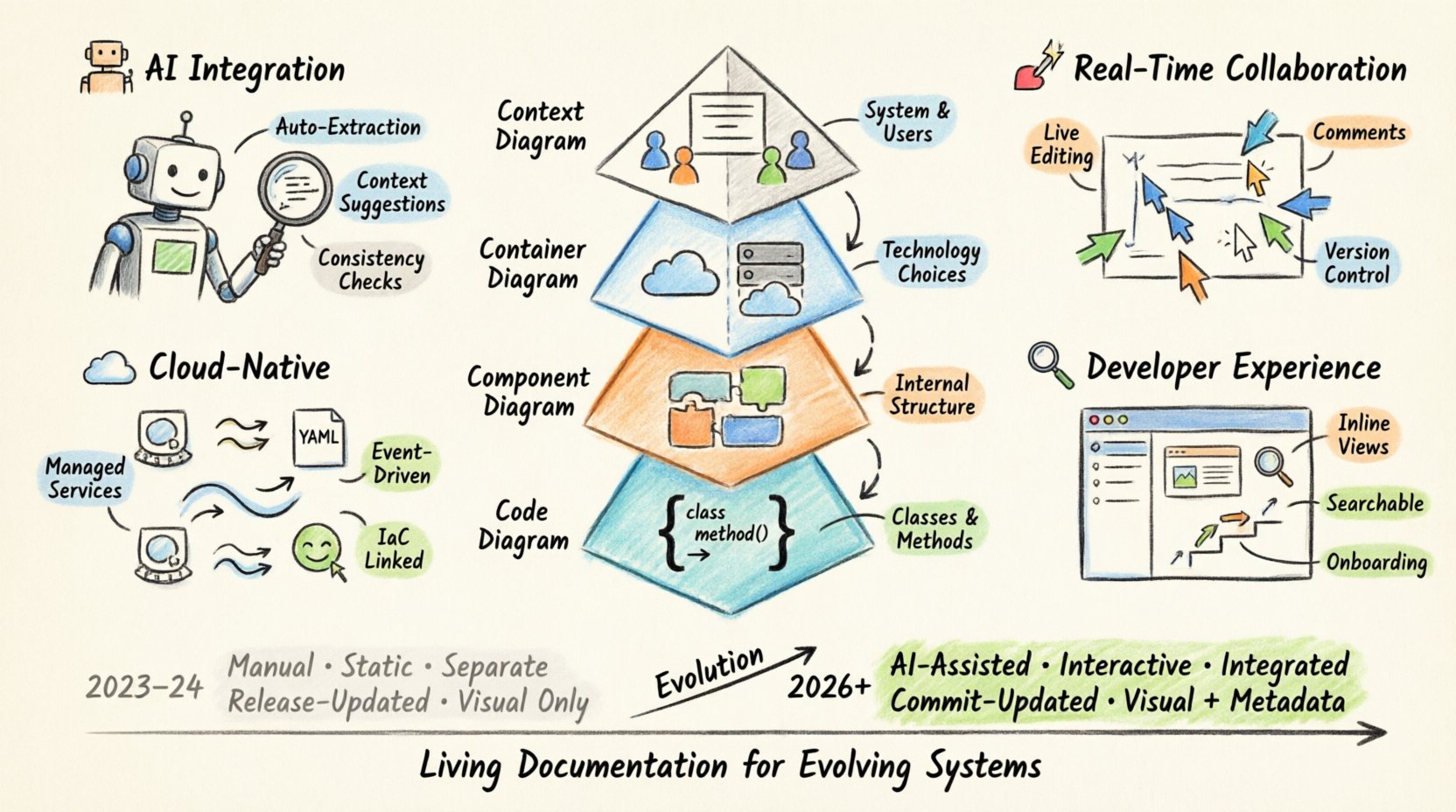
- Level 1: Context Diagrams – Showing the system and its users.
- Level 2: Container Diagrams – Illustrating the technology choices.
- Level 3: Component Diagrams – Detailing the internal structure.
- Level 4: Code Diagrams – Displaying specific classes and methods.
This structure allows architects to zoom in and out without overwhelming the reader. It promotes a culture of living documentation rather than static snapshots. As we move forward, this foundational clarity is more valuable than ever, given the speed of modern development cycles.
📈 Key Trends Shaping the C4 Model in 2026
The next few years will bring significant shifts in how architecture diagrams are created, consumed, and maintained. Several major trends are influencing the future of the C4 model.
1. Integration with Artificial Intelligence 🤖
Artificial intelligence is moving from a novelty to a core component of development workflows. In the context of architecture documentation, AI will play a pivotal role in automating the generation of diagrams. Instead of manually drawing boxes and arrows, developers will provide code repositories or configuration files.
Predictions for 2026 include:
- Automated Extraction: AI agents will parse codebases to infer relationships between containers and components automatically.
- Context Suggestions: Systems will recommend appropriate context diagrams based on the type of application being built.
- Consistency Checks: Automated tools will flag inconsistencies between the code and the architectural diagrams.
This shift reduces the maintenance burden. When code changes, the documentation can update in near real-time, ensuring accuracy without constant manual intervention.
2. Shift Towards Real-Time Collaboration 🤝
Remote work and distributed teams have normalized asynchronous communication. However, the future points toward more synchronous, collaborative editing of architectural diagrams. The ability for multiple architects to work on a single diagram simultaneously is becoming a standard expectation.
Key capabilities expected to evolve:
- Live Cursor Tracking: Seeing where team members are editing in real-time.
- Integrated Comments: Discussion threads tied directly to specific diagram elements.
- Version Control for Diagrams: Treating diagram files with the same rigor as code, allowing for branching and merging.
3. Cloud-Native and Serverless Specifics ☁️
As more organizations migrate to cloud environments, the definition of a “container” or “component” changes. Serverless functions and managed services introduce new abstractions that the C4 model must accommodate.
The model is adapting to reflect these changes:
- Managed Service Recognition: New visual symbols for cloud-managed databases and storage.
- Event-Driven Architecture: Enhanced support for visualizing event streams and message queues.
- Infrastructure as Code: Linking diagrams directly to IaC templates to ensure infrastructure matches design.
4. Developer Experience (DX) Focus 🛠️
Documentation is increasingly viewed as part of the developer experience. A diagram that is hard to read or update becomes a barrier to entry. Future iterations of C4 tools will prioritize ease of use and integration with existing IDEs.
Expectations for 2026:
- Inline Diagrams: Viewing diagrams directly within the code editor without switching contexts.
- Searchable Architecture: Searching for specific components across the entire system documentation.
- Onboarding Tools: Using diagrams to guide new hires through the system landscape.
🔄 Evolution of Diagramming Practices
The way we create diagrams is undergoing a transformation. The static nature of traditional diagrams is giving way to dynamic representations. This section outlines the shift from manual creation to automated, living documentation.
| Current Practice (2023-2024) | Future Outlook (2026+) |
|---|---|
| Manual drawing in external tools | AI-assisted generation from code |
| Static PDF or Image exports | Interactive, web-based views |
| Separate documentation repository | Integrated within the codebase |
| Updated during releases | Updated on every commit |
| Visual only | Visual + Metadata (metrics, ownership) |
This table highlights the transition from static snapshots to dynamic assets. The goal is to ensure that the diagram is always a reflection of the system, not a memory of it.
⚙️ Integration with Development Workflows
For the C4 model to remain viable, it must integrate seamlessly with the tools developers use daily. Siloed documentation tools create friction. The future lies in embedding architecture visualization into the CI/CD pipeline.
Automated Validation Pipelines
Continuous Integration systems can be configured to validate architectural constraints. If a new component violates the defined architecture, the build can fail. This enforces discipline without requiring constant human oversight.
Implementation steps typically include:
- Defining architectural rules in a configuration file.
- Running a linter during the build process.
- Blocking merges that introduce unauthorized dependencies.
- Generating updated diagrams automatically upon successful builds.
Linking to Observability
Architecture diagrams are often disconnected from runtime data. In the future, we expect to see links between diagram elements and monitoring dashboards. Clicking on a container in a diagram could open the live metrics for that service.
This integration bridges the gap between design and operations. It allows teams to see how the theoretical design performs in production.
🧠 The Human Element: Culture and Training
Technology is only half the equation. The adoption of the C4 model depends heavily on team culture and training. As the model evolves, the skills required to maintain it are also changing.
Democratizing Architecture
Historically, architecture was the domain of senior staff. The C4 model lowers the barrier to entry, allowing individual contributors to document their work. This democratization continues to grow.
Benefits of a broader understanding:
- Better communication across teams.
- Reduced dependency on single points of knowledge.
- Faster onboarding for new employees.
- More accurate documentation due to proximity to the code.
Training and Onboarding
Organizations are investing more in teaching the C4 model to new hires. It is becoming a standard skill in job descriptions for software engineers. Training programs focus not just on drawing, but on understanding the *why* behind the design choices.
Effective training includes:
- Workshops on abstraction levels.
- Case studies of successful and failed documentation.
- Pairing sessions with senior architects.
- Access to templates and guidelines.
🛑 Challenges and Considerations
While the outlook is positive, there are challenges to address. Understanding these hurdles helps in planning for the future.
Maintaining Abstraction
It is easy to fall into the trap of documenting too much detail. As systems grow, the temptation to create detailed diagrams for every component increases. This leads to documentation that is too large to maintain.
Strategies to manage this:
- Stick to the four levels strictly.
- Focus on the “boundary” rather than the internals.
- Use aggregation to hide complexity when necessary.
- Regularly review and prune outdated diagrams.
Tool Agnosticism
There is no single standard for file formats. This creates friction when teams switch tools or collaborate across organizations. The future requires better interoperability standards.
Desired outcomes:
- Open file formats that are human-readable.
- Standardized APIs for importing and exporting data.
- Community-driven extensions that do not lock users into specific vendors.
Privacy and Security
As diagrams become more detailed and integrated with code, they may reveal sensitive information. Access controls must be robust to prevent unauthorized access to architectural details.
Security best practices include:
- Role-based access control for documentation platforms.
- Auditing access logs for diagram views.
- Sanitizing sensitive data before generating public diagrams.
- Encrypting diagram files at rest.
🤝 Building a Sustainable Community
The longevity of the C4 model depends on the community surrounding it. Open-source contributions, conferences, and online discussions keep the model evolving.
Knowledge Sharing
Communities share patterns and anti-patterns. This collective wisdom helps individuals avoid common mistakes. As the model matures, more resources will become available for specific industries.
Standardization Efforts
Industry bodies are beginning to recognize architecture modeling as a formal discipline. This may lead to broader standardization, similar to how ISO standards influence hardware.
Future standardization areas:
- Visual notation standards.
- Metadata schemas for diagrams.
- Interoperability protocols between tools.
🌱 Sustainability and Long-Term Maintenance
Documentation is not a one-time task. It requires ongoing care to remain useful. The concept of “architectural debt” is similar to technical debt. If diagrams are not updated, they become misleading.
The Cost of Outdated Diagrams
Outdated diagrams can lead to costly mistakes. Developers might build features based on assumptions that are no longer true. This erodes trust in the documentation process.
To maintain sustainability:
- Assign ownership of diagrams to specific teams.
- Include diagram updates in the Definition of Done.
- Schedule regular audits of the documentation.
- Encourage a culture where updating docs is seen as a value add.
Green Architecture
As sustainability becomes a priority, architecture diagrams can help visualize energy consumption. Future models might include annotations regarding the environmental impact of different architectural choices.
This adds a new dimension to the C4 model:
- Carbon footprint estimation per service.
- Efficiency metrics for data transfer.
- Resource utilization visualization.
💡 Final Thoughts on the Road Ahead
The C4 model is more than just a way to draw boxes. It is a framework for thinking about software systems. As we move into 2026 and beyond, the core principles remain valid, but the tools and processes around them will evolve.
Key takeaways for organizations include:
- Invest in tools that support automation and real-time updates.
- Prioritize training to ensure widespread understanding.
- Integrate documentation into the development lifecycle, not as an afterthought.
- Embrace AI as a helper, not a replacement for human judgment.
The future of software architecture is collaborative, automated, and integrated. By adapting to these changes, teams can ensure their documentation remains a valuable asset rather than a burden. The goal is clarity, consistency, and continuous improvement.
As the industry matures, the C4 model will likely become as ubiquitous as version control systems. It provides the shared vocabulary needed to navigate increasingly complex digital landscapes. Staying informed about these trends ensures that teams can build systems that are not only functional but also understandable and maintainable.
Looking forward, the focus shifts from creating diagrams to managing the flow of information within them. The diagram becomes a living interface between the code and the people who build it. This alignment is crucial for the success of modern software engineering.


Comments (0)