![Free eBooks of IT [BooksOfAll]](https://www.booksofall.com/wp-content/uploads/2022/06/booksofall-logo-2.png)
Tags:
Adapting the Five Forces Model for Digital Economies
The business landscape has shifted. What worked for manufacturing giants in the 20th century often falters when applied to software startups in the 21st. The traditional strategic framework, developed by Michael Porter, remains a cornerstone of competitive analysis. However, the mechanics of value creation have evolved. Digital economies operate on different rules: network effects, near-zero marginal costs, and data-driven decision-making. Adapting the Five Forces Model for digital contexts requires a nuanced understanding of how technology reshapes barriers, power dynamics, and substitution.
This guide explores how to recalibrate each of the five forces when analyzing digital businesses. We move beyond the textbook definitions to examine the realities of platform economics, ecosystem disruption, and the intangible assets that drive modern valuation.
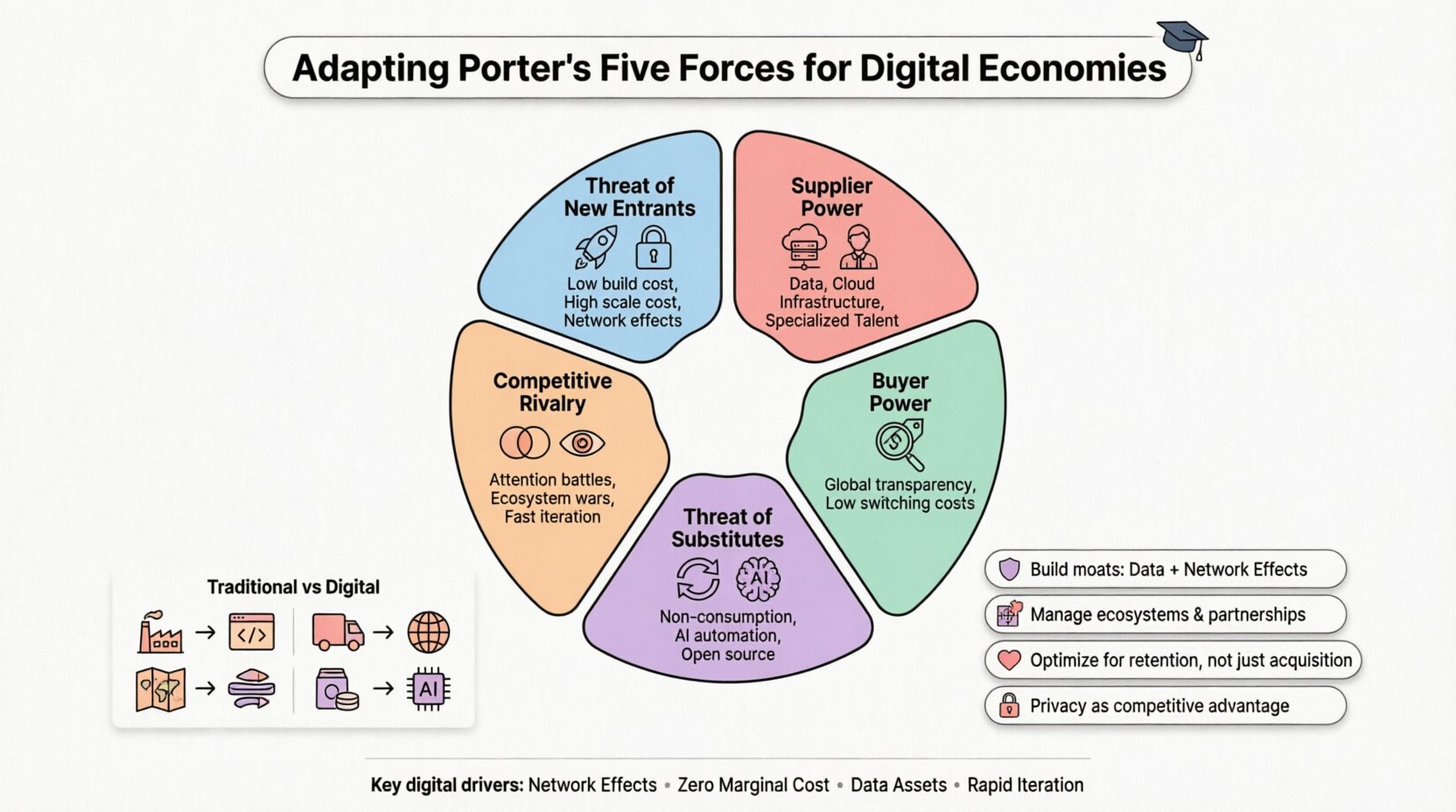
📊 Understanding the Classic Framework
Before adaptation, a clear baseline is necessary. Porter’s Five Forces analyze the competitive intensity and attractiveness of a market. The goal is to determine profitability potential. The five components are:
- Threat of New Entrants: How easy is it for competitors to enter the market?
- Bargaining Power of Suppliers: How much control do vendors have over costs?
- Bargaining Power of Buyers: How much leverage do customers have?
- Threat of Substitutes: Can customers switch to a different solution?
- Rivalry Among Existing Competitors: How intense is the current competition?
In a physical economy, these forces are often dictated by geography, logistics, and capital intensity. In a digital economy, they are dictated by code, data, and connectivity. A physical barrier might be a factory; a digital barrier might be an algorithm or a user base.
🚀 Why Digital Changes the Game
Digital transformation is not merely about using computers. It is about a fundamental shift in how value is delivered. Several key factors disrupt traditional analysis:
- Network Effects: Value increases as more people use the service. This creates winner-take-all dynamics.
- Zero Marginal Costs: Copying a digital product costs almost nothing compared to manufacturing a physical good.
- Speed of Iteration: Products can be updated daily, not annually. Strategy must be agile.
- Data as an Asset: User data becomes a competitive moat that suppliers or buyers cannot easily replicate.
When analyzing a digital business, you must look past the revenue line. You must assess the structural advantages that technology confers. The following sections detail how each force transforms.
💻 Force 1: Threat of New Entrants
In traditional industries, high capital requirements often deter new players. A car manufacturer needs billions for factories and supply chains. In the digital space, the cost of entry can be shockingly low. A developer can build a functional app with a fraction of the budget. However, low entry costs do not guarantee success.
Digital Barriers to Entry
While the cost to build decreases, the cost to scale often increases. New entrants face specific hurdles:
- Network Density: New platforms struggle to attract users without an existing community.
- Switching Costs: Users are often locked in by data portability issues or workflow integration.
- Regulatory Compliance: Digital sectors like fintech or healthtech face strict data privacy laws.
- Brand Trust: In an age of scams, establishing trust takes significant time.
Therefore, the threat of new entrants is not binary. It is a spectrum. A startup might enter easily, but capturing market share remains the true challenge. The analysis must focus on the difficulty of achieving scale, not just the difficulty of launch.
🔧 Force 2: Bargaining Power of Suppliers
Suppliers in a digital context are often different from traditional vendors. They may provide cloud infrastructure, talent, or raw data. The power dynamic shifts based on scarcity and dependency.
Key Supplier Dynamics
- Infrastructure Providers: Relying on a few major cloud providers creates dependency. However, multi-cloud strategies can mitigate this risk.
- Talent Scarcity: Skilled engineers and data scientists are critical suppliers of labor. High salaries and retention issues increase their power.
- Data Sources: If a business relies on a third party for data (e.g., location data or social signals), that third party holds leverage.
- APIs and Integrations: If a platform relies on an external API to function, changes in that API can break the business model.
Digital businesses must assess how critical their suppliers are. If a competitor can replicate the supplier relationship quickly, power is low. If the supplier controls a unique dataset or a proprietary protocol, power is high.
🛒 Force 3: Bargaining Power of Buyers
Information asymmetry used to favor sellers. Buyers often did not know the true cost of alternatives. Digital markets have flipped this. Price transparency is near-perfect. Buyers can compare options instantly.
Factors Influencing Buyer Power
- Comparison Engines: Tools allow users to see pricing side-by-side.
- Low Switching Costs: Digital accounts are often free to leave, or data can be exported easily.
- Volume Sensitivity: Large enterprise buyers have more leverage than individual consumers.
- Subscription Fatigue: Users are increasingly selective about recurring payments.
To reduce buyer power, companies must increase switching costs. This does not mean creating friction, but rather creating value that is lost upon leaving. This could be data history, personalized settings, or ecosystem integration. However, if the value proposition is weak, buyers will leave regardless of friction.
🔄 Force 4: Threat of Substitutes
Substitutes are not just competitors with better products. They are alternative ways of solving a problem. In digital economies, the definition of a substitute is broader. A user might not buy a new software tool; they might simply choose not to solve the problem.
Identifying Digital Substitutes
- Non-Consumption: The best substitute is often doing nothing. If a process is too complex, users abandon it.
- Cross-Industry Shifts: Streaming services substituted cable TV. Ride-sharing substituted taxi services. The threat comes from outside the industry.
- Open Source Solutions: Free alternatives can drive down willingness to pay for proprietary software.
- Automation: AI tools can substitute human labor or manual processes entirely.
Analysis must look for the underlying need. If a business sells “time-saving software,” the substitute is a more efficient workflow or an AI agent, not just another software package.
⚔️ Force 5: Rivalry Among Existing Competitors
Competition in digital markets is often intense. Because distribution is global and costs are low, many players can exist simultaneously. This leads to price wars and rapid feature duplication.
Drivers of Digital Rivalry
- Feature Parity: Once a feature is released, competitors often copy it quickly.
- Marketing Spend: Customer acquisition costs (CAC) can be high, leading to aggressive spending.
- Innovation Cycles: Short product lifecycles mean constant reinvention is required.
- Ecosystem Wars: Competitors often try to lock users into broader ecosystems (hardware, software, services).
Rivalry is not just about price. It is about attention. In the attention economy, the goal is to keep the user engaged longer than the competitor. This shifts the focus from unit economics to engagement metrics.
📋 Traditional vs. Digital Force Analysis
To visualize the adaptation, compare the traditional view against the digital reality.
| Force | Traditional Context | Digital Context |
|---|---|---|
| New Entrants | Capital intensive, high logistics costs | Low build cost, high scale cost, network effects |
| Suppliers | Raw materials, physical logistics | Data, cloud infrastructure, specialized talent |
| Buyers | Local pricing, high search costs | Global transparency, low search costs, high price sensitivity |
| Substitutes | Direct product alternatives | Process changes, AI automation, non-consumption |
| Rivalry | Market share battles, regional | Attention battles, global, ecosystem integration |
🛡️ Strategic Implications
Applying this adapted model leads to different strategic choices. Static strategies fail in dynamic environments. Here are the core implications for decision-makers.
1. Focus on Moats Beyond Technology
Technology alone is rarely a moat. Code is replicable. The moat lies in data, network effects, or brand. Strategy should prioritize building assets that become harder to copy over time.
2. Manage the Ecosystem
Competing in isolation is difficult. Digital businesses often thrive by building partnerships. Integrating with other platforms can reduce rivalry and increase supplier power.
3. Optimize for Retention
Acquiring users is expensive. In a high-switching-cost environment, retention is the primary driver of profitability. Customer success becomes a strategic function, not just support.
4. Data Privacy as a Feature
As regulations tighten, privacy becomes a competitive advantage. Trust can differentiate a brand in a market where data misuse is common.
⚠️ Common Pitfalls in Digital Analysis
Even with the right framework, analysts often stumble. Avoid these common errors when evaluating digital markets.
- Ignoring Unit Economics: Growth at all costs is unsustainable. If CAC exceeds lifetime value, the model fails.
- Overestimating Network Effects: Not all networks are strong. Weak network effects do not protect against competitors.
- Underestimating Regulation: Digital markets are increasingly regulated. Policy changes can alter force dynamics overnight.
- Focusing Only on Direct Competitors: As noted in substitutes, the biggest threat often comes from outside the industry.
- Neglecting Human Capital: In tech, people are the product. Losing key talent can dismantle the strategy.
🔮 Future-Proofing Your Strategy
The digital economy is not static. AI, blockchain, and quantum computing will introduce new variables. To remain relevant, the analysis must be iterative.
- Continuous Monitoring: Market conditions change monthly. Annual reviews are insufficient.
- Scenario Planning: Prepare for multiple futures. What if a competitor launches a superior AI tool? What if data laws change?
- Agile Resource Allocation: Be ready to pivot capital to emerging opportunities or away from dying channels.
- Customer Feedback Loops: Direct feedback helps identify substitute threats before they become mainstream.
🔍 Final Thoughts on Digital Strategy
Adapting the Five Forces Model for digital economies is not about discarding the framework. It is about refining the inputs. The structure remains valid, but the variables have changed. Capital is less important than data. Geography is less important than connectivity.
By understanding the nuances of network effects, supplier dependencies, and buyer transparency, leaders can make informed decisions. The goal is not just to survive the digital shift, but to position the organization where the value flows. Strategic clarity allows for better resource allocation and risk management.
Success in this environment requires vigilance. The forces are always shifting. A strategy that works today may be obsolete tomorrow. Continuous analysis and adaptation are the only sustainable paths forward. Keep the focus on value creation, user retention, and structural advantage.


Comments (0)