![Free eBooks of IT [BooksOfAll]](https://www.booksofall.com/wp-content/uploads/2022/06/booksofall-logo-2.png)
Tags:
Myth-Busting the Five Forces: Separating Fact from Fiction
Michael Porter introduced a framework in 1979 that fundamentally changed how organizations assess their competitive environment. The model, known as Porter’s Five Forces, remains a cornerstone of strategic planning today. Despite its longevity, misconceptions persist regarding its application, scope, and predictive power. Many leaders treat the framework as a rigid checklist or a crystal ball. This guide aims to clarify these misunderstandings by examining common myths and presenting the evidence-based reality.
Strategic analysis requires precision. Misapplying a tool can lead to flawed decisions, wasted resources, and missed opportunities. By understanding the nuances of the Five Forces, you can better navigate industry dynamics. This article explores the factual application of the model while debunking the fiction that surrounds it.
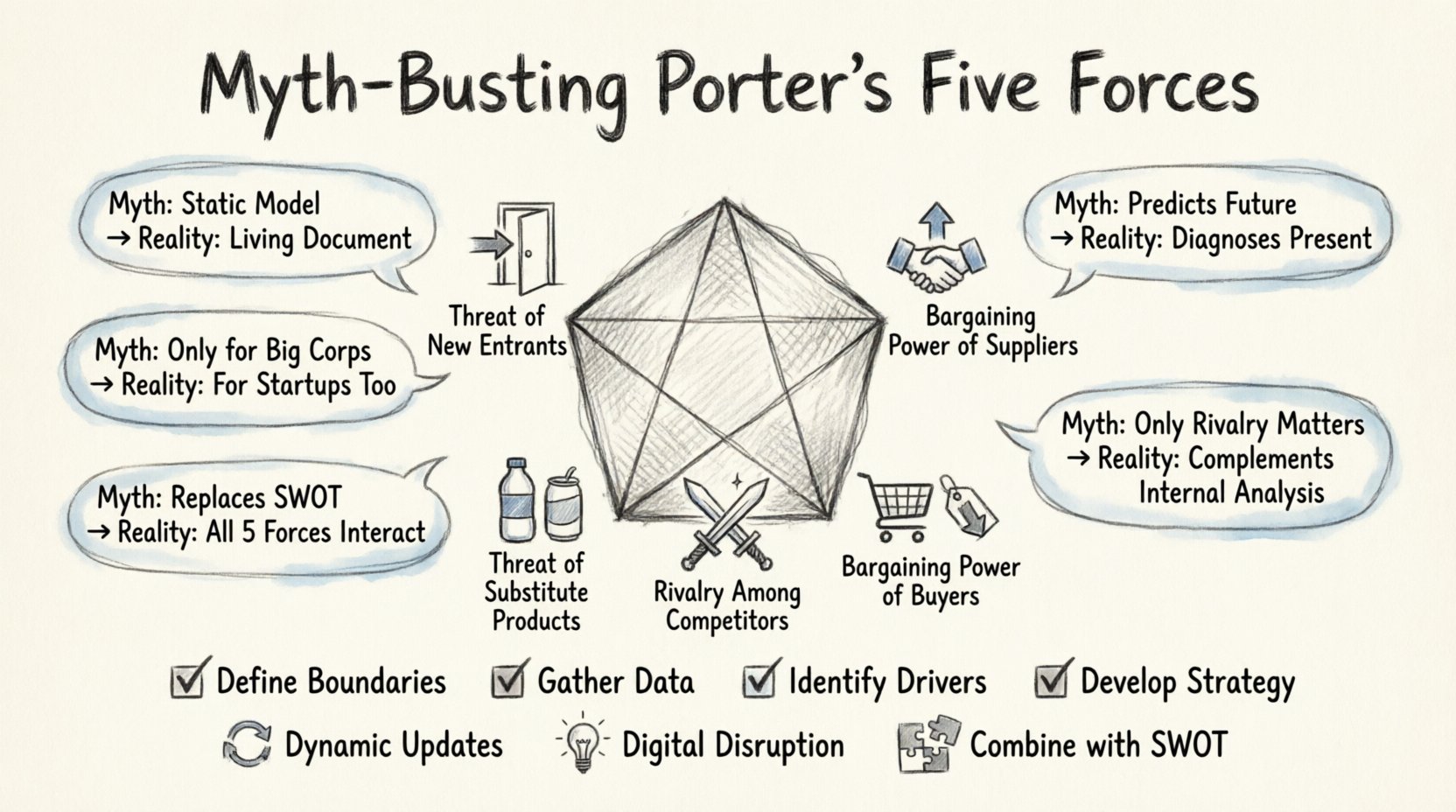
Understanding the Framework 📊
Before addressing misconceptions, it is necessary to define the core components. The model evaluates the attractiveness of an industry based on five specific forces:
- Threat of New Entrants: How easy is it for competitors to enter the market?
- Bargaining Power of Suppliers: Can providers of raw materials or services dictate terms?
- Bargaining Power of Buyers: Can customers drive prices down or demand higher quality?
- Threat of Substitute Products: Are there alternative solutions that meet the same need?
- Rivalry Among Existing Competitors: How intense is the competition for market share?
These forces collectively determine the profitability potential of an industry. They are not independent variables but interact dynamically. High pressure from any of these forces typically erodes the overall profit margin for players within that sector.
Myth 1: The Model is Static and Unchanging ⏸️
A common misconception is that a Five Forces analysis represents a permanent snapshot of the industry. Critics argue that the framework is too rigid to capture the fluidity of modern markets.
The Reality:
- The analysis is a snapshot in time, but it should be treated as a living document.
- Industry structures evolve due to technology, regulation, and consumer behavior.
- Forces that are weak today may become strong tomorrow.
For example, the threat of new entrants was historically high in retail. However, the rise of digital platforms has altered entry barriers in unexpected ways. A company must revisit this analysis regularly. Annual reviews are standard practice for mature organizations. Quarterly assessments are necessary for volatile sectors.
When forces shift, strategy must adapt. A static view leads to complacency. If you assume the competitive landscape is fixed, you risk being blindsided by disruptors. The model provides the structure for analysis, not a fixed conclusion. It is a lens, not a law.
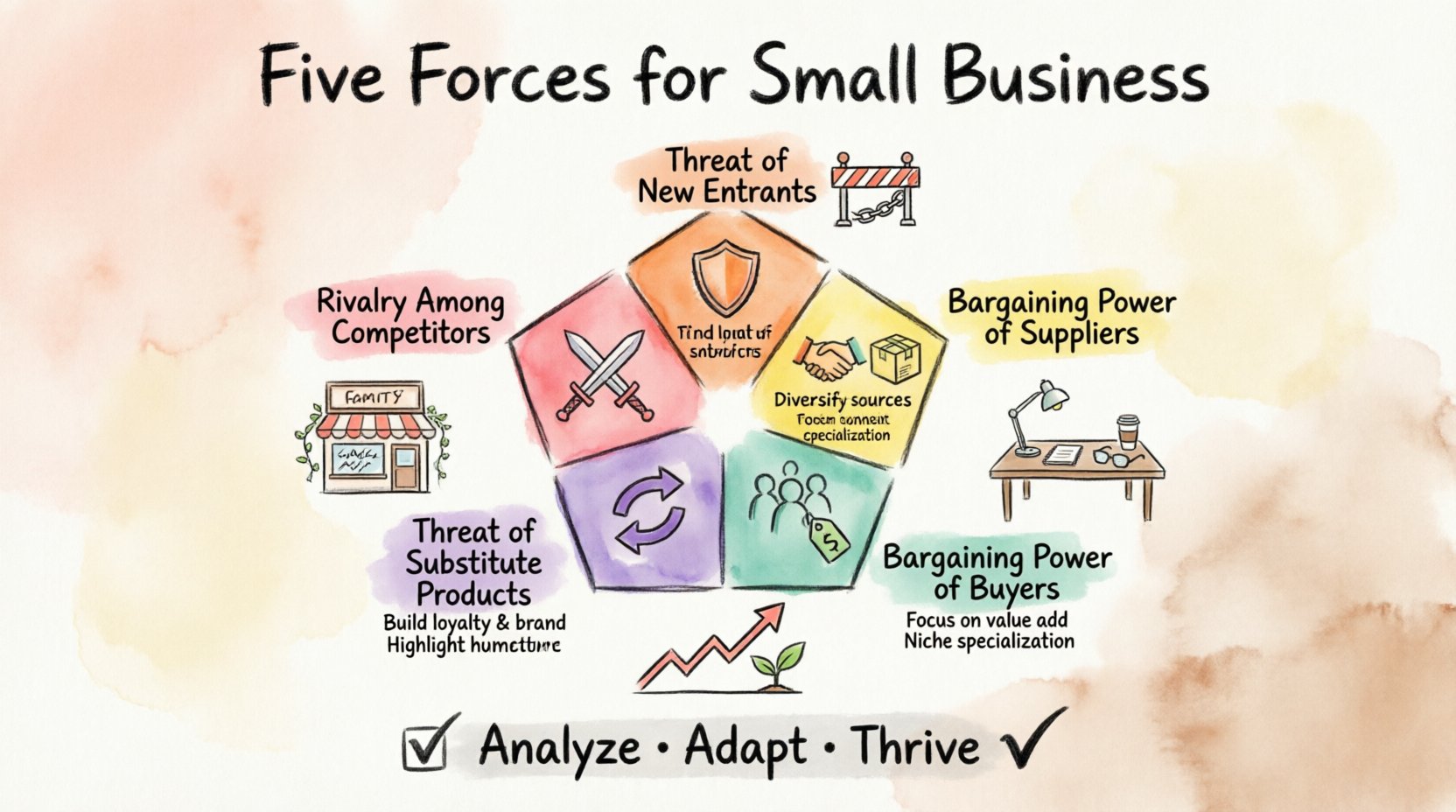
Myth 2: It Is Only for Large Corporations 🏢
Many small business owners and startups believe this framework is reserved for multinational enterprises with dedicated strategy teams. They assume the data requirements are too vast for smaller entities.
The Reality:
- Small teams often face more intense pressure from these forces.
- Startups need to understand supplier power to negotiate better terms.
- Entrepreneurs must assess the threat of substitutes to validate their value proposition.
Consider a startup entering the food delivery space. They face intense rivalry and high bargaining power from restaurants (suppliers). Without understanding these dynamics, they might burn capital on acquisition without a defensible position. The framework helps identify where value can be captured or protected.
Applying the Five Forces at a small scale requires less data but more creativity. You can use public reports, customer feedback, and industry news to gauge the forces. The depth of analysis should match the scale of the decision. A small bakery does not need a $50,000 consulting report. They need to know if the local coffee shops (substitutes) are lowering prices or if the cost of beans (suppliers) is rising.
Myth 3: It Predicts the Future Perfectly 🔮
Some users treat the output of a Five Forces analysis as a guaranteed prediction of industry profitability. They expect the model to tell them exactly which strategy will succeed.
The Reality:
- The model diagnoses the current structural environment.
- It does not account for internal capabilities or execution.
- External shocks (like pandemics or regulation changes) can override structural trends.
A strong strategic position in a profitable industry is still no guarantee of success. A company must have the operational excellence to execute. Conversely, a company in a tough industry can succeed through innovation or efficiency.
| Force | High Pressure Impact | Low Pressure Impact |
|---|---|---|
| New Entrants | Price wars, margin compression | Higher stability, pricing power |
| Supplier Power | Increased costs, reduced flexibility | Cost control, better terms |
| Buyer Power | Demand for lower prices, higher service | Pricing stability, loyalty |
| Substitutes | Price caps, demand erosion | Premium pricing possible |
| Rivalry | Marketing spend, feature wars | Cooperation, niche focus |
This table illustrates how pressure translates to financial outcomes. However, these outcomes are probabilistic, not deterministic. The model helps you understand the terrain, not the weather.
Myth 4: Rivalry is the Only Threat ⚔️
Many leaders focus almost exclusively on competitors. They track competitor pricing and marketing campaigns obsessively while ignoring the other four forces.
The Reality:
- Rivalry is often the symptom, not the cause.
- High rivalry often results from high barriers to exit or slow industry growth.
- Neglecting suppliers or buyers can destroy margins even if you beat competitors.
Consider the airline industry. Rivalry is fierce. However, the true pressure often comes from the bargaining power of customers (who can compare prices instantly) and the threat of substitutes (like high-speed rail or video conferencing for business travel).
By focusing only on rivals, a company might lower prices to win a bid, only to realize their suppliers have just raised costs by 20%. The net result is negative. A holistic view ensures that profitability is protected from all angles. You must manage relationships with suppliers and buyers as strategically as you manage competition.
Myth 5: It Replaces SWOT Analysis 🔄
Some strategists view the Five Forces and SWOT analysis as interchangeable tools. They assume one can substitute for the other to save time.
The Reality:
- Five Forces is external and industry-focused.
- SWOT includes internal strengths and weaknesses.
- Using only one leaves blind spots in your strategic view.
The Five Forces tells you if the industry is attractive. SWOT tells you if your organization can win in that industry. If the Five Forces analysis shows a profitable industry, but your SWOT reveals weak internal capabilities, you still cannot succeed.
Best practice involves using both. Start with Five Forces to select the battlefield. Then use SWOT to determine your resources for the fight. Relying on a single framework creates an incomplete picture of the strategic landscape.
Implementation: How to Apply Correctly 🛠️
Applying the framework correctly requires a disciplined approach. It is not enough to list the forces; you must quantify and qualify them.
Step 1: Define the Industry Boundaries
- What specific market are you analyzing?
- Is it the entire global market or a regional segment?
- Define the product category clearly.
A vague definition leads to vague insights. If you analyze the “beverage industry” instead of “premium sparkling water in Europe,” your data will be useless.
Step 2: Gather Data Points
- Financial reports of competitors.
- Customer surveys regarding price sensitivity.
- Regulatory filings regarding entry barriers.
- Supplier contracts and terms.
Do not rely on assumptions. Use available data to score the intensity of each force. High, Medium, or Low ratings help visualize the pressure.
Step 3: Identify Key Drivers
- What specifically drives supplier power? (Concentration, switching costs).
- What drives rivalry? (Fixed costs, product differentiation).
Understanding the drivers allows you to influence the forces. If switching costs drive buyer power, you can build features that increase those costs.
Step 4: Develop Strategic Responses
- How can you reduce the threat of entry? (Brand loyalty, patents).
- How can you neutralize buyer power? (Differentiation, contracts).
Strategy is about positioning. You can choose to compete on cost, on differentiation, or on focus. The Five Forces analysis informs which position is viable.
Common Pitfalls in Analysis ⚠️
Even experienced strategists make errors when applying this model. Being aware of these pitfalls prevents wasted effort.
- Ignoring Complementary Products: Often overlooked. A complementary product can increase the value of your offering. If the market for complements shrinks, your demand shrinks too.
- Overlooking Indirect Substitutes: You are not just competing with direct rivals. You are competing with the customer’s other options. For example, a movie theater competes with Netflix and streaming services, not just other cinemas.
- Static Data Usage: Using outdated financial reports. Market conditions change rapidly.
- Confusing Industry with Company: The model analyzes the industry. It does not account for specific company execution capabilities.
The Modern Context: Digital Disruption 💻
The digital age has altered the traditional dynamics of the Five Forces. Some forces have intensified, while others have diminished.
Threat of New Entrants
- Changed: Technology lowers physical barriers (cloud computing, open-source software).
- New Barrier: Network effects. Platforms like social media become harder to enter as they grow.
Bargaining Power of Buyers
- Changed: Information asymmetry has vanished. Customers know prices and features instantly.
- Result: Power has shifted significantly toward the buyer in many sectors.
Threat of Substitutes
- Changed: Substitutes are more agile. A digital solution can replace a physical product overnight.
- Result: Price caps are lower. Innovation must be continuous.
Final Thoughts on Strategic Clarity 🧭
Porter’s Five Forces remains a vital tool for understanding competitive dynamics. However, it is not a magic wand. It requires rigorous data collection and honest assessment.
By separating the myths from the facts, organizations can use the framework more effectively. It is not a static prediction, nor is it exclusive to large entities. It is a dynamic lens that, when combined with internal analysis, guides sound decision-making.
Strategic planning is an ongoing process. Revisit your analysis as market conditions shift. Do not treat the output as a final verdict. Treat it as a starting point for deeper inquiry. When applied with nuance and discipline, the Five Forces provide a clear view of where value exists and where risks lie.
Use this tool to inform your strategy, not to define your destiny. The future belongs to those who understand the terrain and adapt to the changes within it.
Key Takeaways 📝
- The framework analyzes industry structure, not company execution.
- Forces are dynamic and require regular updates.
- Applicability extends to startups and non-profits.
- Use alongside internal analysis tools like SWOT.
- Digital transformation has shifted power dynamics significantly.
Commit to regular strategic reviews. Ensure your team understands the underlying drivers of industry profitability. This foundation supports sustainable growth and resilience against market volatility.


Comments (0)