![Free eBooks of IT [BooksOfAll]](https://www.booksofall.com/wp-content/uploads/2022/06/booksofall-logo-2.png)
Tags:
Five Forces Model in Global Supply Chains
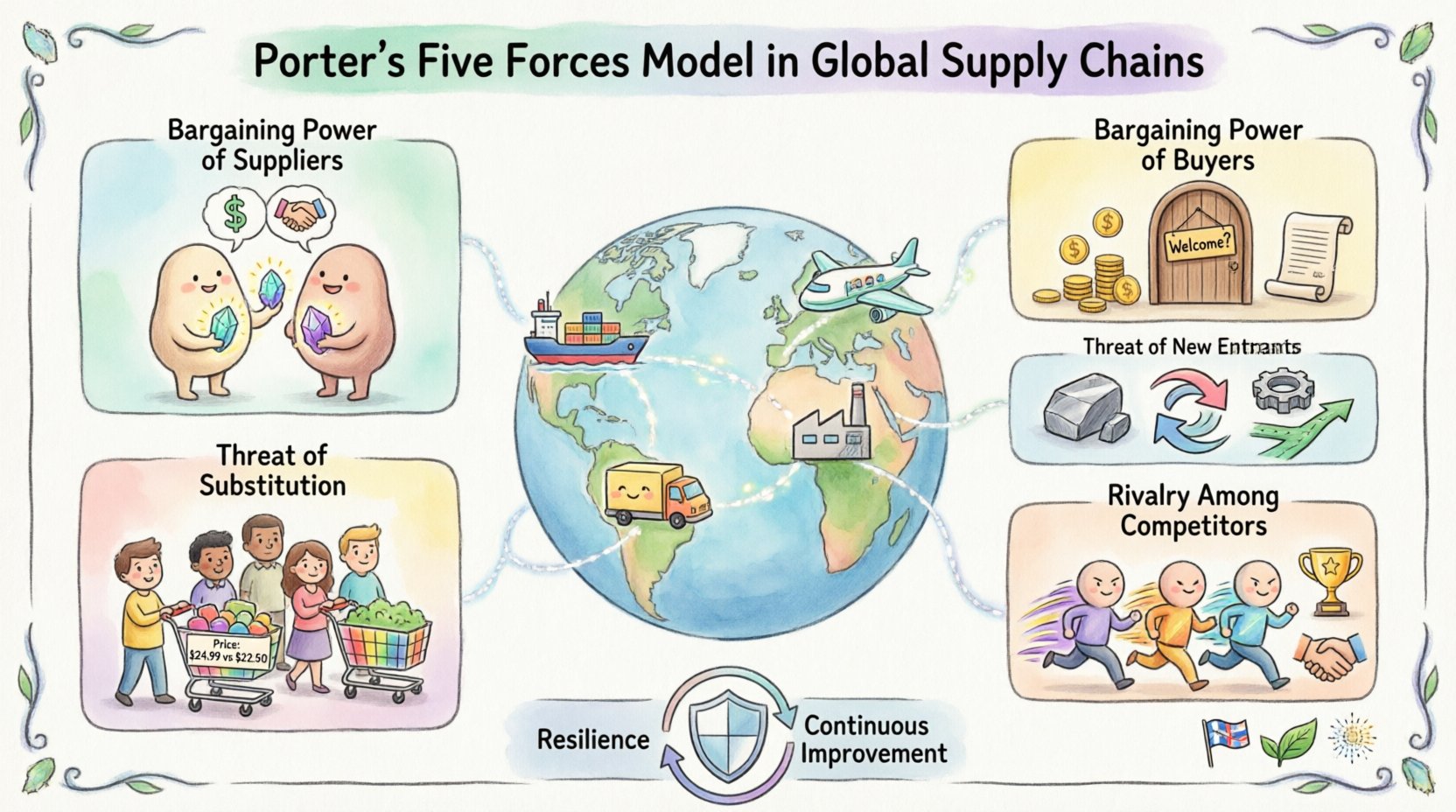
Understanding the competitive landscape is essential for any organization operating within complex international networks. The Five Forces Model, originally developed by Michael Porter, offers a robust framework for analyzing industry structure and profitability. When applied to global supply chains, this model reveals the underlying pressures that dictate margins, operational stability, and strategic positioning. This guide explores how each force influences procurement, logistics, and manufacturing decisions across borders.
Introduction to Strategic Analysis in Logistics 📊
Global supply chains are not merely linear pathways from raw material to finished product. They are intricate webs of relationships involving suppliers, manufacturers, logistics providers, distributors, and end customers. In this environment, profitability is often eroded not by internal inefficiencies, but by external pressures. The Five Forces Model provides a structured way to identify these pressures.
Applying this framework allows supply chain leaders to move beyond reactive management. It enables proactive strategy formulation based on the structural dynamics of the industry. By understanding the balance of power, organizations can negotiate better terms, invest in the right technologies, and mitigate risks before they materialize.
The analysis focuses on five distinct areas:
- 🔹 Threat of New Entrants: Barriers to entering the supply chain ecosystem.
- 🔹 Bargaining Power of Suppliers: Influence held by those providing raw materials or services.
- 🔹 Bargaining Power of Buyers: Leverage held by customers purchasing the final output.
- 🔹 Threat of Substitution: Availability of alternative solutions or materials.
- 🔹 Rivalry Among Existing Competitors: Intensity of competition within the sector.
1. Bargaining Power of Suppliers 🤝
Supplier power refers to the ability of upstream providers to dictate terms, prices, and quality. In global supply chains, this force is often amplified by geography, scarcity, and specialization.
Key Drivers of Supplier Power
- Concentration of Suppliers: When few companies control a specific resource, they hold significant leverage. For example, rare earth minerals are concentrated in specific regions, giving those producers pricing power.
- Switching Costs: If changing suppliers requires significant retooling, certification, or contract renegotiation, the buyer remains locked in. High switching costs increase supplier power.
- Uniqueness of Inputs: Proprietary technology or specialized components cannot be easily sourced elsewhere.
- Forward Integration: Suppliers may decide to manufacture the final product themselves, bypassing the buyer entirely.
Impact on Global Sourcing
Organizations must evaluate the concentration of their supplier base. Over-reliance on a single vendor in a volatile region creates risk. Diversification strategies, such as multi-sourcing or nearshoring, can reduce dependency.
Consider the semiconductor industry. A shortage in one region can halt production worldwide. Companies with strong supplier relationships and diversified sourcing networks maintain stability during disruptions. Those without such buffers face higher costs and delays.
| Factor | Low Supplier Power | High Supplier Power |
|---|---|---|
| Number of Suppliers | Many alternatives available | Few dominant players |
| Standardization | Commodity-like inputs | Specialized or proprietary inputs |
| Switching Costs | Low cost to change vendors | High cost to change vendors |
| Information Availability | Market prices are transparent | Information is opaque or controlled |
2. Bargaining Power of Buyers 👥
Buyer power determines how much pressure customers can exert on a company to lower prices or improve quality. In a global market, buyers are increasingly informed and demanding.
Key Drivers of Buyer Power
- Volume of Purchases: Large buyers who purchase significant portions of a supplier’s output can demand discounts.
- Price Sensitivity: If the product is undifferentiated, buyers will switch based on price alone.
- Threat of Backward Integration: Customers may decide to manufacture the product themselves rather than buy it.
- Access to Information: Buyers with access to global market data can negotiate more effectively.
Strategic Responses
To mitigate buyer power, companies focus on differentiation. Creating value through speed, reliability, or customization reduces the likelihood of price-based switching.
Logistics providers face high buyer power when shipping rates are transparent. Customers can compare freight costs instantly across carriers. In this scenario, value-added services like real-time tracking, customs brokerage, and warehousing become critical differentiators.
Organizations must also consider the fragmentation of their buyer base. If a company sells to thousands of small retailers, its power is higher than if it sells to a single large chain. Concentration of the customer base directly correlates with buyer leverage.
3. Threat of New Entrants 🚪
The threat of new entrants describes how easy it is for competitors to enter the market. High barriers to entry protect existing players, while low barriers invite competition.
Barriers to Entry in Supply Chains
- Capital Requirements: Establishing a global logistics network requires significant investment in infrastructure, vehicles, and technology.
- Regulatory Compliance: International trade involves complex customs, tariffs, and safety regulations. Navigating these requires expertise.
- Economies of Scale: Incumbents often benefit from lower costs due to volume. New entrants struggle to match these prices initially.
- Brand Reputation: Trust is crucial in supply chains. New players must build credibility over time.
Disruptive Technologies
Technology can lower barriers. Digital freight platforms allow smaller players to aggregate demand and access capacity without owning assets. This shifts the power dynamic, allowing agile startups to challenge established carriers.
However, regulatory hurdles remain high. Data privacy laws, environmental standards, and cross-border trade agreements create friction. Companies must invest in compliance capabilities to enter new markets.
4. Threat of Substitution 🔄
Substitution refers to the ability of customers to switch to a different product or service that fulfills the same need. In supply chains, this can mean alternative materials or alternative logistics methods.
Types of Substitution
- Material Substitution: Using synthetic materials instead of natural ones to avoid scarcity or price volatility.
- Process Substitution: 3D printing components locally instead of importing them from overseas.
- Route Substitution: Shifting from ocean freight to air freight for speed, or vice versa for cost.
- Service Substitution: Using internal warehousing instead of third-party logistics providers.
Strategic Implications
Organizations must monitor innovation closely. A new material or manufacturing process can render an existing supply chain obsolete. For example, the rise of renewable energy sources reduces the long-term demand for fossil fuel logistics.
Flexibility is key. Supply chains designed around a single technology or material are vulnerable. Modular designs and adaptable processes allow companies to pivot when substitution threats emerge.
5. Rivalry Among Existing Competitors ⚔️
Competitive rivalry encompasses the intensity of competition among current players. High rivalry leads to price wars, increased marketing spend, and reduced margins.
Factors Influencing Rivalry
- Number of Competitors: A market with many players of similar size tends to have higher rivalry.
- Industry Growth: Slow growth forces companies to fight for market share. Fast growth allows everyone to expand.
- Fixed Costs: High fixed costs pressure companies to fill capacity, often leading to price cutting.
- Exit Barriers: If it is hard to leave the industry, companies stay and compete aggressively rather than exit.
Global Dynamics
In global logistics, rivalry is intense. Major carriers compete on price, speed, and network coverage. Capacity imbalances can lead to volatile pricing spikes.
Collaboration is sometimes necessary to manage rivalry. Consortiums allow competitors to share certain infrastructure while competing on service. This reduces fixed costs and stabilizes the market.
Integrating the Model into Strategy 🛠️
Analysis is useless without action. Integrating the Five Forces into strategic planning requires specific steps.
- Regular Review: Market conditions change. Review the analysis annually or when significant disruptions occur.
- Data Collection: Gather data on supplier concentration, competitor pricing, and buyer trends.
- Scenario Planning: Model how changes in one force affect the others. For example, if supplier power rises, how does that affect buyer power?
- Stakeholder Alignment: Ensure procurement, operations, and finance teams understand the strategic implications.
Modern Challenges in the Global Context 🌐
Traditional models face new variables in the current era. Geopolitical tensions, sustainability mandates, and digitalization alter the forces.
Geopolitics and Trade Wars
Tariffs and trade restrictions act as new barriers to entry. They also increase supplier power for domestic producers in protected markets. Companies must map trade policies to understand cost implications.
Sustainability and ESG
Environmental standards are becoming barriers to entry. Suppliers who cannot meet carbon reduction targets may be excluded. This shifts power to green technology providers.
Digital Transformation
Data transparency reduces information asymmetry. Buyers can see supplier costs more easily. This increases buyer power but also allows efficient suppliers to prove value through data.
Case Analysis: Electronics Manufacturing 📱
Consider the electronics sector. The Five Forces reveal specific dynamics:
- Supplier Power: High. Chip manufacturers are few. Raw material scarcity drives prices.
- Buyer Power: Moderate to High. Consumers choose based on brand and specs, but large retailers also demand volume discounts.
- Threat of Entry: Low. Capital requirements for R&D and manufacturing are massive.
- Threat of Substitution: Moderate. Software can extend hardware life, reducing replacement frequency.
- Rivalry: High. Innovation cycles are short. Price competition is constant.
Strategies here involve securing long-term supply contracts and investing in proprietary technology to reduce substitutability.
Case Analysis: Pharmaceutical Supply Chain 💊
The pharmaceutical industry presents a different profile:
- Supplier Power: High for active ingredients. Few suppliers produce specific chemical compounds.
- Buyer Power: Moderate. Hospitals and insurers negotiate, but patient need creates inelasticity.
- Threat of Entry: Very Low. Regulatory approval takes years and costs billions.
- Threat of Substitution: Moderate. Generic alternatives exist once patents expire.
- Rivalry: Moderate. Differentiated by patents and brand reputation.
Strategies focus on securing intellectual property and ensuring robust distribution networks to prevent stockouts.
Evaluating Risk and Resilience 🛡️
Resilience is a critical outcome of Five Forces analysis. It involves anticipating where pressure points exist.
- Concentration Risk: Identify where single points of failure exist in the network.
- Financial Risk: Assess how price volatility impacts margins.
- Operational Risk: Evaluate dependency on specific routes or partners.
Building resilience requires redundancy. While redundancy increases cost, it provides insurance against disruption. The goal is to find the optimal balance between efficiency and stability.
Continuous Improvement and Adaptation 📈
Supply chains are dynamic. What holds true today may change tomorrow. Continuous monitoring is essential.
- Monitor Market Signals: Watch for changes in raw material prices, labor costs, and regulatory shifts.
- Engage Partners: Share insights with suppliers and customers to anticipate shifts.
- Invest in Analytics: Use data to forecast trends rather than reacting to them.
Organizations that treat strategic analysis as a one-time exercise will fall behind. Those that embed it into their culture maintain agility.
Conclusion on Strategic Positioning 🎯
The Five Forces Model remains a vital tool for navigating the complexities of global supply chains. It provides clarity on where power lies and where vulnerabilities exist. By systematically analyzing supplier power, buyer power, entry barriers, substitution threats, and competitive rivalry, organizations can make informed decisions.
Success in this environment depends on understanding these forces and adapting strategies accordingly. Whether through diversification, differentiation, or collaboration, the goal is to secure a favorable position. The landscape will continue to evolve, but the framework provides a stable foundation for decision-making.
Implementing these insights requires discipline and ongoing attention. Leaders must remain vigilant and willing to adjust as market conditions shift. The result is a supply chain that is not only efficient but also resilient and competitive in the long term.


Comments (0)