![Free eBooks of IT [BooksOfAll]](https://www.booksofall.com/wp-content/uploads/2022/06/booksofall-logo-2.png)
Tags:
Five Forces Model in the Age of AI and Automation
Porter’s Five Forces framework has long served as the cornerstone of strategic analysis. It provides a structured method for evaluating the competitive intensity and attractiveness of a market. However, the rapid integration of artificial intelligence and automation technologies is fundamentally altering the dynamics of these forces. Businesses can no longer rely on static models designed for a pre-digital economy. The introduction of machine learning, robotic process automation, and generative AI introduces new variables that shift power balances between rivals, suppliers, buyers, and potential entrants.
This guide explores how artificial intelligence redefines each of the five competitive forces. It offers a deep dive into the implications for strategic planning without relying on specific software products. The goal is to provide a clear understanding of how automation changes the landscape of industry competition.
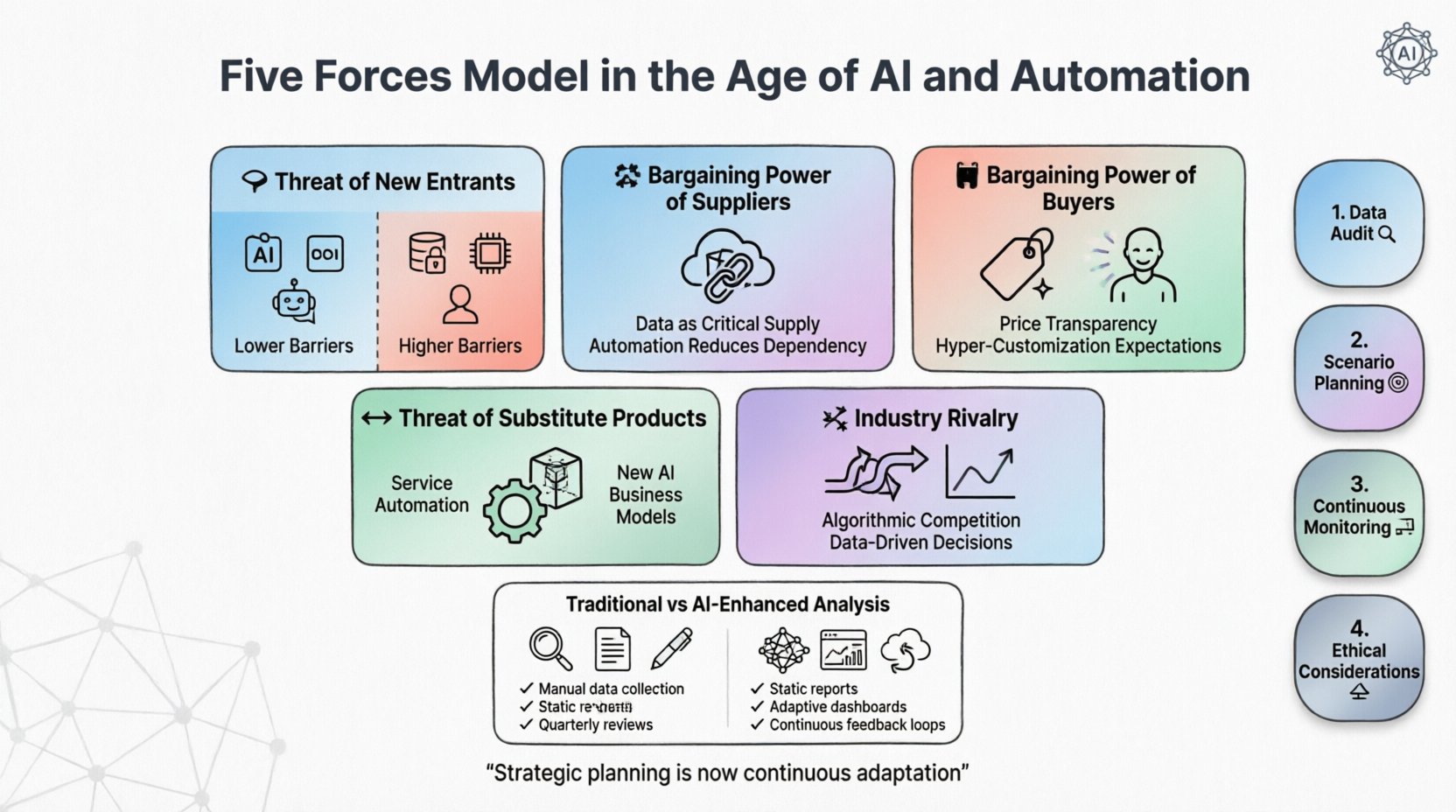
1. Threat of New Entrants 🚪
The threat of new entrants refers to the ease with which competitors can enter the market. Historically, high capital requirements, regulatory barriers, and established distribution channels protected incumbents. AI and automation are disrupting these traditional moats in two distinct ways: lowering entry barriers for some, while raising them for others.
Lowering Barriers to Entry
Certain technologies reduce the cost and time required to launch a venture. This can increase the threat of new entrants significantly.
- Marketing and Content: Generative AI tools allow new players to create high-quality marketing copy, images, and video assets at a fraction of the traditional cost. This reduces the capital needed for brand building.
- Software Development: Low-code and no-code platforms, powered by AI assistants, enable non-technical founders to build functional applications. This diminishes the technical barrier to entry for software-based services.
- Customer Service: Automated chatbots and virtual assistants can handle initial customer inquiries without the need for large support teams. This allows smaller firms to scale service operations instantly.
Raising Barriers to Entry
Conversely, the need for data and compute power can create new, insurmountable barriers for newcomers.
- Data Moats: Successful AI models require vast amounts of historical data to train effectively. Incumbents with decades of transaction history hold a significant advantage over startups.
- Computational Infrastructure: Training large-scale models requires expensive hardware and energy. This creates a capital-intensive hurdle that was not present in previous industrial eras.
- Talent Scarcity: The demand for specialized data scientists and AI engineers exceeds supply. Established companies often have the resources to attract top talent, leaving new entrants at a disadvantage.
Strategic Implication
Incumbents must focus on accumulating and securing proprietary data. New entrants should look for niche markets where data accumulation is slow or where the incumbent’s existing data is irrelevant. The analysis of entry threats must now account for the cost of data acquisition and compute resources, not just physical assets.
2. Bargaining Power of Suppliers ⚙️
Supplier power refers to the ability of vendors to drive up prices or reduce the quality of goods and services. In the context of AI, the definition of a supplier expands beyond raw materials to include data providers, cloud infrastructure, and algorithmic models.
Data as a Critical Supply
Data is the fuel for AI systems. The concentration of data among a few major platforms increases their bargaining power.
- Concentration Risk: If a company relies on a single cloud provider for storage and processing, that provider can dictate pricing and terms.
- Proprietary Data: Suppliers that own unique datasets can charge premium licensing fees. This shifts power from the buyer to the data owner.
Automation of Supply Chains
Automation tools allow companies to optimize their own supply chains, potentially reducing reliance on external suppliers.
- Predictive Logistics: AI-driven inventory management reduces the need for just-in-time ordering, allowing firms to hold more stock and switch suppliers more easily.
- Alternative Sourcing: Algorithms can scan global markets to find alternative materials or services faster than human procurement teams, reducing dependency on any single vendor.
Strategic Implication
Companies must diversify their technology stack to avoid vendor lock-in. Relying on a single ecosystem for AI capabilities creates vulnerability. Negotiating contracts must include clauses regarding data ownership and portability to ensure that the supplier does not gain leverage over the buyer’s intellectual property.
3. Bargaining Power of Buyers 🛒
Buyer power is the pressure customers can exert on businesses to lower prices or improve quality. AI significantly enhances buyer power through information asymmetry reduction and hyper-personalization.
Price Transparency and Comparison
Automation tools allow buyers to compare prices and features across competitors instantly.
- Automated Price Scrubbing: Algorithms can monitor competitor pricing in real-time and alert buyers to better deals. This forces companies to compete more aggressively on price.
- Review Aggregation: AI tools aggregate reviews and sentiment analysis from multiple sources, giving buyers a comprehensive view of product reliability before purchase.
Personalization Expectations
Buyers now expect products tailored to their specific needs. This raises the cost for companies to retain customers.
- Hyper-Customization: AI enables the mass production of personalized experiences. If a competitor offers a better tailored solution, the buyer can switch with minimal friction.
- Dynamic Pricing: Buyers can use AI to predict when prices will drop, timing their purchases to maximize value.
Strategic Implication
Businesses must move beyond transactional relationships. Creating high switching costs through deep integration and unique value propositions is essential. Companies that fail to leverage AI for personalization risk losing customers to competitors who can offer a more relevant experience.
4. Threat of Substitute Products 🔄
Substitutes are products from outside the industry that satisfy the same need. AI creates new categories of substitutes that can render entire business models obsolete.
Automation Replacing Labor
One of the most significant threats is the replacement of human services with automated systems.
- Service Automation: Tasks previously performed by human consultants or analysts can now be handled by AI models, offering lower costs and 24/7 availability.
- Digital Twins: In manufacturing, digital simulations can replace physical testing, reducing the need for physical prototypes and associated suppliers.
New Business Models
AI enables business models that bypass traditional intermediaries.
- Direct-to-Consumer AI: Companies can offer AI-driven advice directly to consumers, bypassing traditional service channels like agents or brokers.
- Platform Substitution: Integrated platforms can offer end-to-end solutions, replacing the need for multiple specialized vendors in a workflow.
Strategic Implication
Organizations must constantly scan the horizon for non-traditional competitors. The threat is not just from companies selling similar goods, but from technologies that solve the same problem in a fundamentally different way. Diversification of revenue streams helps mitigate the risk of a single substitute rendering a core service obsolete.
5. Industry Rivalry ⚔️
Industry rivalry describes the intensity of competition among existing firms. AI accelerates the pace of innovation and competition, often leading to more aggressive market dynamics.
Algorithmic Competition
Competition is no longer just about human strategy; it is also about algorithmic speed.
- Dynamic Pricing: Competitors using AI to adjust prices in real-time can trigger price wars that erode margins for all players in the industry.
- Speed to Market: AI accelerates product development cycles. Firms that can iterate and deploy features faster gain a temporary advantage.
Data-Driven Decision Making
Companies with better data insights can outmaneuver rivals in marketing, operations, and customer acquisition.
- Predictive Analytics: Firms that can predict market shifts before competitors can allocate resources more effectively.
- Customer Churn Prediction: Identifying at-risk customers and intervening automatically reduces the effectiveness of competitor acquisition campaigns.
Strategic Implication
Collaboration may become more vital than competition in certain areas. Companies might form alliances to share data standards or safety protocols, even while competing in the market. Focusing on unique value that cannot be easily automated is the best defense against intense rivalry.
Comparative Analysis: Traditional vs. AI-Enhanced
To visualize the shift in dynamics, consider the following comparison of how each force is analyzed in a traditional setting versus an AI-driven environment.
| Force | Traditional Analysis Focus | AI & Automation Focus |
|---|---|---|
| New Entrants | Capital requirements, physical assets | Data access, compute power, talent |
| Suppliers | Raw material scarcity, logistics | Cloud dependency, data licensing, model access |
| Buyers | Volume of purchase, switching costs | Personalization needs, price transparency tools |
| Substitutes | Alternative products, functional equivalents | Service automation, digital disruption |
| Rivalry | Price wars, marketing spend | Algorithmic pricing, speed of innovation, data advantage |
Implementing the Analysis
Conducting a Five Forces analysis in the age of AI requires a shift in methodology. It is not enough to look at current market share; one must look at the flow of information and the speed of execution.
Step 1: Data Audit
Before analyzing the forces, assess the organization’s data maturity. Where is the data stored? Is it accessible? Is it clean? The quality of the data determines the quality of the strategic insights derived from AI tools.
Step 2: Scenario Planning
Use simulation models to test different scenarios. How would the industry react if a major competitor automated their entire supply chain? How would customer churn rates change if a new AI-driven substitute entered the market? These hypotheticals help prepare for potential shifts.
Step 3: Continuous Monitoring
Static analysis is insufficient. The landscape changes monthly. Set up automated dashboards to track competitor activity, pricing changes, and technology adoption rates. This allows the strategy to evolve in real-time.
Step 4: Ethical Considerations
Strategic planning must include an assessment of ethical risks. Bias in algorithms, privacy concerns, and labor displacement can damage brand reputation and invite regulatory scrutiny. These factors can become new competitive advantages for companies that prioritize trust and transparency.
Future Outlook
The integration of AI and automation is not a temporary trend; it is a permanent restructuring of economic fundamentals. The Five Forces model remains valid, but the variables within it have changed. Companies that treat AI as a strategic lever rather than just a cost-saving tool will define the future of their industries.
Success will depend on the ability to adapt quickly. The organizations that thrive will be those that understand the new rules of engagement. They will focus on building resilient data infrastructures, fostering agile cultures, and maintaining ethical standards. The competitive landscape is shifting from a war of attrition to a race of intelligence. Those who can process information faster and act with greater precision will hold the advantage.
Strategic planning is no longer a periodic exercise. It is a continuous process of adaptation. By applying the Five Forces framework with a modern lens, leaders can navigate the complexities of the digital age with clarity and confidence.


Comments (0)