![Free eBooks of IT [BooksOfAll]](https://www.booksofall.com/wp-content/uploads/2022/06/booksofall-logo-2.png)
Tags:
Five Forces Model for Local Retail Businesses
Running a local retail business involves navigating a complex web of market pressures. While big chains often have dedicated strategy teams, independent store owners must understand their competitive landscape without external consultants. The Five Forces Model, originally developed by Michael Porter, offers a structured way to assess industry attractiveness and profitability. This framework helps local retailers understand the intensity of competition and the strength of their position.
Applying this model to a local setting provides clarity on where leverage exists and where vulnerabilities lie. Whether you operate a boutique, a hardware store, or a grocery outlet, the dynamics of supply, demand, and competition define your success. This guide breaks down each force with specific relevance to neighborhood commerce, helping you build a resilient business model.
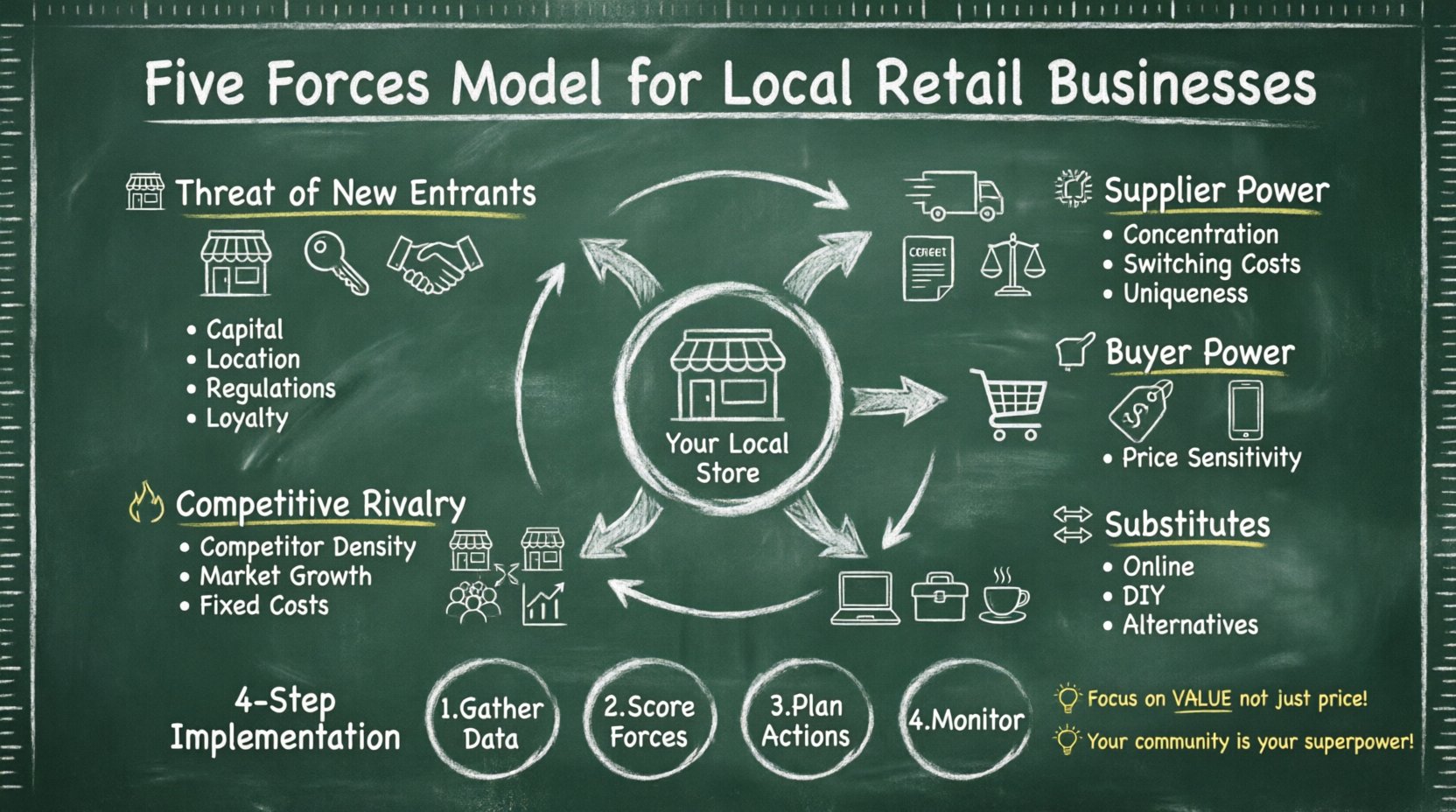
Why Local Retail Needs Strategic Analysis 🧠
Local commerce faces unique challenges compared to national franchises. Foot traffic, community relationships, and immediate proximity to customers are assets, but they also come with constraints. A lack of formal strategy often leads to reactive decision-making, such as cutting prices in response to a new competitor without understanding the root cause.
Using the Five Forces framework allows you to:
- Identify Threats Early: Spot changes in supplier relationships or new entrants before they impact margins.
- Understand Pricing Power: Know when you can raise prices based on value rather than fear of losing customers.
- Optimize Inventory: Align stock with what buyers actually want, not just what suppliers push.
- Strengthen Loyalty: Build defenses against substitutes by enhancing the customer experience.
1. Threat of New Entrants 🚧
This force examines how easy it is for a competitor to start a business that serves the same local market. In local retail, barriers to entry can be surprisingly low, but they also vary significantly by sector.
Barriers in the Local Context
For a small bookstore, the barrier is primarily capital for rent and inventory. For a specialized auto repair shop, it is the technical skill and equipment required. Understanding these barriers helps you gauge how quickly you might lose market share.
- Capital Requirements: Opening a physical storefront requires significant upfront investment. High costs can deter casual competitors.
- Location Scarcity: Prime spots in town centers or busy strips are limited. Securing a lease in a high-traffic area creates a natural moat.
- Regulatory Hurdles: Zoning laws, health permits, and licensing can slow down new entrants.
- Customer Loyalty: Established relationships with neighbors create a psychological barrier. People prefer buying from someone they trust.
Strategic Implications
If the threat of new entrants is high, you must focus on differentiation. You cannot compete solely on price against a new store with lower overhead. Instead, you build a brand that feels essential to the community. Deepen your local connections through events, sponsorships, and personalized service.
2. Bargaining Power of Suppliers ⚖️
Your suppliers control the cost and quality of your inventory. In local retail, you often rely on wholesalers, distributors, or local manufacturers. If a supplier becomes too dominant, they can squeeze your profit margins.
Indicators of High Supplier Power
Consider the following factors to determine how much leverage your suppliers hold:
- Concentration: Are there many vendors, or just one or two that dominate the local market?
- Switching Costs: Is it difficult or expensive to change suppliers? Do you need specific certifications or equipment?
- Uniqueness of Product: Are you selling a generic item available everywhere, or a unique local craft?
- Forward Integration: Could the supplier decide to sell directly to consumers, bypassing your store?
Managing Supplier Relationships
To reduce dependency, diversify your supply chain. Do not rely on a single vendor for your core products. Negotiate volume discounts if possible, even in smaller quantities, by committing to longer contracts.
Key Actions:
- Build personal relationships with account managers at supplier companies.
- Join buying groups or cooperatives to pool purchasing power with other local retailers.
- Keep an eye on alternative sourcing options, including direct-from-manufacturer channels.
3. Bargaining Power of Buyers 🛒
Buyers are your customers. Their power lies in their ability to drive prices down, demand higher quality, or switch to competitors easily. In the local retail space, buyer power is often high because the market is frequently saturated with similar options.
Factors Increasing Buyer Power
- Price Sensitivity: In a tight economy, customers compare prices across multiple stores before purchasing.
- Availability of Information: Customers can check prices online while standing in your aisle. Transparency reduces your ability to markup prices arbitrarily.
- Lack of Differentiation: If your products look and feel the same as the store next door, customers will choose based on convenience or price.
- Switching Costs: If it is easy for a customer to leave your store for another, they will.
Reducing Buyer Leverage
You cannot change the market dynamics, but you can change the customer experience. When buyers feel a connection to your store, they become less price-sensitive.
- Personalization: Remember names and preferences. Offer recommendations based on past purchases.
- Exclusive Products: Stock items that are not available at big-box retailers or online giants.
- Value-Added Services: Offer gift wrapping, delivery, or installation services that competitors do not provide.
- Community Engagement: Host workshops or local events that make the store a destination rather than just a transaction point.
4. Threat of Substitute Products or Services 🔄
Substitutes are not just competitors in the same aisle. They are alternative ways to solve the same problem. For a local hardware store, the substitute is not just another hardware store, but the option to do it yourself, hire a contractor, or buy online.
Common Substitutes in Local Retail
| Retail Category | Direct Competitor | Substitute Solution |
|---|---|---|
| Local Coffee Shop | Another cafe down the street | Brewing at home, office machine, energy drinks |
| Grocery Store | Supermarket chain | Meal kits, grocery delivery apps, eating out |
| Bookstore | Another bookstore | E-readers, library, audiobooks |
| Hardware Store | Big box retailer | DIY tutorials, hiring contractors, rental tools |
Strategic Response
When substitutes are prevalent, convenience becomes king. Local businesses have a distinct advantage in immediacy. If a customer needs a part today, they will drive to you rather than wait for shipping.
- Emphasize Speed: Market your ability to provide immediate solutions.
- Bundle Services: Combine products with advice or installation to make the substitute less attractive.
- Educate: Show customers why the substitute might fail for their specific situation.
5. Competitive Rivalry 🔥
This is the intensity of competition among existing firms. In local retail, rivalry can be fierce due to proximity. Competitors are often just a few blocks away, fighting for the same pool of customers.
Drivers of High Rivalry
- Number of Competitors: A high density of similar stores increases pressure.
- Industry Growth: If the market is stagnant, you must take share from others to grow. If it is growing, you can all expand.
- Fixed Costs: High overheads (rent, utilities) force businesses to cut prices to maintain cash flow.
- Exit Barriers: If it is hard to close the business (leases, specialized equipment), companies stay in the market and fight longer than is profitable.
Strategies to Stand Out
Engaging in a price war is rarely a winning strategy for local retail. It erodes margins for everyone. Focus on non-price competition.
- Niche Specialization: Become the go-to expert for a specific category within your sector.
- Customer Service: Train staff to be knowledgeable and helpful. Service is a differentiator big chains often struggle to match.
- Loyalty Programs: Implement a rewards system that incentivizes repeat business.
- Visual Merchandising: Keep the store inviting and organized. A pleasant environment encourages browsing and buying.
Implementing the Analysis 📊
Once you have analyzed each force, you need to translate those insights into action. The goal is not just to understand the landscape, but to position your business for long-term viability.
Step 1: Gather Data
Collect information on your suppliers, competitors, and customers. Talk to your staff about what customers ask for. Observe where your competitors are placing their products. Check local business licenses to see who is new in the area.
Step 2: Score the Forces
Rate each force as High, Medium, or Low threat. For example, if you have a unique supplier, their power might be Medium. If there are five other coffee shops within a mile, rivalry is High.
Step 3: Develop Countermeasures
Create a plan for each High threat. If buyer power is high, launch a loyalty program. If new entrants are likely, secure your prime location with a long-term lease. If substitutes are strong, improve your in-store experience.
Step 4: Monitor Regularly
Markets change. A new shopping center might open nearby, or a supplier might go out of business. Review this analysis annually or whenever a significant market shift occurs.
Common Pitfalls to Avoid ⚠️
When applying this framework, local business owners often make mistakes that reduce the value of the exercise.
- Ignoring Online Competition: Even if you are a physical store, online retailers are part of your substitute threat. Do not ignore the digital landscape.
- Focusing Only on Price: Competing on price attracts customers who will leave for a lower price elsewhere. Focus on value.
- Overlooking Staff: Your employees are part of your defense against substitutes. They deliver the service that keeps people coming back.
- Static Analysis: The forces are not static. A supplier might raise prices, or a competitor might close. The analysis must be dynamic.
Conclusion 🏁
The Five Forces Model provides a clear lens through which to view the challenges of local retail. By systematically evaluating the threat of new entrants, supplier power, buyer power, substitutes, and rivalry, you gain a comprehensive understanding of your business environment.
This understanding empowers you to make informed decisions about pricing, inventory, marketing, and customer service. It shifts your focus from reacting to problems to anticipating them. In a competitive market, preparation is the most valuable asset you can possess.
Use this framework to build a strategy that leverages your local strengths. Your community is your foundation, and understanding the forces around it ensures that foundation remains solid for years to come.


Comments (0)