![Free eBooks of IT [BooksOfAll]](https://www.booksofall.com/wp-content/uploads/2022/06/booksofall-logo-2.png)
Tags:
Five Forces Model: Building a Sustainable Competitive Advantage
Understanding the structural dynamics of an industry is fundamental to strategic planning. For decades, business leaders and analysts have relied on a specific framework to assess profitability and potential risk. This framework is the Five Forces Model. Developed by Michael Porter in 1979, it offers a structured approach to analyzing the competitive environment in which a company operates.
Building a sustainable competitive advantage requires more than just a great product. It demands a clear view of the forces shaping the industry. By evaluating these pressures, organizations can position themselves more effectively against rivals, suppliers, and customers. This guide explores how to apply this model to secure a stronger market position.
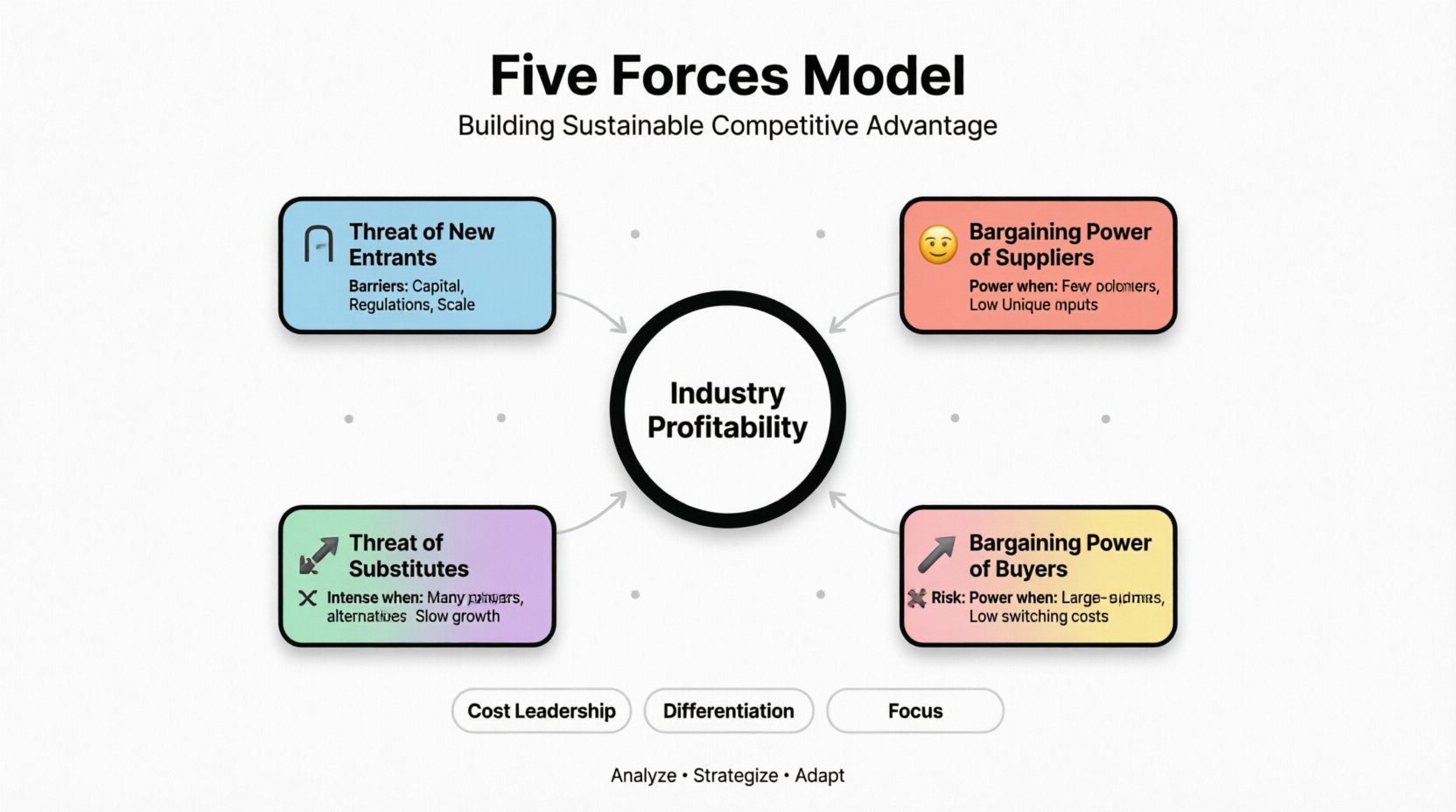
1. Understanding the Framework 🧭
The core premise of this model is that the profitability of an industry is determined by five fundamental competitive forces. These forces dictate how the value created in an industry is divided between the players. If the forces are intense, profitability tends to be lower. If they are weak, profitability tends to be higher.
Many strategic decisions fail because they ignore the external environment. A company might innovate perfectly but fail to account for new entrants or changing buyer expectations. This analysis provides a holistic view of the industry structure.
Why It Matters
- Identifies Profitability Drivers: It reveals where the pressure on margins comes from.
- Guides Resource Allocation: Helps decide where to invest for maximum return.
- Anticipates Changes: Allows planning for shifts in the competitive landscape.
- Supports Decision Making: Provides data for entering or exiting markets.
2. The Five Forces Explained 📊
To utilize this tool effectively, one must understand each force individually and how they interact. The following table provides a quick overview of the forces and their primary impact.
| Force | Primary Impact | Key Question |
|---|---|---|
| Threat of New Entrants | Price Competition | How easy is it for others to enter? |
| Bargaining Power of Suppliers | Cost Increases | Can suppliers raise prices easily? |
| Bargaining Power of Buyers | Price Reductions | Can customers demand lower prices? |
| Threat of Substitute Products | Price Ceiling | Are there alternatives available? |
| Rivalry Among Existing Competitors | Profit Erosion | How intense is the competition? |
2.1 Threat of New Entrants 🚪
This force measures the ease with which new competitors can enter the market. If entry barriers are low, new players can quickly capture market share and drive down prices. High barriers protect existing companies and maintain profitability.
Barriers to entry can take several forms:
- Capital Requirements: Does the industry require massive investment in machinery or infrastructure?
- Regulatory Hurdles: Are there licenses or legal restrictions that limit entry?
- Switching Costs: How difficult is it for customers to switch from an incumbent to a new entrant?
- Access to Distribution: Can new players get their products to shelves or online channels effectively?
- Economies of Scale: Do existing players benefit from lower costs due to high volume?
When analyzing this force, look for trends that might lower these barriers. For instance, technology advancements often reduce the capital needed to start a business in certain sectors. If the threat is high, a strategy might involve building stronger customer loyalty or increasing switching costs.
2.2 Bargaining Power of Suppliers 💼
Suppliers exert power when they can raise prices or reduce the quality of goods and services. This pressure directly impacts the company’s cost structure. If suppliers are powerful, they can capture more of the industry value.
Supplier power is typically high under these conditions:
- Few Suppliers: The industry is concentrated among a small number of providers.
- Unique Products: The input is specialized or differentiated, with no close substitutes.
- High Switching Costs: Changing suppliers requires significant time or money.
- Critical Input: The supplied item is a major component of the final product.
- Threat of Integration: Suppliers might threaten to enter the buyer’s industry.
Companies can mitigate supplier power by diversifying their supply base, creating backward integration, or standardizing components to make switching easier.
2.3 Bargaining Power of Buyers 🛒
Buyers exert power when they can demand lower prices or higher quality. This force is the counterpart to supplier power. Strong buyers can squeeze profitability by forcing prices down.
Buyer power increases when:
- Large Purchase Volumes: Buyers purchase a significant portion of the industry’s output.
- Limited Differentiation: Products are commoditized and easily compared.
- Low Switching Costs: Buyers can move to competitors without penalty.
- Price Sensitivity: The product represents a significant portion of the buyer’s costs.
- Threat of Backward Integration: Buyers might threaten to produce the product themselves.
To counter this, businesses focus on differentiation. If a product offers unique value, buyers have less leverage to negotiate price. Building strong brands and customer service relationships also reduces buyer power.
2.4 Threat of Substitute Products 🔄
Substitutes are products from outside the industry that satisfy the same need. They place a ceiling on prices. If the price of the industry’s product rises too high, customers will switch to the alternative.
Consider the difference between a substitute and a competitor. A competitor sells a similar product within the industry. A substitute solves the problem differently. For example, video conferencing software is a substitute for business travel, not a direct competitor to airlines.
Factors increasing the threat of substitutes include:
- Price-Performance Ratio: Substitutes offer better value.
- Switching Incentives: Customers have little reason to stay with the current solution.
- Trends: Social or technological shifts favor the alternative.
Managing this risk involves continuous innovation. If the core product becomes obsolete due to a substitute, the company must evolve to remain relevant.
2.5 Rivalry Among Existing Competitors ⚔️
This force represents the intensity of competition among current players. High rivalry leads to price wars, advertising battles, and increased innovation costs, all of which reduce industry profitability.
Rivalry is intense when:
- Many Competitors: The market is fragmented or has major players.
- Slow Industry Growth: Companies fight for market share rather than growing the pie.
- High Fixed Costs: Companies need to fill capacity to cover costs.
- Homogeneous Products: Products are similar, making price the main differentiator.
- High Exit Barriers: Companies stay in the market even when unprofitable, creating excess supply.
Strategies to reduce rivalry include focusing on niche segments, forming alliances, or differentiating through service and quality.
3. Strategic Implementation 🛠️
Conducting the analysis is only the first step. The true value lies in applying the insights to build a competitive advantage. There are three generic strategies that align with the findings of the Five Forces.
Cost Leadership
If the analysis shows that supplier power and buyer power are high, cost leadership becomes a priority. The goal is to become the lowest-cost producer. This provides a buffer against price pressures. Cost advantages can come from economies of scale, proprietary technology, or access to exclusive materials.
Differentiation
When the threat of substitutes is high or buyer power is strong, differentiation is key. This involves creating a product that customers perceive as unique. This could be through design, brand image, technology, or customer service. Differentiation reduces price sensitivity and weakens the bargaining power of buyers.
Focus
This strategy targets a specific segment of the market. By focusing on a niche, a company can better understand the specific needs of that group. This allows for higher efficiency and stronger relationships within that segment, often reducing the intensity of direct rivalry.
4. Limitations and Modern Adaptations 🌐
While powerful, the model is not without limitations. It was designed in an era of manufacturing dominance. In the modern digital economy, some dynamics have shifted.
- Network Effects: In tech industries, value increases as more people use a product. This can create monopolies that the model does not fully capture.
- Complementors: Porter later acknowledged the role of complementors (companies that make the product more valuable, like app developers for a phone). These are not explicitly in the original five forces.
- Static Snapshot: The model is often a snapshot in time. Industries change rapidly, requiring continuous analysis.
- Interdependence: The forces do not exist in isolation. A change in one force often triggers changes in others.
To adapt, analysts should view the Five Forces as a starting point rather than a complete rulebook. Integrating insights about ecosystem dynamics and platform economics adds necessary context.
5. Frequently Asked Questions ❓
Common questions arise when organizations attempt to apply this framework. Addressing these helps clarify the process.
How often should I re-evaluate the forces?
Strategic analysis is not a one-time task. Market conditions shift due to technology, regulation, and consumer behavior. A comprehensive review should happen annually or whenever a significant market disruption occurs.
Can small businesses use this model?
Absolutely. Small businesses often face specific pressures regarding supplier power or buyer concentration. Understanding these forces helps them negotiate better or find niches where larger competitors are less agile.
Does this replace financial analysis?
No. Financial analysis looks at historical and current performance. This model looks at structural drivers of future profitability. They should be used together for a complete picture.
What if the forces are all strong?
This indicates a low-profitability industry. The strategic choice might be to exit the market, acquire a competitor, or fundamentally change the business model to alter the industry structure.
6. Steps to Conduct the Analysis 📝
Executing the analysis requires a systematic approach. Follow these steps to ensure accuracy and actionable insights.
- Define the Industry: Be specific. Are you analyzing the coffee industry or the specialty coffee market? The scope determines the boundaries.
- Gather Data: Collect information on market size, growth rates, concentration ratios, and cost structures. Use public reports, financial statements, and interviews.
- Evaluate Each Force: Score each force from low to high. Document the reasoning behind each assessment.
- Identify Key Drivers: Determine which specific factors are driving the intensity of each force.
- Assess Profitability: Synthesize the findings to estimate the long-term profitability of the industry.
- Formulate Strategy: Align your strategic goals with the insights derived from the analysis.
Data integrity is crucial during this process. Relying on assumptions without evidence can lead to flawed strategies. Cross-verify information from multiple sources to ensure reliability.
7. Conclusion on Application ✅
Building a sustainable competitive advantage is a continuous effort. The Five Forces Model provides the map for navigating the terrain of industry competition. By understanding the pressures from entrants, suppliers, buyers, substitutes, and rivals, leaders can make informed decisions.
Success comes from adapting to these forces rather than fighting them blindly. Whether through cost control, differentiation, or focus, the goal is to position the organization where the forces are weakest or where the company can influence them favorably. Regular review and adaptation ensure the strategy remains relevant as the business landscape evolves.


Comments (0)