![Free eBooks of IT [BooksOfAll]](https://www.booksofall.com/wp-content/uploads/2022/06/booksofall-logo-2.png)
Tags:
Five Forces Model: Lessons from Failed Business Strategies
Business strategy often feels like navigating a ship through fog. Leaders make decisions based on vision, data, and intuition. However, the most critical factor in survival is understanding the competitive landscape. This is where the Five Forces Model comes into play. Developed by Michael Porter, this framework provides a structured way to analyze the intensity of competition within an industry. Yet, knowing the model is not enough. The real value lies in applying it correctly to avoid the pitfalls that have sunk major corporations.
Many strategic failures stem from a static view of the market. Companies look at current competitors and ignore the forces that could dismantle their business model overnight. By examining historical failures through the lens of Porter’s framework, we can identify specific warning signs. This guide explores the mechanics of the model and extracts actionable lessons from businesses that underestimated their environment.
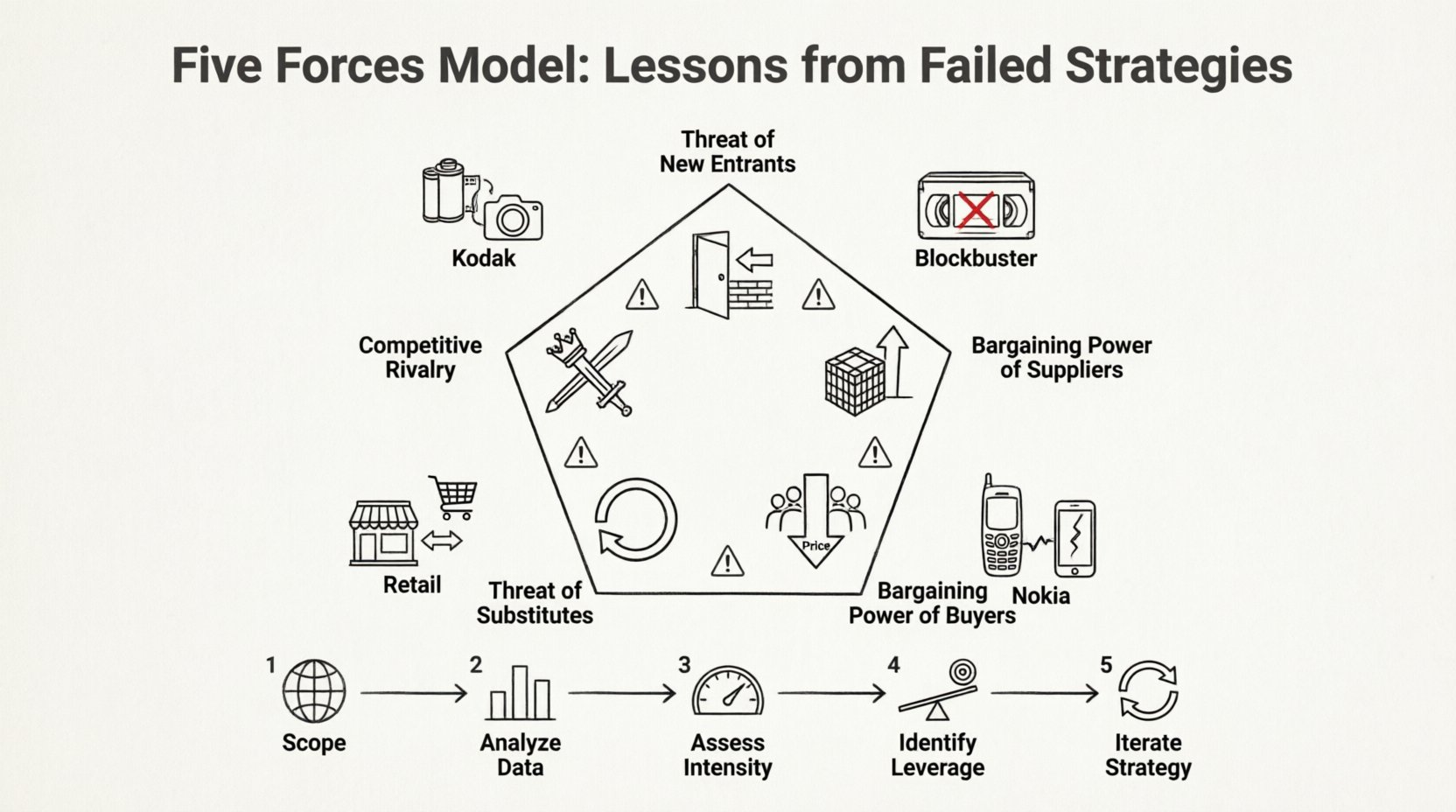
🔍 Understanding the Five Forces Framework 🔍
The Five Forces Model evaluates the profitability and attractiveness of an industry. It moves beyond simple competitor analysis to look at the broader economic structure. If these forces are strong, profits are usually squeezed. If they are weak, there is room for healthy returns. Understanding each force helps strategists anticipate shifts before they happen.
1. Threat of New Entrants ⚖️
This force measures how easy it is for new competitors to enter the market. High barriers to entry protect existing players. Low barriers invite disruption. Barriers include capital requirements, regulatory hurdles, access to distribution channels, and proprietary technology.
- High Barrier: Heavy capital investment is needed, or patents protect the technology.
- Low Barrier: Minimal startup costs, easy access to supply chains, or open platforms.
When companies assume their position is secure without barriers, they leave themselves open to agile startups. A failure here often involves complacency about technology shifts that lower entry costs.
2. Bargaining Power of Suppliers 📦
Suppliers can drive up prices or reduce quality if they hold leverage. This power increases when there are few suppliers, unique products, or high switching costs for the buyer.
- Supplier Concentration: If a few companies control the raw materials, they dictate terms.
- Switching Costs: If changing suppliers requires expensive retooling, the buyer is trapped.
- Threat of Integration: If a supplier can start making the product themselves, they become a competitor.
Strategic failure occurs when a business relies on a single source without a backup plan. Supply chain shocks often reveal this vulnerability.
3. Bargaining Power of Buyers 👥
Buyers exert pressure when they can force prices down or demand higher quality. Power grows when buyers are concentrated, products are commoditized, or price sensitivity is high.
- Volume Purchasing: Large buyers can negotiate better terms due to scale.
- Product Differentiation: If the product is unique, buyer power is low. If it is a commodity, buyer power is high.
- Information Access: Modern consumers have instant access to price comparisons, increasing their leverage.
Companies fail when they ignore the shifting power dynamics of their customers. Relying on loyal customers who eventually find cheaper alternatives is a common mistake.
4. Threat of Substitutes 🔄
Substitutes are products from outside the industry that solve the same problem. A coffee shop competes not just with other cafes, but with tea, energy drinks, and home brewing.
- Price-Performance Ratio: If a substitute is cheaper and good enough, demand shifts.
- Switching Cost: How much effort does the customer need to make to switch?
- Perceived Value: Does the customer view the substitute as a viable option?
This is often the most dangerous force. It is not about direct competition, but about obsolescence. Businesses that define themselves too narrowly miss the threat of a different solution entirely.
5. Competitive Rivalry ⚔️
This looks at the intensity of competition among existing firms. It is high when there are many equally balanced competitors, slow industry growth, or high fixed costs.
- Number of Competitors: More competitors usually mean more aggressive tactics.
- Industry Growth: In a stagnant market, fighting for market share becomes a zero-sum game.
- Exit Barriers: If it is expensive to leave the industry, companies stay and fight, driving prices down.
Rivalry leads to price wars. When margins are thin, any disruption can cause financial distress. Strategic differentiation is the only defense here.
💀 Lessons from Failed Business Strategies 💀
Theoretical knowledge means little without practical application. History provides clear examples of companies that ignored these forces. Below are specific instances where the failure to analyze the competitive landscape led to decline.
Case Study 1: The Decline of Blockbuster 🎬
Blockbuster is a classic example of misjudging the Threat of New Entrants and Substitutes.
- The Blind Spot: They focused on physical stores and late fees, ignoring the shift to digital delivery.
- New Entrants: Netflix entered with a mail-order model, then streaming. The barrier to entry for media distribution dropped significantly.
- Substitutes: Cable on-demand and eventually peer-to-peer file sharing offered alternatives.
- The Result: Blockbuster failed to adapt its cost structure and value proposition. They underestimated how much convenience mattered to buyers.
Case Study 2: Kodak and Digital Photography 📷
Kodak invented the digital camera but failed to capitalize on it, focusing on their film business.
- Threat of Substitutes: Digital sensors replaced film. The core need (capturing memories) remained, but the method changed.
- Competitive Rivalry: New entrants from the electronics industry (Sony, Canon) entered the photography space.
- Supplier Power: Kodak relied on chemical suppliers for film, not chip manufacturers for sensors.
- The Result: They protected a dying revenue stream while letting the new market grow around them. They viewed themselves as a film company, not a memory company.
Case Study 3: Traditional Retail vs. E-Commerce 🛒
Many brick-and-mortar retailers struggled against online giants.
- Bargaining Power of Buyers: Online shoppers can compare prices instantly. Physical stores had less price transparency.
- Threat of New Entrants: E-commerce platforms lowered the cost of opening a store globally.
- Competitive Rivalry: Online players had lower overhead costs, allowing them to price lower.
- The Result: Retailers who did not integrate digital channels lost market share. Those who tried to copy the model without fixing their cost structures struggled.
Case Study 4: Nokia in the Smartphone Era 📱
Nokia dominated the phone market but lost to the iPhone and Android.
- Competitive Rivalry: They focused on hardware durability rather than the software ecosystem.
- Threat of Substitutes: Smartphones replaced feature phones as the primary communication device.
- Supplier Power: The app ecosystem became the product. Nokia did not control the developer network.
- The Result: Hardware quality mattered less than user experience and app availability. They misread the force of ecosystem competition.
📊 Comparison of Failure Indicators by Force 📊
To make these lessons clearer, we can categorize common failure signs against each force.
| Force | Warning Sign of Failure | Strategic Response |
|---|---|---|
| Threat of New Entrants | Stagnant innovation; reliance on legacy infrastructure | Build moats through IP or network effects |
| Supplier Power | Single-source dependency; rising input costs | Diversify supply chain; vertical integration |
| Buyer Power | Price sensitivity increasing; low switching costs | Enhance brand loyalty; increase switching costs |
| Threat of Substitutes | Market demand shifting to non-industry solutions | Innovate within the ecosystem; pivot offerings |
| Competitive Rivalry | Price wars; shrinking margins; commoditization | Focus on differentiation; niche targeting |
🛠️ How to Apply the Model Effectively 🛠️
Conducting the analysis is a process that requires rigor. It is not a one-time exercise. Markets evolve, and forces shift. Here is a structured approach to using the model.
Step 1: Define the Industry Scope 🌍
Be precise about what constitutes your industry. If you are a car manufacturer, are you competing with other car makers, ride-sharing services, or public transit? Broadening the scope reveals hidden threats.
Step 2: Gather Data on Each Force 📝
Collect information on market share, supplier concentration, and customer satisfaction. Look for trends over time, not just current snapshots. Use financial reports, industry publications, and customer feedback.
Step 3: Assess the Intensity 📉
Rate each force as High, Medium, or Low. Be honest. If you feel the competition is intense, do not downplay it. High intensity means lower profitability.
Step 4: Identify Strategic Levers 🎯
Once you know the forces, determine where you can act. Can you reduce supplier power? Can you increase switching costs for buyers? Can you create barriers for new entrants?
Step 5: Monitor Continuously 🔄
Set up a system to review the analysis regularly. Quarterly or bi-annually, check if the forces have changed. Technology changes fast; a low barrier today might be high tomorrow, or vice versa.
⚠️ Common Pitfalls in Strategic Analysis ⚠️
Even with the right framework, errors occur. These mistakes can lead to flawed strategies that mirror the failures of the companies mentioned earlier.
- Static Analysis: Treating the market as unchanging. Technology and consumer behavior evolve rapidly.
- Internal Bias: Assuming your company is better than it is. Focusing on internal strengths while ignoring external threats.
- Ignoring Complements: Sometimes products that work together drive value. Ignoring complementary goods can miss a key revenue stream.
- Over-reliance on History: Past success does not guarantee future performance. The conditions that worked five years ago may not work today.
- Confirmation Bias: Seeking data that supports your existing plan rather than challenging it. If the data says the market is shrinking, acknowledge it.
🔄 Adapting to Dynamic Markets 🔄
The modern business environment is volatile. The Five Forces Model remains useful, but it must be adapted. In the past, industries changed slowly. Now, disruption happens in months.
Integrating Digital Disruption
Digital transformation affects all five forces. It lowers entry barriers for new competitors. It gives buyers more power through information. It creates new substitutes. A strategic plan must account for the digital layer.
Focus on Ecosystems
Value is increasingly created in ecosystems rather than single products. A company might lose on hardware but win on services. Analyze the entire value chain, not just the transaction.
Agility in Strategy
Strategy should be a hypothesis, not a decree. Test assumptions. If a force changes, adjust the strategy. Rigid adherence to a plan that no longer fits the market is a path to failure.
🏁 Final Thoughts on Strategic Resilience 🏁
Business survival depends on accurate perception. The Five Forces Model offers a lens to see the competitive landscape clearly. It highlights where pressure is coming from and where opportunities exist.
Failed strategies often share a common thread: a refusal to see the changing reality. Companies that survived did so by acknowledging the forces and adapting. They did not wait for the market to crash; they positioned themselves before the crash happened.
When analyzing your own business, ask hard questions. Is your supplier power too high? Is your buyer too powerful? Are new entrants knocking at the door? Answering these questions honestly is the first step toward building a resilient strategy.
Use this framework not to predict the future with certainty, but to prepare for multiple scenarios. The goal is not to eliminate risk, but to understand it. By doing so, you reduce the likelihood of falling victim to the same mistakes that have shaped the history of business.


Comments (0)