![Free eBooks of IT [BooksOfAll]](https://www.booksofall.com/wp-content/uploads/2022/06/booksofall-logo-2.png)
Tags:
Five Forces Model: Predicting Market Trends and Shifts
Understanding the competitive dynamics of an industry is fundamental to strategic planning. Since Michael Porter introduced his framework in 1979, organizations have relied on the Five Forces Model to gauge profitability and intensity. This analysis provides a structured approach to evaluating the external factors that influence an industry’s structure. By examining the competitive landscape, businesses can anticipate changes and position themselves for sustainable growth.
The model does not merely describe the current state of competition. It serves as a diagnostic tool for identifying where power lies within a market. When applied correctly, it reveals how value is created and captured. This guide explores the mechanics of the framework, the nuances of each force, and how they signal broader market trends.
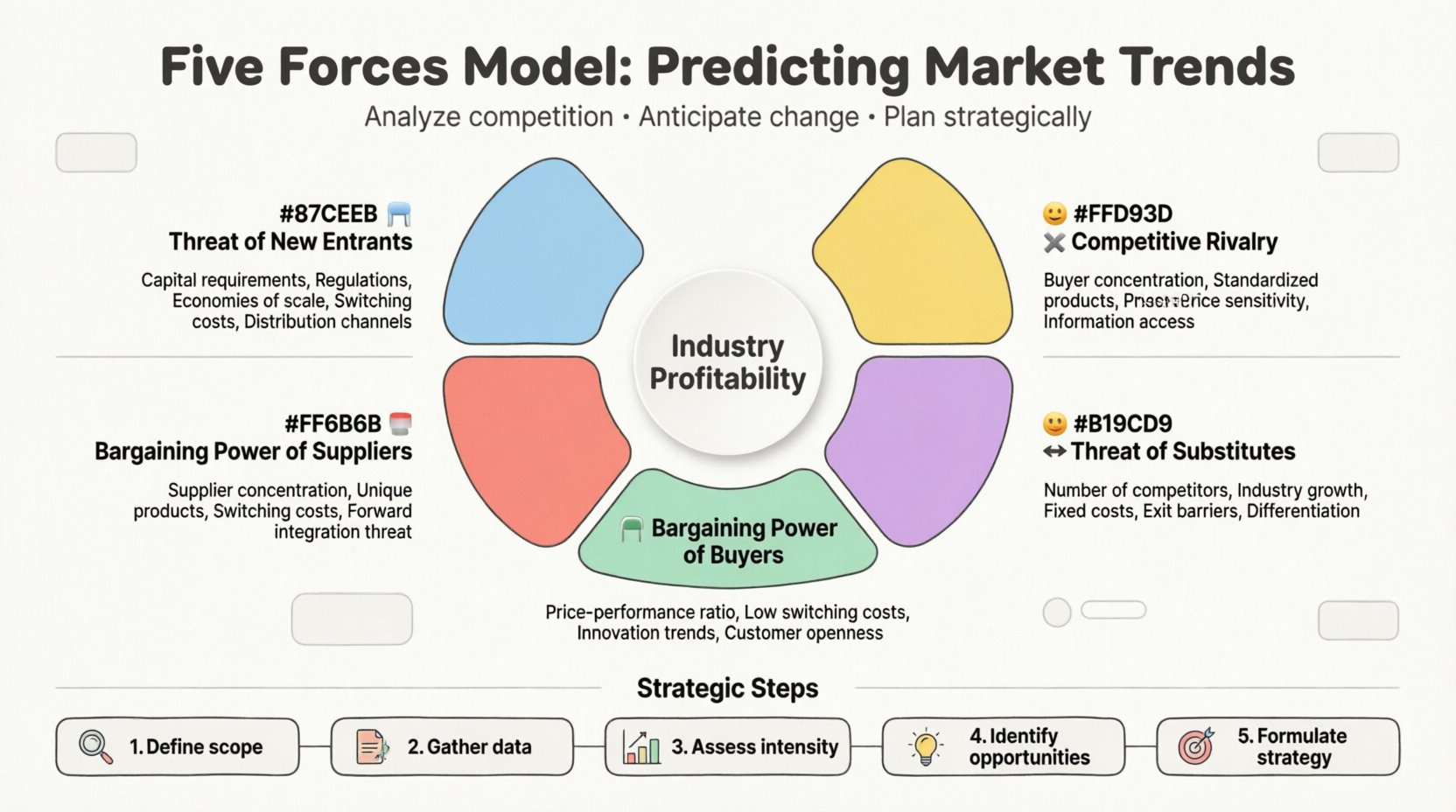
Understanding the Framework 🧩
The Five Forces Model assesses the attractiveness of an industry. Attractiveness here refers to the potential for long-term profitability. An industry is considered unattractive if the forces are strong, compressing margins and limiting returns. Conversely, an attractive industry allows participants to protect their profits against competitive pressures.
The framework consists of five specific elements:
- Threat of New Entrants: The ease with which new competitors can enter the market.
- Bargaining Power of Suppliers: The influence suppliers have over pricing and terms.
- Bargaining Power of Buyers: The leverage customers possess to drive prices down.
- Threat of Substitute Products: The availability of alternative solutions to the core offering.
- Rivalry Among Existing Competitors: The intensity of competition between current players.
These forces work together to determine the overall competitive environment. A change in one force often impacts the others. For instance, a reduction in barriers to entry may increase rivalry among existing firms.
Force 1: Threat of New Entrants 🚪
The threat of new entrants depends on the barriers to entry. High barriers protect existing companies from new competition. Low barriers invite aggressive competition, which drives down prices and profits.
Key Barriers to Entry
- Capital Requirements: Industries requiring significant investment in plant, equipment, or R&D are harder to enter.
- Regulatory Policies: Government licenses, patents, and compliance standards can restrict access.
- Economies of Scale: Established players often have cost advantages due to volume, making it difficult for smaller entrants to compete on price.
- Switching Costs: If customers face high costs to switch from an incumbent to a new vendor, entry is harder.
- Distribution Channels: Securing access to effective distribution networks can be a significant hurdle.
Implications for Market Trends
When barriers to entry decrease, the market becomes more volatile. This often happens when technology reduces the need for physical infrastructure. For example, cloud computing lowered the cost of entry for software companies. This shift forces incumbents to innovate faster or face displacement.
Conversely, if regulations tighten or capital requirements rise, the threat of new entrants diminishes. This stability allows existing firms to focus on optimization rather than defensive strategies.
Force 2: Bargaining Power of Suppliers 🏭
Suppliers exert power by raising prices or reducing the quality of goods and services. When supplier power is high, it squeezes the margins of the industry participants. When supplier power is low, it allows companies to negotiate better terms.
Factors Influencing Supplier Power
- Supplier Concentration: A market dominated by a few suppliers gives them leverage over buyers.
- Uniqueness of Product: If a supplier offers a differentiated or patented product, buyers have fewer alternatives.
- Switching Costs: High costs to switch suppliers increase the supplier’s power.
- Threat of Forward Integration: If a supplier can easily enter the buyer’s industry, they hold significant leverage.
- Importance of Volume: If the supplier’s business is highly dependent on the buyer’s volume, the buyer gains power.
Market Shift Indicators
Consolidation among suppliers is a clear signal of increasing power. When multiple small suppliers merge, the remaining entities gain pricing control. This often leads to industry-wide cost increases.
Additionally, the development of substitute inputs can reduce supplier power. If a buyer can source a similar material from a different sector, the original supplier loses leverage. Monitoring supply chain dynamics is crucial for predicting cost pressures.
Force 3: Bargaining Power of Buyers 🛒
Buyers exert power by demanding lower prices or higher quality. When buyer power is high, companies must compete aggressively to retain customers. This force is particularly relevant in markets where products are commoditized.
Drivers of Buyer Power
- Concentration of Buyers: A few large buyers purchasing a significant portion of the industry’s output hold more power.
- Standardized Products: If products are identical across providers, buyers switch based on price alone.
- Price Sensitivity: If the cost of the product is a large portion of the buyer’s budget, they will scrutinize prices closely.
- Availability of Information: Access to transparent pricing data empowers buyers to negotiate effectively.
- Threat of Backward Integration: If buyers can produce the product themselves, they threaten to bypass the supplier.
Impact on Pricing Strategy
High buyer power forces companies to differentiate their offerings. Value-added services, customization, or brand loyalty become essential to justify premium pricing. In industries where buyer power is low, firms can maintain stable pricing even during economic downturns.
Transparency in the digital age has generally increased buyer power. Customers can compare options instantly. This trend requires businesses to invest heavily in customer experience and relationship management.
Force 4: Threat of Substitute Products 🔄
Substitutes are products from different industries that satisfy the same customer need. They place a ceiling on the prices an industry can charge. If prices rise too high, customers will switch to a substitute.
Identifying Substitutes
Substitutes are not always direct competitors. A video conferencing tool is a substitute for business travel. A streaming service is a substitute for cable television. Identifying these requires looking at the underlying need rather than the product category.
Key Drivers of Substitution
- Price-Performance Ratio: If a substitute offers better value, adoption increases.
- Switching Costs: Low switching costs facilitate adoption of substitutes.
- Buyer Propensity to Substitute: Some customer segments are more open to trying new solutions than others.
- Innovation Trends: Technological advancements often create entirely new categories that replace old ones.
Strategic Implications
Industries facing high substitution threats must innovate continuously. Complacency leads to obsolescence. Companies should monitor emerging technologies that address the same pain points.
For example, the rise of digital photography threatened film manufacturers. The threat was not from a new film camera, but from a completely different technology. Recognizing these cross-industry threats is vital for long-term survival.
Force 5: Competitive Rivalry Among Existing Competitors ⚔️
Rivalry is the most visible of the five forces. It manifests in price wars, advertising battles, and new product introductions. High rivalry reduces profitability for all participants in the industry.
Conditions Increasing Rivalry
| Factor | Impact on Rivalry |
|---|---|
| Number of Competitors | More competitors often mean more intense rivalry. |
| Industry Growth Rate | Slow growth leads to fighting for market share. |
| Fixed Costs | High fixed costs encourage price cutting to fill capacity. |
| Exit Barriers | High exit barriers trap struggling firms in the market. |
| Differentiation | Lack of differentiation leads to price competition. |
Navigating Competitive Intensity
When rivalry is high, companies often focus on cost leadership or differentiation. Cost leadership involves achieving the lowest production costs to offer lower prices. Differentiation involves creating unique value that justifies a premium.
Strategic alliances can also mitigate rivalry. While competitors may collaborate on non-core activities like research, they remain rivals in the market. This balance is delicate and requires careful management.
Analyzing Market Trends Through the Forces 📈
The Five Forces Model is not static. The forces evolve over time, reflecting changes in technology, regulation, and consumer behavior. By tracking shifts in these forces, analysts can predict market trends before they become obvious.
Signal Detection
- Technological Disruption: New tech often lowers barriers to entry and increases substitution threats.
- Regulatory Changes: New laws can alter supplier power or create new barriers.
- Consumer Behavior: Shifts in values can increase buyer power or reduce demand for certain products.
- Globalization: Access to global markets can change the concentration of buyers and suppliers.
Scenario Planning
Organizations can use the model to run scenarios. For example, what happens if a major supplier exits the market? What if a new regulation restricts pricing? These hypothetical exercises help prepare for potential shifts.
Regular reassessment is necessary. A market analysis done five years ago may no longer reflect current conditions. Continuous monitoring ensures strategies remain relevant.
Strategic Implementation Steps 🛠️
Applying the Five Forces Model requires a structured approach. It involves data collection, analysis, and strategic formulation. The following steps outline the process.
1. Define the Industry Scope
Clearly define the boundaries of the industry. Is it the broader category or a specific niche? The scope determines which competitors and substitutes are relevant.
2. Gather Data
Collect information on each force. This includes market share data, supplier contracts, customer feedback, and technological trends. Primary research and secondary research both contribute to the picture.
3. Assess Intensity
Evaluate the strength of each force. Is it high, medium, or low? Consider the factors discussed in the previous sections. Be objective and avoid assumptions.
4. Identify Opportunities and Threats
Map the findings to strategic opportunities. High buyer power might suggest a need for loyalty programs. High supplier power might suggest a need for vertical integration.
5. Formulate Strategy
Develop actions based on the assessment. This could involve cost reduction, product differentiation, or market expansion. The goal is to position the organization favorably against the forces.
Limitations and Considerations ⚖️
While powerful, the Five Forces Model has limitations. It is primarily static and focuses on industry structure rather than internal capabilities. It may not fully capture the dynamics of platform economies or network effects.
Modern Context Challenges
- Network Effects: In digital markets, the value of a service increases with the number of users. This dynamic is not fully explained by traditional forces.
- Commoditization of Innovation: Rapid innovation cycles mean competitive advantages are short-lived.
- Ecosystem Competition: Companies often compete through ecosystems rather than single products.
Despite these limitations, the framework remains a foundational tool. It should be used in conjunction with other strategic models to provide a holistic view.
Conclusion on Strategic Utility 🎯
The Five Forces Model offers a disciplined way to analyze the external environment. It moves decision-making beyond intuition and into structured analysis. By understanding the forces at play, organizations can anticipate shifts and adapt their strategies accordingly.
Market trends are not random. They are the result of underlying structural changes. Identifying these changes early allows for proactive rather than reactive management. Regular application of the model keeps leaders informed about the health of their competitive landscape.
Success in business depends on understanding where value is created. This framework highlights the mechanisms that distribute that value. Whether entering a new market or defending an existing position, the insights provided are invaluable for long-term planning.
Strategic planning is an ongoing process. As forces shift, strategies must evolve. The framework provides the lens through which these changes can be viewed and understood. Keeping this perspective ensures resilience in a changing world.


Comments (0)