![Free eBooks of IT [BooksOfAll]](https://www.booksofall.com/wp-content/uploads/2022/06/booksofall-logo-2.png)
Tags:
Five Forces Analysis for Niche Markets and Startups
Navigating the business landscape as a new entrant requires more than just a great idea. It demands a rigorous understanding of the competitive environment. For startups and niche market players, the traditional strategic frameworks often need adaptation. The Five Forces model, originally developed by Michael Porter, offers a structured way to analyze industry attractiveness. However, applying this model to a niche or early-stage venture involves specific nuances regarding resource constraints, market size, and agility.
This guide provides a deep dive into adapting the Five Forces framework specifically for startups operating in specialized markets. We will explore how to identify vulnerabilities, leverage strengths, and construct a defensible position without relying on generic advice. By understanding the underlying dynamics of rivalry, suppliers, buyers, entrants, and substitutes, founders can make informed decisions that align with long-term viability.
🧩 Understanding the Framework in a Startup Context
The Five Forces framework evaluates the intensity of competition and profitability within an industry. For a large corporation, the analysis might focus on global market share and supply chain dominance. For a startup, the focus shifts to survival, cash flow, and customer acquisition costs. Niche markets add another layer of complexity because the total addressable market is smaller, meaning every customer interaction carries higher weight.
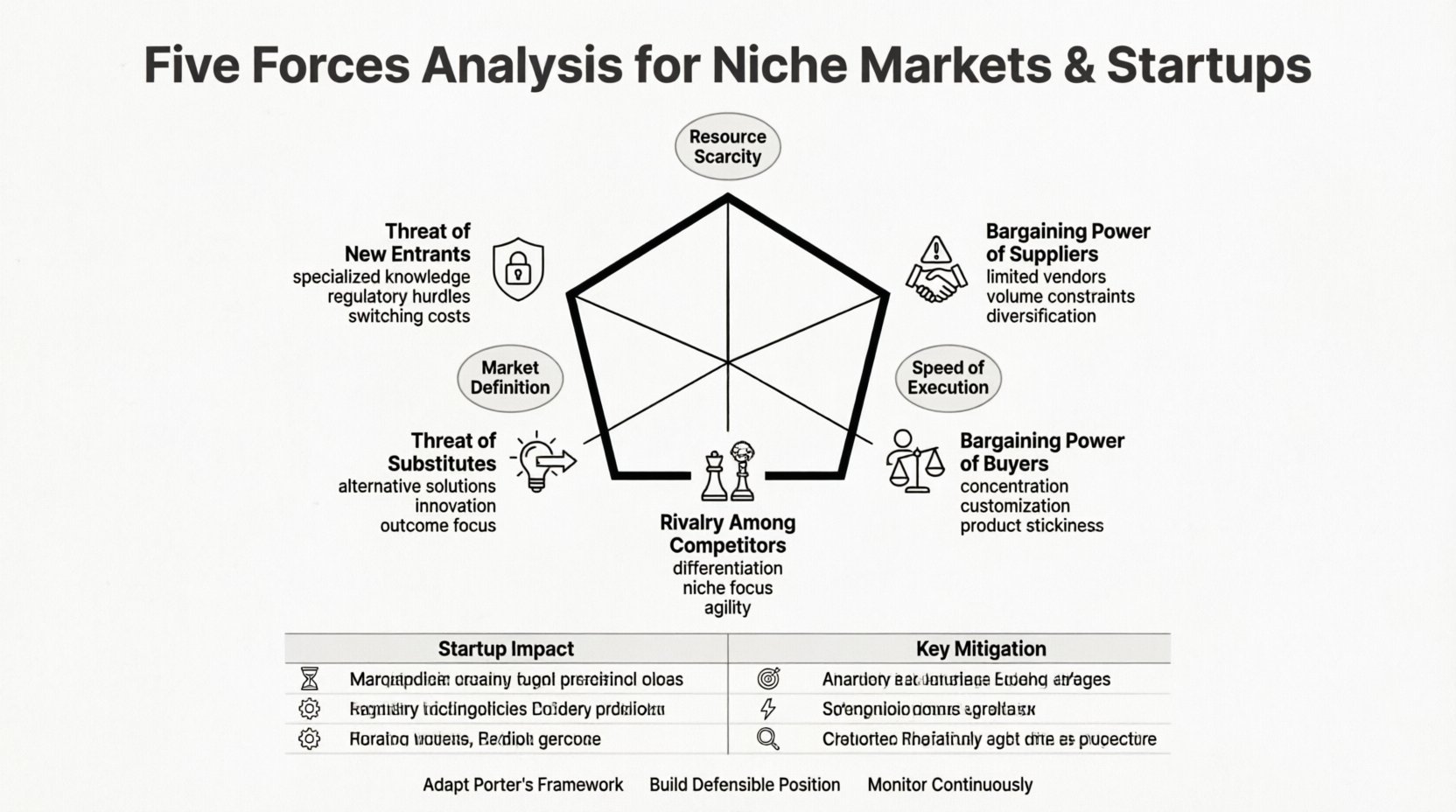
- Resource Scarcity: Startups often lack the capital to weather price wars or invest heavily in supplier relationships.
- Speed of Execution: Unlike incumbents, startups must pivot quickly when competitive dynamics shift.
- Market Definition: In niche sectors, defining the “industry” boundaries can be fluid. A niche product might compete with a general solution.
Applying this model requires a shift from macro-level industry data to micro-level operational realities. It is not about predicting the future perfectly, but about recognizing the structural forces that dictate pricing power and margin potential.
⚔️ 1. Threat of New Entrants: Barriers to Entry
This force examines how easy it is for other companies to enter your market. For a startup, this is a double-edged sword. You are the new entrant, but you also need to protect yourself from copycats.
Identifying Barriers in Niche Sectors
In a niche market, barriers might not be financial. They could be technical, regulatory, or relational.
- Specialized Knowledge: If your product requires proprietary technology or deep domain expertise, it creates a natural moat.
- Regulatory Hurdles: Industries like health tech or fintech often have compliance requirements that slow down competitors.
- Customer Switching Costs: If your customers find it difficult or expensive to move to a competitor, you have retention leverage.
Strategic Implications for Startups
When analyzing this force, ask yourself if you are building a business that can be easily replicated.
- Brand Loyalty: In small niches, word-of-mouth is critical. Building a reputation early creates a barrier based on trust.
- Network Effects: If your service becomes more valuable as more people use it, you gain protection.
- Access to Distribution: Securing exclusive partnerships with key distributors can limit the reach of new competitors.
Startups should focus on accelerating the creation of these barriers. Waiting until a competitor appears to build defenses is often too late.
🤝 2. Bargaining Power of Suppliers: Sourcing Challenges
Supplier power refers to the ability of vendors to drive up prices or reduce quality. For startups, supply chain fragility can be a critical point of failure.
Niche Supply Chain Dynamics
In a niche market, the pool of suppliers might be extremely limited. This concentration increases their leverage.
- Limited Vendor Options: If there is only one manufacturer for a critical component, that manufacturer holds significant power.
- Volume Constraints: Startups often lack the volume to demand discounts, making them price takers.
- Specialized Talent: In knowledge-intensive niches, the “suppliers” are the skilled employees. Their bargaining power is high.
Mitigation Strategies
Reducing dependency on powerful suppliers is a priority for resilience.
- Vertical Integration: Consider bringing key processes in-house to control costs and quality.
- Diversification: Identify alternative suppliers early, even if they are not the primary choice. This creates a fallback option.
- Long-term Contracts: Secure agreements that lock in pricing or priority status, though this requires capital.
- Standardization: Where possible, use off-the-shelf components rather than custom-built parts to increase supplier competition.
Understanding supplier power helps in forecasting margin compression. If a key input cost rises, does the business model hold?
🛒 3. Bargaining Power of Buyers: Niche Customer Dynamics
Buyer power is the pressure customers can exert to drive down prices or demand better service. In niche markets, the relationship between buyer and seller is often more personal.
Characteristics of Niche Buyers
Buyers in specialized sectors often have very specific requirements. This can reduce their power if they cannot find alternatives, but it increases their demands.
- Concentration: If a startup relies on a few large clients, those clients have high leverage.
- Information Access: Modern buyers are well-informed. They know the market rates and competitor offerings.
- Price Sensitivity: In some niches, the solution is so specialized that price is secondary to fit. In others, budget is the primary constraint.
Reducing Buyer Leverage
To protect margins, startups must create value that is difficult to compare.
- Customization: Tailoring the offering to the specific workflow of the client makes switching costs higher.
- Service Quality: High-touch support can justify premium pricing even in competitive environments.
- Product Stickiness: Integrate deeply into the customer’s operations so that removing the product causes disruption.
Regularly surveying customers to understand their pain points ensures the value proposition remains aligned with their needs, reducing the temptation to look elsewhere.
🔄 4. Threat of Substitute Products: Innovation vs. Disruption
Substitutes are not direct competitors but offer a different solution to the same problem. This is often the most overlooked force for startups.
Defining the Substitute
A substitute might be a manual process, a different technology, or even doing nothing.
- Alternative Solutions: If you sell a project management tool, the substitute might be a spreadsheet or a whiteboard.
- Technological Shifts: New technologies can render existing solutions obsolete quickly.
- Cost of Switching: If the cost to switch to a substitute is low, the threat is high.
Strategic Response
Startups must monitor the broader landscape for indirect threats.
- Focus on Outcomes: Sell the result, not just the feature. If your product delivers a specific outcome better than any alternative, the threat diminishes.
- Continuous Innovation: Stay ahead of the curve by iterating faster than the market can find a substitute.
- Education: Help customers understand why your solution is superior to the alternative methods they currently use.
Ignoring substitutes can lead to a situation where a startup is competing against a market that no longer exists.
🔥 5. Rivalry Among Existing Competitors: Fighting for Share
This force measures the intensity of competition among current players. In a niche market, rivalry might seem low, but it can be fierce among those who remain.
Assessing Competitive Intensity
Even in small markets, competition can be aggressive if the growth potential is high.
- Number of Competitors: Fewer competitors usually mean less direct rivalry, but more focus on the few who are there.
- Industry Growth: In a stagnant market, companies fight for share. In a growing market, they fight for expansion.
- Differentiation: If products are commoditized, competition becomes a price war.
Positioning in the Market
Startups should avoid direct confrontation with established incumbents unless they have a distinct advantage.
- Blue Ocean Strategy: Create a new market space where competition is irrelevant.
- Niche Focus: Target a specific segment that large players ignore due to size.
- Agility: Use your speed to adapt to customer feedback faster than larger rivals.
Rivalry analysis helps determine whether to enter a market at all. If the incumbents are entrenched and profitable, entry might be costly.
📊 Comparative Analysis Matrix
The following table summarizes how each force impacts a startup in a niche market compared to a traditional large enterprise.
| Force | Impact on Startup | Key Mitigation Strategy |
|---|---|---|
| Threat of New Entrants | High risk of rapid copying due to low capital barriers. | Build IP, focus on brand, and increase switching costs. |
| Bargaining Power of Suppliers | Low volume leads to higher unit costs and dependency. | Diversify vendors and consider vertical integration. |
| Bargaining Power of Buyers | Concentrated buyers can dictate terms and pricing. | Diversify customer base and increase product stickiness. |
| Threat of Substitutes | Indirect competitors may solve the problem differently. | Focus on outcomes and continuous innovation. |
| Rivalry Among Competitors | Aggressive pricing or feature wars in small markets. | Differentiate and target underserved segments. |
🛠️ Strategic Integration: Turning Analysis into Action
Conducting the analysis is only the first step. The value lies in integrating the findings into the business strategy.
Step-by-Step Implementation
- Data Collection: Gather qualitative and quantitative data on each force. Talk to customers, suppliers, and industry experts.
- Scoring: Rate the intensity of each force as High, Medium, or Low. Be honest about the risks.
- Scenario Planning: Create scenarios based on the most intense forces. What happens if supplier costs rise by 20%?
- Resource Allocation: Direct capital and effort toward areas that reduce the most significant threats.
Building Resilience
A resilient startup does not just react to threats but anticipates them. This means building a financial buffer and maintaining a flexible operational model. It also means keeping a close eye on the market to detect shifts in the Five Forces early.
- Monitor Trends: Track regulatory changes, technological advancements, and competitor movements.
- Customer Feedback Loops: Ensure you are hearing from customers directly to validate assumptions.
- Financial Buffers: Maintain cash reserves to withstand periods of increased competition or supply chain disruption.
⚠️ Common Pitfalls in Strategic Planning
Even with a solid framework, errors can occur during the planning process. Awareness of these pitfalls helps avoid costly mistakes.
- Static Analysis: The market changes. A Five Forces analysis done once is obsolete quickly. It requires regular updates.
- Overlooking the Ecosystem: Focus too much on direct competitors and ignore the broader ecosystem of partners and platforms.
- Confirmation Bias: Only looking for data that supports the decision to launch, ignoring warning signs.
- Ignoring Cash Flow: A good strategic position does not matter if the business runs out of cash before reaching profitability.
🌐 Final Considerations for Sustainable Growth
Applying the Five Forces model to a niche market and startup environment requires a balance of caution and ambition. It is not about finding a perfect market, but about understanding the risks and building a model that can withstand them.
Startups that take the time to deeply analyze their competitive landscape are better positioned to allocate resources effectively. They avoid industries where profitability is structurally impossible and focus on areas where they can build a sustainable advantage.
The goal is not to eliminate all competition, but to create a position where the company can thrive despite the pressures of the market. By understanding the forces at play, founders can navigate the complexities of niche markets with clarity and confidence.
Remember that strategy is a dynamic process. As the business grows, the forces will shift. What was a low threat at the beginning may become a high threat as the company scales. Continuous monitoring and adaptation are the keys to long-term success in any competitive environment.


Comments (0)