![Free eBooks of IT [BooksOfAll]](https://www.booksofall.com/wp-content/uploads/2022/06/booksofall-logo-2.png)
Tags:
Bargaining Power of Buyers: Navigating the Five Forces
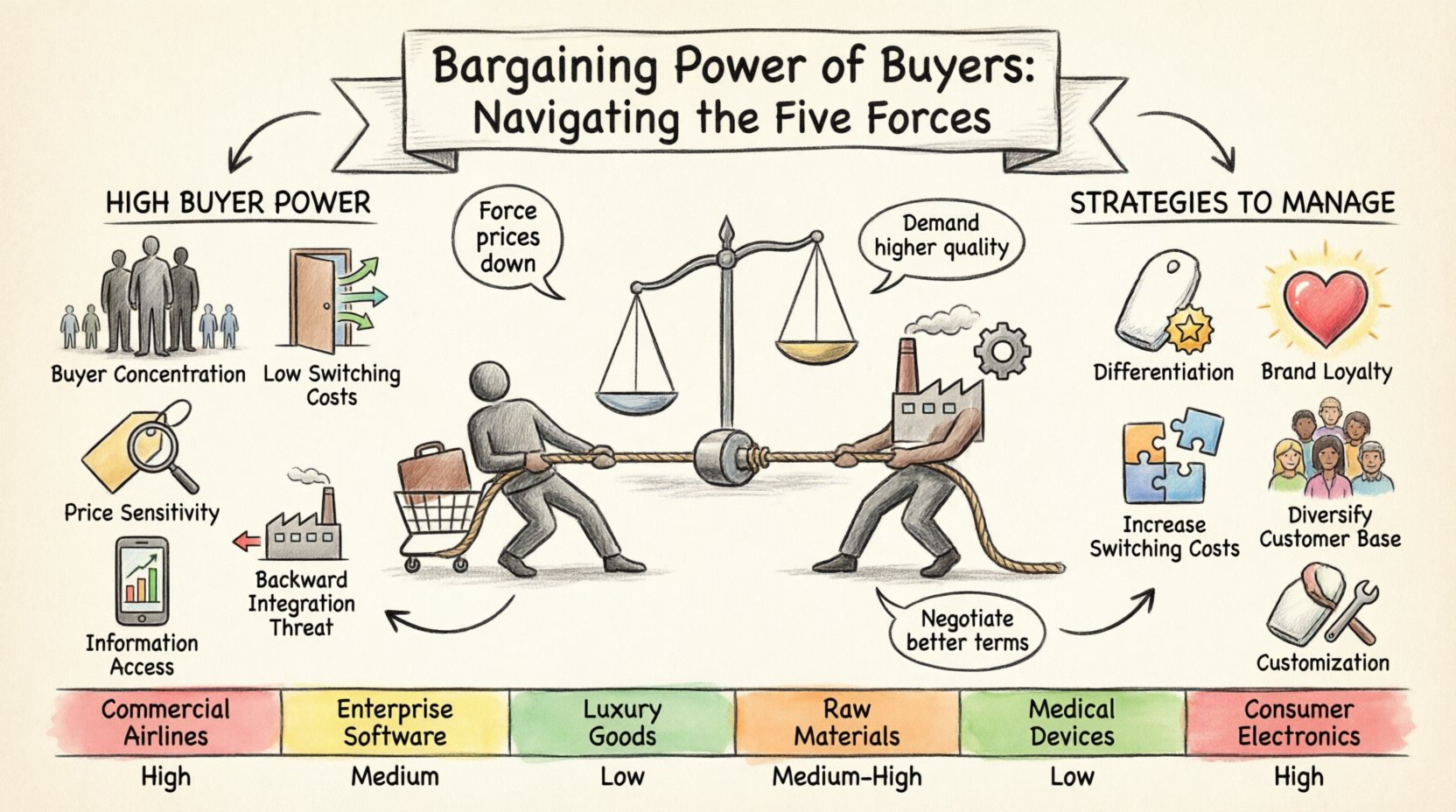
Market dynamics are rarely static. They shift based on the balance of power between industry participants and the external environment. Within strategic frameworks, understanding who holds the leverage is essential for long-term viability. One of the most critical forces to analyze is the bargaining power of buyers. This concept defines the ability of customers to drive prices down, demand higher quality, or play competitors against each other. When buyers hold significant power, the industry’s profit potential shrinks.
This guide provides a deep dive into buyer power within Porter’s Five Forces framework. It covers the drivers of this force, how to assess it, and practical strategies for managing customer leverage. We will look at real-world examples and specific indicators that signal a shift in market dynamics. By understanding these factors, businesses can better position themselves against customer pressure.
Defining the Buyer Force in Industry Analysis 📊
The bargaining power of buyers is a measure of how much influence customers have over an industry. It is not simply about having many customers. Instead, it is about the structural conditions that allow customers to dictate terms. This force interacts with the other four forces to determine the overall profitability of a sector.
When buyers are powerful, they can:
- Force prices down to reduce their own costs.
- Demand higher quality or better service levels without paying a premium.
- Play suppliers against one another to extract concessions.
- Threaten to integrate backward and produce the product themselves.
Conversely, when buyers have low power, suppliers can maintain higher margins. They face less pressure to innovate or lower prices. This distinction is vital for investors and strategists evaluating an industry’s attractiveness.
Key Indicators of High Buyer Power 🔍
Several structural factors contribute to high buyer power. Identifying these indicators early allows companies to prepare countermeasures. The following factors are the primary drivers of customer leverage.
1. Buyer Concentration
If a small number of buyers account for a large portion of the industry’s sales, they hold significant sway. These customers know their value to the supplier. They can threaten to leave the partnership if demands are not met. This is common in B2B sectors where a few large firms dominate the purchasing landscape.
- High Concentration: One or two customers buy 50% of the output.
- Low Concentration: Thousands of small customers buy individually.
2. Switching Costs
Switching costs refer to the expenses a buyer incurs when changing suppliers. These can be financial, procedural, or psychological. High switching costs lock customers in, reducing their power. Low switching costs make it easy for buyers to move to a competitor, increasing their leverage.
- Financial: Installation fees, training costs, or new equipment purchases.
- Procedural: Integration into existing workflows or software systems.
- Psychological: Risk aversion or trust built over years.
3. Price Sensitivity
Buyers are more powerful when they are highly sensitive to price. This occurs when the product represents a significant portion of their total costs. It also happens when the product is standardized, making price the primary differentiator. In these scenarios, buyers will shop around aggressively to find the lowest rate.
- Commoditized products lead to higher price sensitivity.
- Customized solutions lead to lower price sensitivity.
4. Availability of Information
The internet has revolutionized access to information. Buyers can now easily compare prices, specifications, and reviews. When information is transparent, buyers can negotiate more effectively. They know the market rate and can use this knowledge to pressure suppliers.
5. Threat of Backward Integration
If buyers have the ability to produce the product themselves, their bargaining power increases. This threat becomes credible when the industry margins are high. Buyers may consider bringing production in-house to capture value. Suppliers must watch for signs of this capability developing.
Indicators of Low Buyer Power 🛡️
Not all industries suffer from aggressive customer pressure. In some sectors, suppliers retain control over pricing and terms. Understanding these conditions helps identify opportunities for stable returns.
- Fragmented Customer Base: When there are many small buyers, no single entity can dictate terms.
- High Switching Costs: Complex systems or proprietary technology create lock-in effects.
- Product Differentiation: Unique features or brand loyalty reduce the focus on price.
- Low Price Sensitivity: If the product is a small fraction of the buyer’s costs, they care less about the price.
- Lack of Alternatives: Monopolies or oligopolies limit the buyer’s ability to choose competitors.
Impact on Industry Profitability 💰
The balance of buyer power directly correlates with industry profitability. When buyers are strong, they capture value that would otherwise go to suppliers. This pressure squeezes profit margins across the sector.
High buyer power leads to:
- Reduced average selling prices.
- Increased marketing spend to retain customers.
- Higher investment in customer service and support.
- Greater innovation pressure to stay ahead of commoditization.
Low buyer power allows for:
- Stable or rising price points.
- Consistent profit margins.
- Lower costs associated with customer acquisition.
- Ability to invest in long-term R&D without immediate ROI pressure.
Strategies to Manage Buyer Power 🛠️
Companies cannot always change the structural conditions of an industry. However, they can adopt strategies to mitigate the negative effects of buyer power. The goal is to reduce customer leverage and increase supplier stickiness.
1. Product Differentiation
Making a product unique reduces price sensitivity. If customers perceive a distinct value, they are less likely to switch based on cost alone. This can be achieved through:
- Proprietary technology or patents.
- Superior design or aesthetics.
- Enhanced functionality that solves specific problems.
2. Building Brand Loyalty
A strong brand creates an emotional connection. Customers may pay a premium for a trusted name. This loyalty acts as a barrier to switching. Consistent messaging and quality delivery reinforce this bond.
3. Increasing Switching Costs
While this can be controversial, increasing the cost of leaving the relationship reduces buyer power. This includes:
- Developing integrated ecosystems.
- Offering training and certification programs.
- Providing long-term contracts with favorable terms for loyalty.
4. Diversifying the Customer Base
Reliance on a few large buyers creates vulnerability. Spreading revenue across many smaller customers dilutes the power of any single entity. This reduces the risk of a major client defecting.
5. Offering Customization
Standard products are easy to replace. Custom solutions are harder to replicate. Tailoring products to specific client needs makes the supplier indispensable.
Industry Comparison Table 📉
The table below illustrates how buyer power varies across different sectors. These examples highlight the structural differences that drive leverage.
| Industry | Buyer Power Level | Key Drivers |
|---|---|---|
| Commercial Airlines | High | Low switching costs, high price transparency, many competitors. |
| Enterprise Software | Medium | High switching costs, complex integration, but strong competition. |
| Luxury Goods | Low | Brand exclusivity, low price sensitivity, scarcity of supply. |
| Raw Materials | Medium to High | Standardized products, price sensitivity, global market dynamics. |
| Specialized Medical Devices | Low | High regulation, high switching costs, critical functionality. |
| Consumer Electronics | High | Rapid obsolescence, frequent new models, easy price comparison. |
Assessment Framework for Strategists 🧠
To apply this analysis, leaders should ask specific questions about their market position. This framework helps quantify the level of buyer power in a specific context.
- Concentration: What percentage of revenue comes from the top 5 customers?
- Volume: Does the product represent a significant cost for the buyer?
- Information: How easy is it for buyers to compare our offering with competitors?
- Standardization: Is our product a commodity or a specialized solution?
- Integration: Are there credible threats of customers producing the product themselves?
- Profit Impact: How sensitive are we to price changes in our pricing model?
The Digital Age and Buyer Power 💻
Technology has shifted the balance of power in recent decades. Social media and review platforms give buyers a collective voice. Negative reviews can damage a brand reputation quickly. This amplifies the bargaining power of even small customers.
Key digital trends include:
- Transparency: Price comparison tools are ubiquitous.
- Community: Buyers share information and strategies online.
- Direct-to-Consumer: Brands can bypass intermediaries, but face the buyer directly.
- Data: Customers expect personalized experiences based on their data.
Companies must adapt to this environment. Ignoring digital feedback loops can lead to rapid loss of market share. Engaging with customers on these platforms is no longer optional.
Evaluating Long-Term Viability 📈
When analyzing an investment or business plan, the sustainability of buyer power must be considered. Industries with high buyer power often face a cycle of price wars. This makes cash flow unpredictable. Industries with low buyer power offer more stability.
However, low buyer power is not a guarantee of success. Other forces, such as the threat of new entrants or supplier power, may be more significant. A holistic view of all five forces is required. Buyer power is just one piece of the puzzle.
Strategic planning should account for shifts in this force. For example, consolidation among buyers can suddenly increase their power. A company that relied on a fragmented market may find itself vulnerable overnight. Continuous monitoring is necessary.
Case Study: The Airline Industry ✈️
The airline industry serves as a classic example of high buyer power. Passengers have many options for similar routes. The product (a seat from point A to point B) is largely standardized. Price comparison is instant via online travel agencies.
Consequences include:
- Thin profit margins.
- High marketing costs to build loyalty.
- Frequent discounting to fill seats.
- Reliance on ancillary revenue (baggage, upgrades).
Airlines attempt to counter this with loyalty programs. However, these programs often fail to fully neutralize price sensitivity. The structural power remains with the buyer.
Case Study: Enterprise SaaS 💾
Software as a Service (SaaS) presents a mixed scenario. Buyers have power initially because switching seems easy. However, once data is migrated and workflows are built, switching becomes difficult.
This creates a lifecycle for buyer power:
- Acquisition Phase: High buyer power. They shop around for the best deal.
- Onboarding Phase: Power begins to shift. Implementation costs rise.
- Usage Phase: Supplier power increases. Switching costs are high.
- Renewal Phase: Power dynamic stabilizes. Buyers may negotiate based on long-term value.
Understanding this lifecycle helps SaaS providers manage pricing and retention strategies effectively.
Final Considerations for Decision Makers 🎯
Navigating buyer power requires a proactive approach. Waiting for customer demands to dictate terms is a reactive strategy that often leads to margin erosion. Instead, companies should shape the environment.
Key takeaways include:
- Monitor Concentration: Watch for mergers among your customers.
- Invest in Loyalty: Build relationships that go beyond transactional exchanges.
- Innovate Continuously: Stay ahead of commoditization.
- Diversify Revenue: Do not rely on a single large client.
- Communicate Value: Ensure buyers understand why your product is worth the cost.
Strategic foresight allows businesses to anticipate shifts in buyer leverage. By understanding the underlying drivers, organizations can build resilience against market pressures. This analysis is not static. It requires regular review as market conditions evolve.
Ultimately, the goal is to create a sustainable balance. Neither extreme is ideal. Some buyer pressure drives efficiency and innovation. Too much pressure destroys profitability. Finding the equilibrium is the core challenge of strategic management.
Summary of Critical Factors 📝
| Factor | Effect on Buyer Power | Strategic Implication |
|---|---|---|
| Number of Buyers | More buyers = Lower Power | Aim for a broad customer base. |
| Switching Costs | Higher costs = Lower Power | Invest in integration and training. |
| Product Differentiation | Higher differentiation = Lower Power | Focus on unique value propositions. |
| Price Sensitivity | Higher sensitivity = Higher Power | Justify price through value. |
| Information Access | More info = Higher Power | Control narrative and communication. |
Applying these principles leads to more robust business models. It ensures that growth is not achieved at the expense of long-term profitability. By respecting the dynamics of buyer power, companies can navigate complex markets with confidence.
The analysis of buyer power is a fundamental tool for any serious strategist. It provides clarity on where value is created and where it is captured. With the right insights, organizations can turn a potential weakness into a managed variable. This approach fosters stability and growth in volatile environments.


Comments (0)