![Free eBooks of IT [BooksOfAll]](https://www.booksofall.com/wp-content/uploads/2022/06/booksofall-logo-2.png)
Tags:
Bargaining Power of Suppliers: A Five Forces Deep Dive
Understanding the competitive landscape requires more than just looking at direct rivals. It demands a structural analysis of the industry environment. One critical component of this framework is the Bargaining Power of Suppliers. This metric determines how much control vendors hold over prices, quality, and terms within a market.
When suppliers hold significant leverage, they can erode profitability for buyers. Conversely, weak supplier power can create opportunities for margin expansion. This guide explores the mechanics of supplier influence within Porter’s Five Forces model, providing actionable insights for strategic planning.
Understanding Porter’s Five Forces Framework 📊
Michael Porter introduced this framework in 1979 to identify the intensity of competition and potential profitability in an industry. While often associated with rivalry, the supplier element is foundational. It dictates input costs, which are a direct driver of margins.
- Rivalry among Competitors: Intensity of competition.
- Threat of New Entrants: Barriers to entry.
- Threat of Substitutes: Alternative products.
- Bargaining Power of Buyers: Customer leverage.
- Bargaining Power of Suppliers: Vendor leverage.
Ignoring the supplier force often leads to miscalculated financial projections. A sudden shift in supplier capability can disrupt operations or inflate costs overnight.
Defining Supplier Bargaining Power 💪
Supplier bargaining power refers to the ability of a supplier to dictate terms of trade. High power means suppliers can raise prices, reduce quality, or limit supply without losing customers. Low power implies a buyer-friendly market where options are plentiful.
This dynamic is not static. It changes based on market conditions, technology shifts, and geopolitical factors. Companies must continuously monitor this force to maintain resilience.
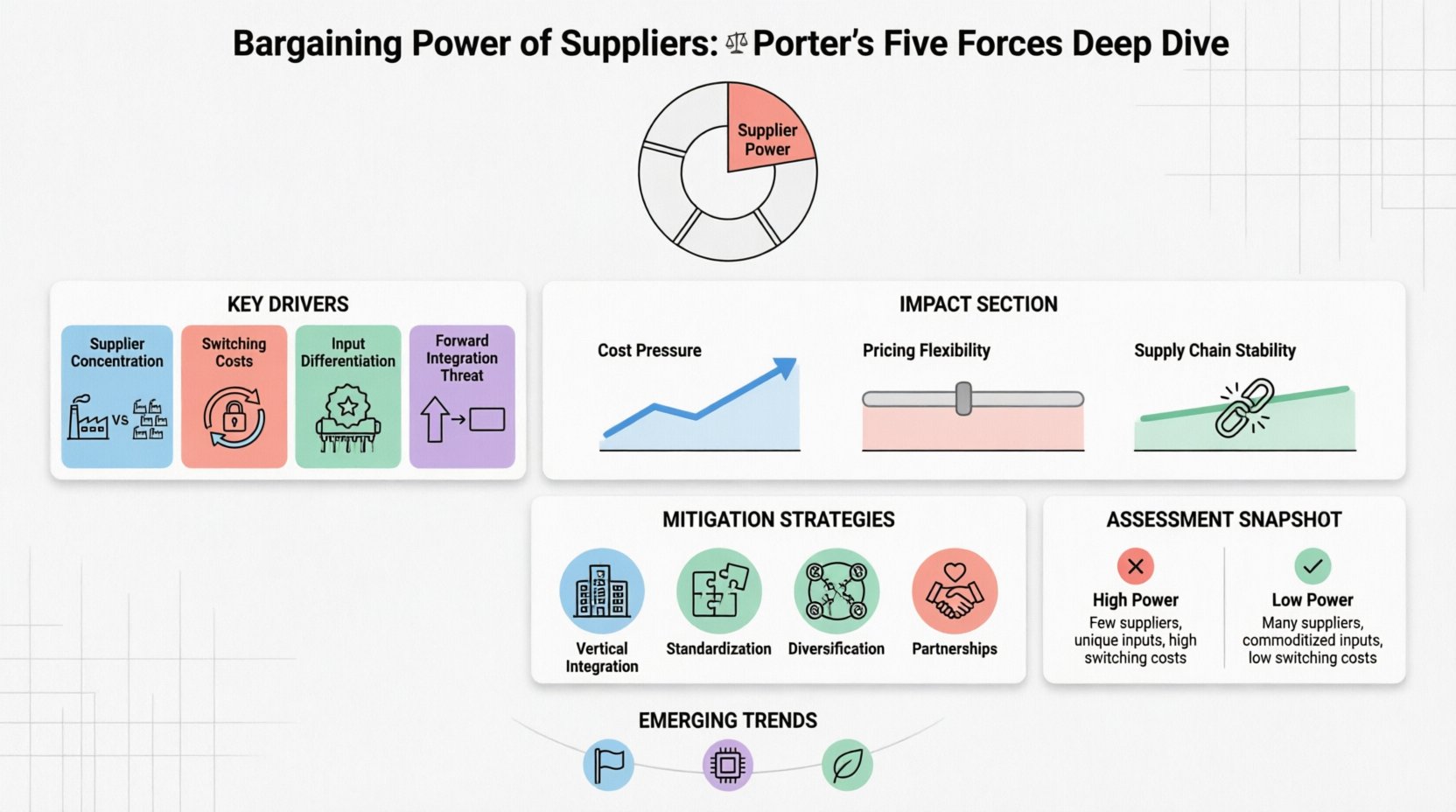
Key Drivers of Supplier Influence 🔑
Several factors contribute to the level of power a supplier group holds. Analyzing these drivers helps organizations anticipate risks.
1. Supplier Concentration 🧱
If an industry relies on a few dominant suppliers, power shifts upward. Monopolies or oligopolies allow vendors to coordinate pricing strategies.
- High Concentration: Few suppliers serve many buyers. Example: Semiconductor manufacturing.
- Low Concentration: Many suppliers compete for buyers. Example: Office supplies.
2. Switching Costs 🔄
Switching costs represent the financial or operational burden of changing vendors. High costs lock buyers into existing relationships.
- Asset Specificity: Specialized equipment required for the supplier relationship.
- Training Costs: Time and money spent training staff on vendor systems.
- Integration Complexity: Difficulty integrating new suppliers into existing workflows.
3. Differentiation of Inputs 🎨
Unique or differentiated products increase supplier power. If a raw material is patented or has no close substitutes, the buyer has little choice.
- Proprietary Technology: Patents protect the supplier’s advantage.
- Brand Reputation: Suppliers with strong brand equity can command premiums.
- Quality Standards: Specialized materials that meet strict regulatory requirements.
4. Threat of Forward Integration 📉
Suppliers can threaten to enter the buyer’s business. If a supplier can produce the final product themselves, they gain leverage in negotiations.
- Financial Resources: Can the supplier afford to expand?
- Profit Margins: Are margins in the buyer’s industry attractive?
- Strategic Fit: Does vertical integration align with the supplier’s goals?
Impact on Profitability and Strategy 📉
High supplier power directly impacts the bottom line. It creates pressure on cost structures and limits pricing flexibility.
Cost Structure Pressure
When input costs rise, companies must either absorb the expense or pass it to customers. Absorbing costs reduces net income. Passing costs risks losing market share to competitors with lower input expenses.
Pricing Flexibility
Suppliers with power can dictate terms that affect the entire value chain. This restricts the buyer’s ability to innovate or compete on price.
Supply Chain Stability
Reliance on powerful suppliers increases risk. Disruptions at the source lead to production halts. Diversification becomes a necessity rather than a choice.
Strategies for Mitigation 🛡️
Organizations can take steps to reduce dependency and increase their own negotiating position. These strategies focus on reducing switching costs and increasing alternatives.
1. Vertical Integration 🏗️
Acquiring or building a supplier function in-house reduces reliance on external vendors. This offers control over costs and quality but requires significant capital investment.
- Backward Integration: Buying suppliers to secure inputs.
- Forward Integration: Acquiring distribution channels to secure demand.
2. Standardization of Inputs ⚙️
Using standardized materials reduces supplier differentiation. If a component is available from multiple sources, price competition increases.
- Interchangeable Parts: Designing products to accept various vendors.
- Open Standards: Adopting industry-wide specifications.
3. Supplier Diversification 🌐
Working with multiple suppliers prevents single points of failure. It also creates competition among vendors.
- Multi-Sourcing: Spreading orders across different providers.
- Global Sourcing: Accessing markets with different cost structures.
- Local Sourcing: Reducing logistics risks and lead times.
4. Strategic Partnerships 🤝
Collaborating with suppliers can align interests. Long-term contracts often secure better pricing in exchange for volume commitments.
- Joint Development: Co-creating products to reduce differentiation.
- Information Sharing: Providing demand forecasts to improve efficiency.
Industry Case Studies 🏭
Real-world examples illustrate how supplier power varies across sectors.
Automotive Manufacturing
Auto makers face high supplier power regarding specialized components like microchips or batteries. During chip shortages, manufacturers faced production delays. Many OEMs responded by securing long-term contracts or investing in their own semiconductor divisions.
Food and Beverage
Large retailers often hold power over agricultural suppliers due to volume. However, suppliers with unique branding (e.g., specific coffee beans) can negotiate better terms with premium retailers.
Technology Hardware
Hardware companies rely heavily on contract manufacturers. While there are many potential partners, switching costs for tooling and quality assurance are high. This creates moderate supplier power.
Assessment Framework: High vs. Low Power 📋
Use this table to evaluate the current state of your supplier relationships.
| Factor | High Supplier Power | Low Supplier Power |
|---|---|---|
| Number of Suppliers | Few dominant players | Many small competitors |
| Input Uniqueness | Highly specialized or patented | Commoditized or standard |
| Switching Costs | High financial or operational cost | Low, easy to change |
| Forward Integration Threat | Supplier can easily enter your market | Supplier lacks resources or intent |
| Price Sensitivity | Buyers are less sensitive to price | Buyers are highly price-sensitive |
Emerging Trends in Supply Chain Dynamics 🌍
The landscape of supplier power is evolving due to global shifts. Understanding these trends is crucial for long-term planning.
Geopolitical Tensions
Trade wars and sanctions can restrict access to certain suppliers. Companies must assess risk based on geography, not just cost.
- Nearshoring: Moving production closer to home markets.
- Friend-shoring: Partnering with nations that share political alignment.
Digital Transformation
Technology reduces information asymmetry. Buyers can compare prices and quality more easily. This tends to reduce supplier power over time.
- Procurement Platforms: Digital marketplaces increase transparency.
- Data Analytics: Better forecasting reduces reliance on single sources.
Sustainability Requirements
Environmental regulations are forcing suppliers to meet stricter standards. This can limit the pool of qualified vendors, potentially increasing power for compliant suppliers.
- Carbon Footprint: Suppliers must report emissions.
- Ethical Sourcing: Labor practices are under scrutiny.
Common Analysis Mistakes ⚠️
Even experienced strategists make errors when evaluating supplier power. Avoid these pitfalls to ensure accurate analysis.
- Ignoring Indirect Suppliers: Focusing only on direct vendors while overlooking raw material providers.
- Static Assessment: Treating power levels as fixed rather than dynamic.
- Overlooking Substitute Inputs: Failing to identify materials that could replace current inputs.
- Neglecting Buyer Power: Not considering how buyer concentration might counter supplier leverage.
Building Resilience Against Supplier Risk 🛠️
Resilience is the ability to withstand shocks. Companies with strong supplier management are better positioned during disruptions.
Contractual Safeguards
Contracts should include clauses for price adjustments, delivery guarantees, and termination rights. Clear terms reduce ambiguity during disputes.
Inventory Management
Maintaining strategic stockpiles of critical components buffers against supply interruptions. This requires balancing holding costs against risk.
Supplier Audits
Regularly assessing supplier financial health and operational capacity identifies vulnerabilities early. This proactive approach prevents surprises.
Final Thoughts on Strategic Planning 🎯
Supplier bargaining power is a pivotal element in industry analysis. It influences pricing, margins, and operational stability. By understanding the drivers of this force, organizations can design strategies that protect their interests.
Continuous monitoring is essential. Market conditions change, and so does the balance of power. A robust strategy adapts to these shifts, ensuring long-term viability in a competitive environment.
Focus on reducing dependency where possible. Diversify your sources. Invest in relationships that create mutual value. These actions build a foundation for sustained success regardless of external pressures.


Comments (0)