![Free eBooks of IT [BooksOfAll]](https://www.booksofall.com/wp-content/uploads/2022/06/booksofall-logo-2.png)
Tags:
Understanding the Threat of New Entrants in the Five Forces
Business strategy relies heavily on understanding the competitive landscape. Among the various frameworks available, Porter’s Five Forces remains a cornerstone for industry analysis. Within this model, the Threat of New Entrants stands out as a critical determinant of long-term profitability and stability. This force examines the ease or difficulty with which new competitors can enter an industry and challenge established players.
When barriers to entry are low, the market becomes crowded quickly. Profit margins shrink as supply increases and price competition intensifies. Conversely, high barriers protect incumbents, allowing them to maintain pricing power and steady cash flows. A comprehensive understanding of this dynamic is essential for any organization aiming to sustain its market position over time.
🔍 Defining the Threat of New Entrants
The threat of new entrants refers to the probability that competitors outside the current industry will enter the market. This concept is not merely about new companies starting up; it encompasses potential competitors who have the resources and motivation to disrupt the status quo. These entrants can range from startups with innovative business models to large corporations diversifying from adjacent sectors.
For established businesses, the arrival of a new player can fundamentally alter the competitive equation. New entrants often bring fresh capital, novel technologies, or more efficient operational processes. They are less burdened by legacy systems or entrenched customer expectations, allowing them to pivot quickly. However, their success is not guaranteed. The industry structure determines how easily they can penetrate the market.
🚧 Barriers to Entry: The Primary Defense
The most significant factor influencing the threat of new entrants is the existence of barriers. These are obstacles that make it difficult for new companies to gain a foothold. Barriers can be structural, regulatory, or strategic. When barriers are high, the threat is low. When barriers are low, the threat is high.
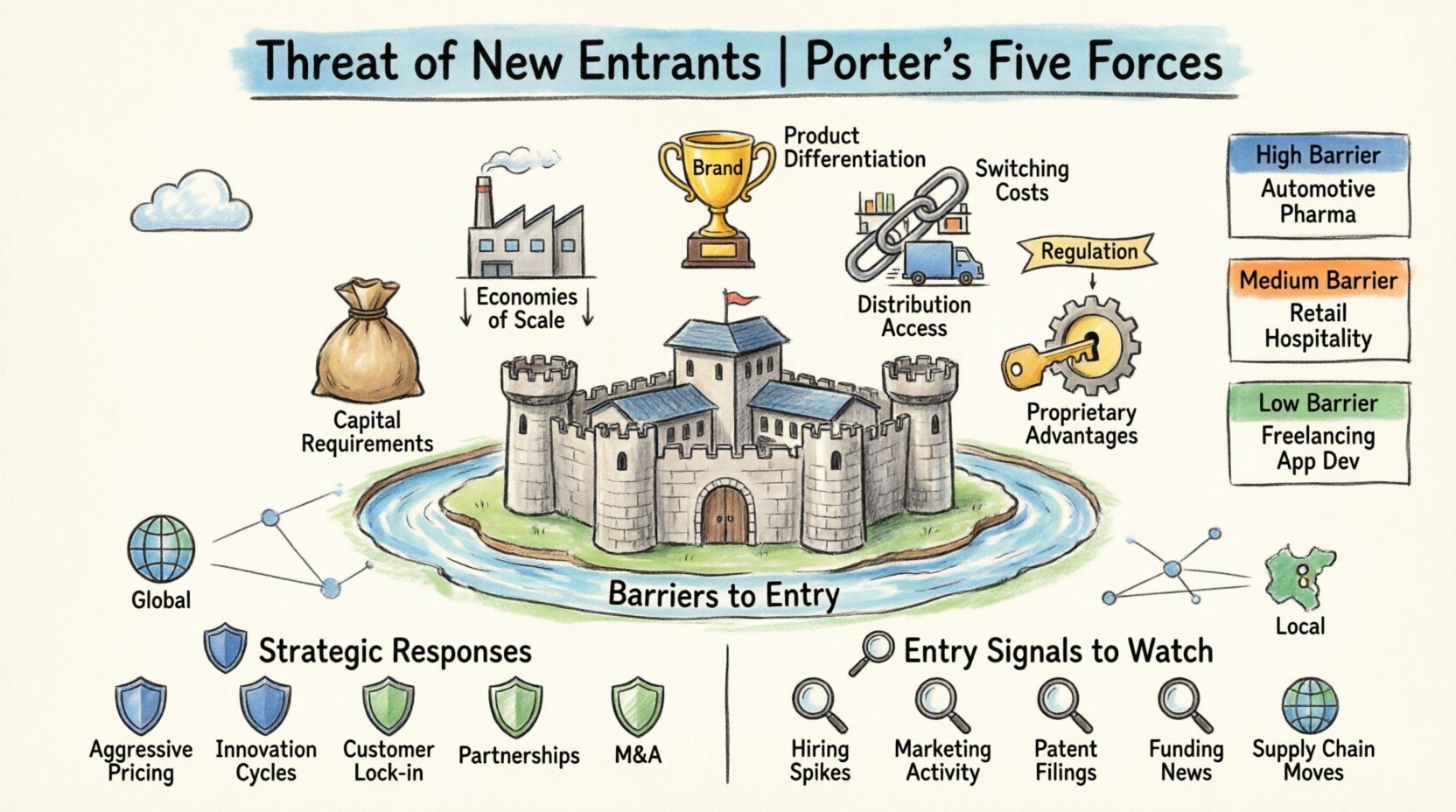
Barriers act as a moat around the industry, protecting the revenue streams of existing firms. Analyzing these barriers requires a deep dive into the economics of the specific sector. Below are the primary categories of barriers to entry:
- Capital Requirements: Some industries demand massive upfront investment. Building a manufacturing plant, launching a telecommunications network, or developing pharmaceutical drugs requires significant financial resources. If a new entrant cannot secure funding, they cannot enter the market.
- Economies of Scale: Incumbents often benefit from lower unit costs due to high production volumes. New entrants starting at a small scale face higher costs per unit, making it difficult to compete on price without sacrificing margins.
- Product Differentiation: Established brands often enjoy strong customer loyalty. New entrants must invest heavily in marketing to convince customers to switch. If the product is perceived as commoditized, differentiation becomes harder to achieve.
- Switching Costs: If it is expensive or difficult for customers to switch from one provider to another, new entrants face a significant hurdle. This is common in enterprise software, banking, and industrial supply chains.
- Access to Distribution Channels: Getting products to customers is a vital step. Incumbents often have exclusive contracts with retailers or logistics providers. New entrants may struggle to find shelf space or delivery networks.
- Government Policy and Regulation: Licenses, patents, and safety standards can legally restrict entry. Industries like energy, healthcare, and aviation are heavily regulated to ensure safety and stability.
- Cost Advantages Independent of Scale: Incumbents may have proprietary technology, favorable geographic locations, or access to raw materials at lower costs. These advantages persist regardless of production volume.
📊 Comparing High vs. Low Threat Environments
Not all industries face the same level of risk from new competitors. The following table illustrates the differences between sectors with high and low threats of new entrants.
| Industry Type | Threat Level | Key Characteristics | Example Sectors |
|---|---|---|---|
| High Barrier | Low Threat | High capital, strict regulation, strong IP | Automotive, Aerospace, Pharmaceuticals |
| Medium Barrier | Moderate Threat | Brand loyalty matters, moderate scale | Retail Banking, Hospitality, Consumer Goods |
| Low Barrier | High Threat | Low capital, easy access, low switching costs | Freelancing, Food Services, App Development |
Understanding where an industry falls on this spectrum helps organizations allocate resources effectively. In low barrier sectors, the focus is on rapid innovation and customer retention. In high barrier sectors, the focus is on maintaining regulatory compliance and protecting intellectual property.
🏗️ Deep Dive into Specific Barriers
1. Economies of Scale
Economies of scale occur when the cost per unit of production decreases as the volume of output increases. Large incumbents can produce more efficiently than smaller new entrants. This creates a cost disadvantage for newcomers who must compete at a smaller scale initially.
To overcome this, new entrants often target niche markets. By focusing on a specific segment, they can achieve profitability without needing mass production volumes. However, if the niche is small, the growth potential is limited. This strategy is common in the luxury goods sector or specialized industrial equipment.
2. Brand Loyalty and Switching Costs
Customers often stick with familiar brands to reduce risk. In many industries, switching providers involves not just financial costs but also time and effort. For example, changing a banking provider involves updating automatic payments, direct deposits, and security settings.
New entrants must offer a compelling value proposition to overcome this inertia. This often means offering lower prices, better features, or superior customer service. In digital services, a free trial or a freemium model is frequently used to lower the initial barrier.
3. Capital Requirements
Access to funding is a critical bottleneck. Venture capital and private equity are available, but they come with expectations of high growth and exit strategies. Traditional banks may be hesitant to lend to unproven business models.
In capital-intensive industries like telecommunications, the barrier is physical infrastructure. Laying fiber optic cables or building cell towers requires billions in investment. This naturally limits the number of competitors to a few major players.
4. Government Regulation
Regulatory bodies exist to protect public interest, but they also act as barriers. Licensing requirements ensure that only qualified entities operate in sensitive fields. Patents grant temporary monopolies to inventors, preventing others from copying the technology.
Compliance can be expensive. New entrants must hire legal teams and compliance officers to navigate the regulatory landscape. This adds to the operational overhead before the company even generates revenue.
⚡ The Impact of Digital Disruption
Technology has reshaped the concept of barriers to entry in the 21st century. Cloud computing, open-source software, and digital marketing have lowered costs for many sectors. A startup can now reach a global audience without a physical presence.
However, technology creates new barriers. Network effects become a dominant force. In social media or marketplace platforms, the value of the service increases as more users join. A new entrant with fewer users offers less value, creating a cycle that is hard to break. This is why dominant platforms often face little competition despite low capital requirements.
Data privacy and security also play a role. Incumbents with years of data accumulation have a significant advantage in personalizing services. New entrants must build their data assets from scratch, which takes time and trust.
🛡️ Strategic Responses for Incumbents
Established companies cannot rely on barriers alone. They must actively manage the threat of new entrants. Proactive strategies help maintain market share and profitability.
- Aggressive Pricing: Temporarily lowering prices can discourage new entrants who cannot sustain losses. This is a risky strategy that must be executed carefully to avoid long-term margin damage.
- Innovation Cycles: Continuously updating products ensures that new entrants are always chasing a moving target. If the product evolves faster than competitors can replicate it, the threat is mitigated.
- Customer Lock-in: Creating ecosystems where customers use multiple services from the same provider increases switching costs. Loyalty programs and integrated services reinforce this.
- Strategic Partnerships: Forming alliances with suppliers or distributors can block access to critical channels. Exclusive contracts are a common tactic in this area.
- Mergers and Acquisitions: Buying potential competitors removes them from the market entirely. This is a direct way to reduce the number of threats, though it often attracts regulatory scrutiny.
📈 Identifying Signals of Entry
Monitoring the market is essential for early detection of threats. Organizations should watch for specific signals that indicate a new player is preparing to enter.
- Hiring Spikes: Sudden recruitment in specific technical or sales roles can indicate preparation for a launch.
- Marketing Activity: Increased advertising spend or domain registrations for potential new brands suggest upcoming activity.
- Patent Filings: New intellectual property applications can reveal intended product developments before they reach the market.
- Funding Announcements: Venture capital rounds often signal confidence in entering a specific sector.
- Supply Chain Movements: Changes in vendor relationships or raw material purchases can indicate production scaling.
Ignoring these signals can lead to strategic surprises. A company that fails to anticipate a disruptive entrant may find its market share eroded before it realizes the threat exists.
🌍 Global vs. Local Considerations
The threat of new entrants varies significantly across geographic boundaries. In local markets, barriers might be cultural or logistical. In global markets, currency fluctuations and trade policies come into play.
A local business might be protected by physical distance or cultural nuances. A foreign competitor may struggle to adapt to local preferences or regulations. Conversely, global players can leverage economies of scale that local firms cannot match. They have access to larger capital pools and diverse talent markets.
Trade agreements can lower barriers by reducing tariffs and quotas. This makes it easier for international entrants to compete. Companies operating in open markets must be vigilant about global competitors entering their home turf.
🔄 Dynamic Nature of the Threat
Barriers are not static. They change over time due to technological advancements, regulatory shifts, and changes in consumer behavior. What was a high barrier five years ago might be low today.
For instance, the cost of manufacturing has dropped significantly due to automation and 3D printing. This has allowed new entrants in hardware industries to compete with established giants. Similarly, digital payment systems have reduced the capital requirement for launching fintech services.
Strategic planning must account for this dynamism. A static analysis of the threat is insufficient. Continuous monitoring and adaptive strategies are required to stay ahead of the evolving landscape.
🎯 Conclusion on Competitive Analysis
Evaluating the threat of new entrants provides critical insights into industry profitability. It helps organizations understand the fragility of their market position and the durability of their competitive advantages. By identifying barriers and monitoring signals, companies can make informed decisions about investment and expansion.
Success in this analysis requires objectivity. It is tempting to underestimate the capabilities of new competitors. However, history shows that disruptive entrants often succeed by redefining the rules of the game. Organizations that respect this threat and prepare accordingly are better positioned for long-term resilience.
The Five Forces model remains a powerful tool when applied with depth and nuance. The threat of new entrants is not just a metric; it is a reminder of the constant pressure in any competitive market. Staying aware of this pressure ensures that strategies remain relevant and effective.



Comments (0)