![Free eBooks of IT [BooksOfAll]](https://www.booksofall.com/wp-content/uploads/2022/06/booksofall-logo-2.png)
Tags:
Five Forces Model: Best Practices for Strategic Planning
Understanding the competitive landscape is fundamental to sustainable business growth. The Five Forces Model, originally developed by Michael Porter, remains a cornerstone for industry analysis. It provides a structured framework to evaluate the intensity of competition and the attractiveness of an industry. When applied correctly within strategic planning, it reveals where power lies in a business transaction and helps organizations identify where their influence is limited.
This guide details how to implement this framework effectively. We explore the specific forces, best practices for gathering intelligence, and methods to integrate findings into long-term planning. The goal is not merely to describe the market but to understand the underlying dynamics that drive profitability and risk.
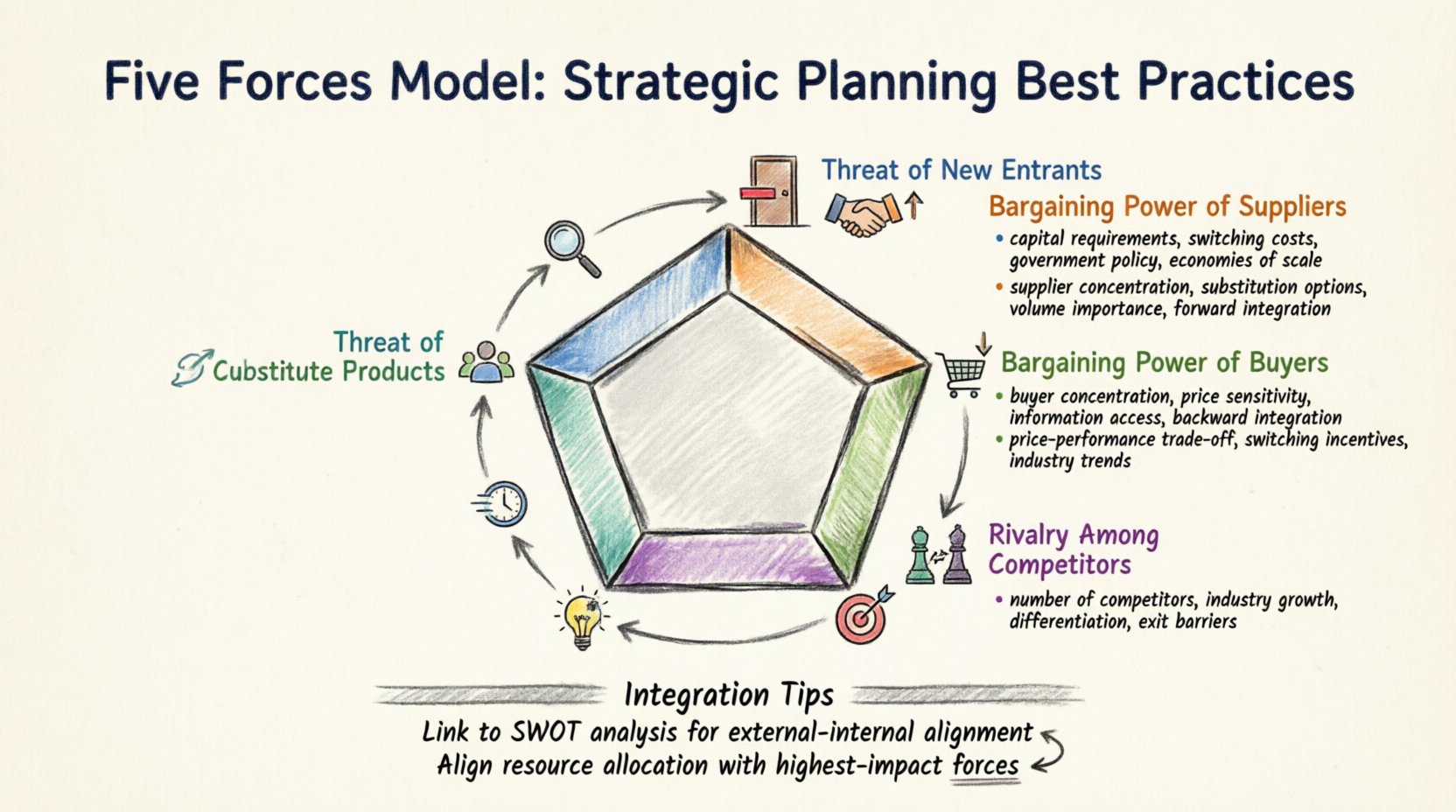
🔍 Understanding the Framework
The model categorizes five distinct forces that determine the competitive intensity and attractiveness of a market. These forces shape the profit potential of an industry. A robust analysis considers the interaction between these forces, rather than viewing them in isolation. Strategic planning becomes more resilient when it accounts for the shifting balance of power among these elements.
Each force represents a different source of competitive pressure. Recognizing which force exerts the most influence allows leaders to allocate resources where they will have the greatest impact. This process moves strategy beyond intuition and grounds it in observable market mechanics.
🏗️ The Five Forces Breakdown
To utilize this framework, one must examine each force in detail. Below is an in-depth look at each component, including key indicators to observe.
1️⃣ Threat of New Entrants
This force assesses how easily new competitors can enter the market. High barriers to entry protect existing players, while low barriers invite disruption. Analyzing this requires looking at capital requirements, regulatory hurdles, and access to distribution channels.
- Capital Requirements: Does the industry require significant upfront investment? High costs deter new players.
- Switching Costs: How difficult is it for customers to switch to a new provider? High switching costs reduce the threat.
- Government Policy: Are there licenses, patents, or regulations that restrict entry?
- Economies of Scale: Can existing players produce at a lower cost per unit than potential entrants?
2️⃣ Bargaining Power of Suppliers
Suppliers can drive up prices by limiting availability or quality. This force is strongest when there are few suppliers or when their products are unique. Strategic planning must account for supply chain vulnerabilities.
- Supplier Concentration: Is the market dominated by a few large suppliers?
- Substitution: Are there alternative materials or sources available?
- Importance of Volume: Does the supplier rely heavily on the buying company for revenue?
- Forward Integration: Does the supplier have the capability to enter the buyer’s market directly?
3️⃣ Bargaining Power of Buyers
Customers can drive down prices or demand higher quality. This power increases when buyers are concentrated or when the product is commoditized. Understanding buyer behavior is crucial for pricing strategy.
- Concentration: Are there a few large buyers or many small ones?
- Price Sensitivity: How much does price affect the purchasing decision?
- Availability of Information: Do buyers have easy access to competitor pricing and features?
- Backward Integration: Can buyers produce the product themselves?
4️⃣ Threat of Substitute Products
Substitutes offer a different solution to the same problem. They place a ceiling on the prices companies can charge. This force is often overlooked but can be the most disruptive in the long term.
- Price-Performance Trade-off: How does the substitute compare in price and utility?
- Switching Incentives: Why would a customer switch to an alternative?
- Industry Trends: Is technology or consumer behavior shifting toward alternatives?
5️⃣ Rivalry Among Existing Competitors
This force measures the intensity of competition between current players. High rivalry leads to price wars, advertising battles, and increased innovation costs. It is the most visible aspect of the model.
- Number of Competitors: More competitors often mean more aggressive tactics.
- Industry Growth: Slow growth forces firms to fight for market share.
- Differentiation: Is the product unique or commoditized?
- Exit Barriers: Are there high costs to leave the industry, keeping competitors in the fight?
📊 Comparative Analysis of Forces
| Force | Primary Question | High Impact Indicator |
|---|---|---|
| New Entrants | How easy is it to start here? | Low capital barriers |
| Suppliers | Can they raise prices? | Few suppliers, unique inputs |
| Buyers | Can they lower prices? | High concentration of buyers |
| Substitutes | Can they replace us? | Low switching costs for users |
| Rivalry | How aggressive are competitors? | Slow industry growth |
🛠️ Best Practices for Application
Executing this analysis requires discipline and accurate data. Simply filling out a template is insufficient. The following practices ensure the output informs real decision-making.
📥 Data Collection and Validation
Reliable strategy depends on reliable data. Avoid relying on internal assumptions alone. Gather external market intelligence to validate assumptions.
- Primary Research: Conduct interviews with customers, suppliers, and industry experts.
- Secondary Research: Utilize industry reports, financial statements of competitors, and regulatory filings.
- Market Metrics: Track key performance indicators such as market share, pricing trends, and customer churn.
- Validation: Cross-reference findings from multiple sources to ensure accuracy.
👥 Cross-Functional Collaboration
Strategy is not the sole responsibility of a single department. Input from sales, operations, and finance provides a holistic view.
- Sales Insights: Frontline teams know what customers complain about and what they value.
- Operations Input: Supply chain managers understand supplier leverage and production constraints.
- Financial Perspective: Finance teams can assess the capital intensity and profitability of different segments.
⏱️ Dynamic Review Cycles
Markets change. An analysis conducted once will become outdated quickly. Establish a regular review schedule.
- Quarterly Updates: Review key metrics and adjust assumptions.
- Trigger Events: Initiate a full review upon major regulatory changes, new technology releases, or competitor exits.
- Historical Comparison: Compare current findings with past data to identify trends.
🎯 Focus on Key Drivers
Not all forces carry equal weight in every industry. Identify the critical drivers for your specific context.
- Identify the Dominant Force: Determine which of the five forces exerts the most pressure.
- Allocate Resources: Focus strategic initiatives on mitigating the dominant threats.
- Ignore Noise: Do not spend excessive time on forces that have negligible impact on the bottom line.
🔗 Integrating into Strategic Planning
The value of this model lies in its integration with broader strategic frameworks. It should not stand alone but work in conjunction with other planning tools.
Linking to SWOT Analysis
Strengths, Weaknesses, Opportunities, and Threats (SWOT) benefit from the specificity provided by the Five Forces. The external analysis from the model feeds directly into Opportunities and Threats.
- Opportunities: Arise when a force is weakening (e.g., suppliers losing power).
- Threats: Arise when a force is strengthening (e.g., new technology creating substitutes).
- Strategies: Use the model to justify resource allocation decisions within the SWOT matrix.
Informing Resource Allocation
Capital and talent should be directed toward areas that improve competitive positioning.
- Investment in Barriers: If entry is easy, invest in branding or patents to raise barriers.
- Supplier Relationships: If supplier power is high, invest in vertical integration or long-term contracts.
- Customer Retention: If buyer power is high, invest in loyalty programs or superior service.
Scenario Planning
Use the forces to build scenarios. What happens if a new entrant appears? What if a substitute becomes cheaper?
- Stress Testing: Test current strategies against potential shifts in the forces.
- Contingency Plans: Develop fallback options for high-risk scenarios.
- Early Warning Systems: Define metrics that signal a shift in a specific force.
⚠️ Common Pitfalls to Avoid
Even experienced strategists make mistakes when applying this framework. Awareness of common errors helps ensure accuracy.
- Static Analysis: Treating the industry as unchanging. Markets are dynamic and require constant monitoring.
- Ignoring Complements: Focusing only on substitutes and missing the impact of complementary products.
- Overlooking Global Dynamics: Analyzing only local competition when global players are present.
- Confirmation Bias: Seeking data that supports a pre-determined decision rather than objective facts.
- Aggregating Too Broadly: Defining the industry too broadly (e.g., “Automotive”) instead of a specific segment (e.g., “Luxury Electric Vehicles”).
🚀 Future Considerations and Ecosystems
Modern business environments often blur the lines of traditional industry definitions. Digital platforms and ecosystems challenge the rigid boundaries of the model.
Ecosystem Thinking
Companies now compete within networks rather than isolated chains. Partnerships and platforms create value in ways the original model did not anticipate.
- Platform Dynamics: Consider how platform owners influence the five forces.
- Network Effects: Assess how the value of a product changes with the number of users.
- Data Leverage: Recognize data as a critical asset that can alter bargaining power.
Digital Disruption
Technology often lowers barriers to entry or creates new substitutes rapidly.
- Speed of Change: Traditional analysis cycles may be too slow for digital markets.
- Agility: Strategy must remain flexible to adapt to rapid shifts in competitive forces.
- Innovation: Continuous innovation is required to maintain position against new entrants.
📈 Measuring Impact and Success
How do you know the analysis was useful? Success is measured by the quality of decisions made based on the insights.
- Market Share Stability: Did the strategy help maintain or grow market share?
- Profitability Margins: Were pricing power and cost structures managed effectively?
- Risk Mitigation: Did the analysis help avoid costly strategic missteps?
- Speed of Execution: Did the insights allow for faster, more confident decision-making?
Implementing the Five Forces Model requires rigor and honesty. It is a tool for clarity, not a crystal ball. By focusing on the structural drivers of competition, organizations can build strategies that endure. The process of analysis itself often reveals blind spots and opportunities that would otherwise remain hidden. Regular application ensures that the organization stays attuned to the shifting tides of the market.
Remember that the objective is not to predict the future with certainty, but to understand the probabilities of various outcomes. This understanding forms the basis of sound strategic planning. When leaders combine this structural analysis with operational excellence and customer focus, they create a durable competitive advantage.


Comments (0)