![Free eBooks of IT [BooksOfAll]](https://www.booksofall.com/wp-content/uploads/2022/06/booksofall-logo-2.png)
Tags:
From Theory to Practice: A Deep Dive into the Five Forces
Strategic planning requires more than intuition; it demands a structured understanding of the forces shaping an industry. Michael Porter introduced a framework in 1979 that remains a cornerstone of business analysis today. This model, known as Porter’s Five Forces, provides a clear lens through which to view competitive dynamics. By dissecting the underlying pressures in a market, organizations can make informed decisions about where to allocate resources and how to sustain profitability.
This guide explores each component of the framework in detail. It moves beyond simple definitions to examine practical application, strategic implications, and the nuances of modern market conditions. Whether you are analyzing a startup environment or a mature industry, understanding these forces is essential for long-term viability.
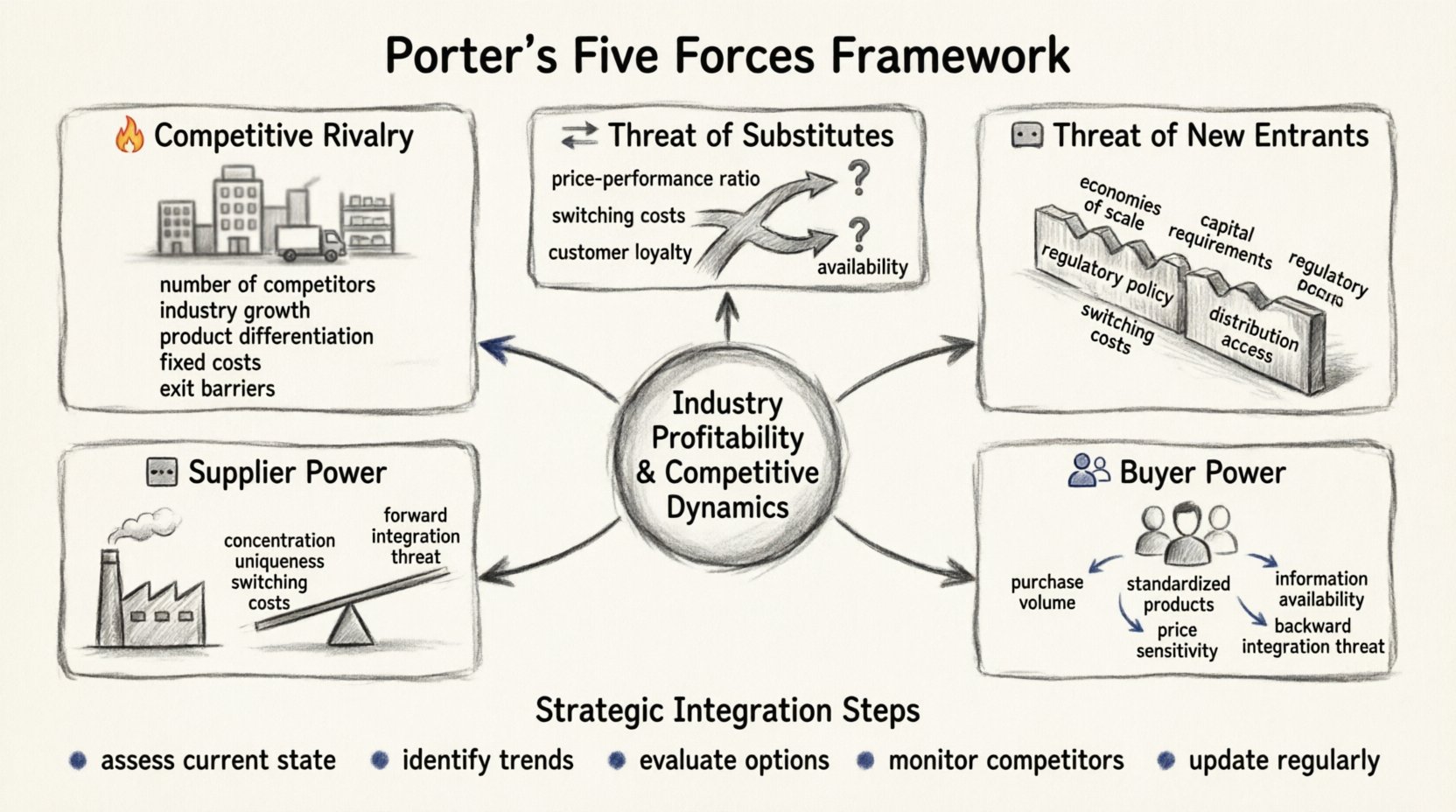
Understanding the Framework 🧠
The Five Forces model posits that industry profitability is determined by five distinct competitive forces. These forces collectively define the intensity of competition and the attractiveness of a market. When these forces are strong, profitability tends to be lower. When they are weak, there is more room for margins.
- Industry Rivalry: The intensity of competition among existing players.
- Threat of New Entrants: The ease with which new competitors can enter the market.
- Threat of Substitutes: The availability of alternative solutions to the core product.
- Bargaining Power of Suppliers: The influence suppliers have on pricing and terms.
- Bargaining Power of Buyers: The leverage customers possess to demand lower prices or better quality.
Analyzing these factors allows leaders to identify where the power lies in their specific ecosystem. It is not merely about looking at competitors. It is about looking at the entire value chain and the external pressures that constrain or enable growth.
1. Competitive Rivalry 🔥
Competitive rivalry represents the most direct form of competition within an industry. It involves existing firms vying for market share, often through price wars, advertising battles, or product innovation. The intensity of this rivalry dictates how much profit is available for everyone in the sector.
Factors Driving Rivalry
Several structural characteristics influence how fierce competition becomes:
- Number of Competitors: A market with many players of similar size often leads to aggressive competition. Conversely, a monopoly or oligopoly may stabilize pricing.
- Industry Growth Rate: In stagnant markets, companies fight for the same pie. In growing markets, expansion is easier, reducing direct conflict.
- Product Differentiation: If products are commoditized, price becomes the main differentiator. Unique offerings reduce direct price competition.
- Fixed Costs: High fixed costs create pressure to fill capacity, often leading to discounting to maintain volume.
- Exit Barriers: If it is difficult or expensive to leave an industry, companies may stay and fight longer than is economically rational.
Practical Application
When rivalry is high, strategies often focus on efficiency and differentiation. Companies might invest in brand loyalty to make price less relevant. Alternatively, they might consolidate through mergers to reduce the number of players. Understanding the current state of rivalry helps in setting realistic revenue targets and pricing strategies.
2. Threat of New Entrants 🚪
New competitors entering the market can disrupt established dynamics. They bring new capacity, often seek market share aggressively, and can drive down prices. The threat of entry depends heavily on barriers to entry—obstacles that make it difficult for a newcomer to succeed.
Key Barriers to Entry
| Barrier Type | Description | Impact on Threat |
|---|---|---|
| Economies of Scale | Cost advantages enjoyed by large incumbents. | High Barrier (Low Threat) |
| Capital Requirements | High investment needed for infrastructure or R&D. | High Barrier (Low Threat) |
| Regulatory Policy | Licensing, patents, or government restrictions. | High Barrier (Low Threat) |
| Switching Costs | Costs incurred by customers when changing providers. | High Barrier (Low Threat) |
| Access to Distribution | Difficulty in reaching customers through channels. | Medium/High Barrier |
When barriers are low, the threat of entry is high. This forces incumbents to maintain innovation and efficiency constantly. When barriers are high, incumbents enjoy more stability but must remain vigilant against disruptive technologies that bypass traditional barriers.
Strategic Implications
Companies should assess their own barriers. Are they patents? Brand reputation? Proprietary technology? Strengthening these barriers protects margins. However, relying solely on barriers can lead to complacency. The goal is to build a moat that is difficult to cross but flexible enough to adapt to change.
3. Threat of Substitutes 🔄
Substitutes are not direct competitors. They are products or services from outside the industry that satisfy the same customer need. For example, video conferencing software is a substitute for business travel. This force is often underestimated because it comes from unexpected sectors.
Determinants of Substitute Threat
- Price-Performance Ratio: If a substitute offers better value for money, demand will shift.
- Switching Costs: If it is easy for customers to switch to a substitute, the threat is higher.
- Customer Loyalty: Strong emotional or functional loyalty reduces the likelihood of switching.
- Availability: The more accessible the substitute, the greater the threat.
In the digital age, this force has intensified. Technology often enables substitutes to appear rapidly. A company focused only on direct competitors may miss the threat of a substitute that redefines the category entirely.
Case Context
Consider the streaming industry. Traditional cable TV faced a substitute threat not just from other cable companies, but from internet-based media consumption. The substitute offered lower cost and higher convenience. Industries must constantly ask: “What else could solve this problem for the customer?”
4. Bargaining Power of Suppliers 🏭
Suppliers can squeeze profitability by raising prices or reducing quality. Their power depends on the number of suppliers available and the uniqueness of their product or service.
Indicators of Supplier Power
- Concentration: Few suppliers serving many buyers increases supplier power.
- Uniqueness: Specialized inputs with no close substitutes give suppliers leverage.
- Switching Costs: If changing suppliers is costly or risky, the incumbent supplier is powerful.
- Threat of Forward Integration: If a supplier can easily become a competitor, they hold leverage.
- Importance of Volume: If the supplier’s business depends heavily on the buyer, their power decreases.
Negotiation Strategies
When supplier power is high, companies must look for alternatives. This might involve vertical integration, where a company acquires its own suppliers. Alternatively, they might diversify their supply chain to avoid dependency on a single source. Building long-term partnerships can also stabilize costs, though this requires trust and alignment.
High supplier power often forces companies to pass costs to customers. If customers are price-sensitive, this can lead to lost market share. Therefore, managing supplier relationships is a critical component of cost control.
5. Bargaining Power of Buyers 👥
Buyers exert power by demanding lower prices or higher quality. They can play competitors against each other to drive down margins. Their power is highest when they are few in number, buy in large volumes, or face low switching costs.
Indicators of Buyer Power
- Volume of Purchases: Large buyers have significant leverage.
- Standardized Products: If products are identical, buyers can switch easily.
- Information Availability: Buyers with full market knowledge can negotiate better terms.
- Price Sensitivity: If the product is a significant portion of the buyer’s cost, they will seek discounts.
- Threat of Backward Integration: If buyers can make the product themselves, they have leverage.
Reducing Buyer Leverage
To counter high buyer power, firms focus on differentiation. If a product is unique, buyers cannot easily compare prices. Building brand loyalty also reduces sensitivity. Service levels, warranty terms, and support can add value that justifies a premium price.
In B2B markets, deep integration with the buyer’s processes can lock them in. This makes switching difficult and reduces their ability to demand price cuts. However, over-reliance on a single large buyer can be risky if that buyer decides to switch suppliers.
Integrating the Analysis 📊
Conducting the analysis is only the first step. The value comes from integrating the findings into strategic planning. A comprehensive view requires looking at all five forces simultaneously, not in isolation.
Steps for Effective Integration
- Assess Current State: Map out where power lies in each force today.
- Identify Trends: Determine which forces are strengthening or weakening over time.
- Evaluate Strategic Options: See how different moves affect the balance of power.
- Monitor Competitors: Watch how rivals are responding to these forces.
- Update Regularly: Markets change. The analysis should be a living document.
Scenario Planning
Using the model for scenario planning allows organizations to stress-test their strategies. For example, “What happens if a new entrant arrives with a disruptive technology?” or “What if our main supplier raises prices by 20%?” These scenarios help build resilience.
It is also useful to compare your position against key competitors. Do they have better leverage with suppliers? Do they face less rivalry? This comparison highlights areas where you need to improve or areas where you have a distinct advantage.
Limitations and Modern Context ⚠️
While powerful, the Five Forces model has limitations. It was designed for stable industrial environments. Modern markets are often faster and more interconnected. Digital platforms, for instance, can change the rules of engagement overnight.
Digital Disruption
- Network Effects: Platforms become more valuable as more users join, creating winner-take-all dynamics that the model does not fully capture.
- Zero Marginal Costs: Digital products can be replicated at near-zero cost, altering pricing strategies.
- Data as an Asset: Data collection creates barriers that were not present in traditional models.
Complementary Products
Some analysts suggest adding a sixth force: the power of complements. Products that work well together can enhance value. For example, hardware and software often need each other. Ignoring these relationships can lead to incomplete strategies.
Conclusion on Application 📝
Using this framework requires discipline and objectivity. It is easy to see the market the way you want it to be, rather than how it is. The model forces a confrontation with reality.
Success comes from acting on the insights. If rivalry is high, focus on cost leadership. If substitutes are a threat, focus on innovation. If supplier power is high, focus on diversification. The analysis is a tool for decision-making, not just a report.
By regularly revisiting these forces, organizations can anticipate shifts before they become crises. This proactive approach is what separates resilient companies from those that struggle. The market will always change, but the fundamentals of competition remain relevant.
Start your analysis today. Gather data, interview stakeholders, and map the forces. The clarity you gain will inform better choices and stronger outcomes.


Comments (0)