![Free eBooks of IT [BooksOfAll]](https://www.booksofall.com/wp-content/uploads/2022/06/booksofall-logo-2.png)
Tags:
Future Outlook: How the Five Forces Model Evolves in Modern Markets
Business strategy has long relied on frameworks that provide clarity in complex environments. Among these, the Five Forces Model remains a cornerstone for understanding industry competition. Originally introduced in 1979, the framework offers a structured way to analyze the intensity of competition and the attractiveness of a market. However, the landscape has shifted dramatically since the late 20th century. Today, digital transformation, artificial intelligence, and shifting consumer values redefine how these forces interact.
This guide explores how the Five Forces Model adapts to the modern business environment. It examines the nuances of competition in a connected world and outlines how strategic leaders can apply this classic tool to current realities without losing its analytical rigor. Understanding these shifts is essential for maintaining a competitive edge in an era defined by rapid change.
📊 The Traditional Framework: A Quick Recap
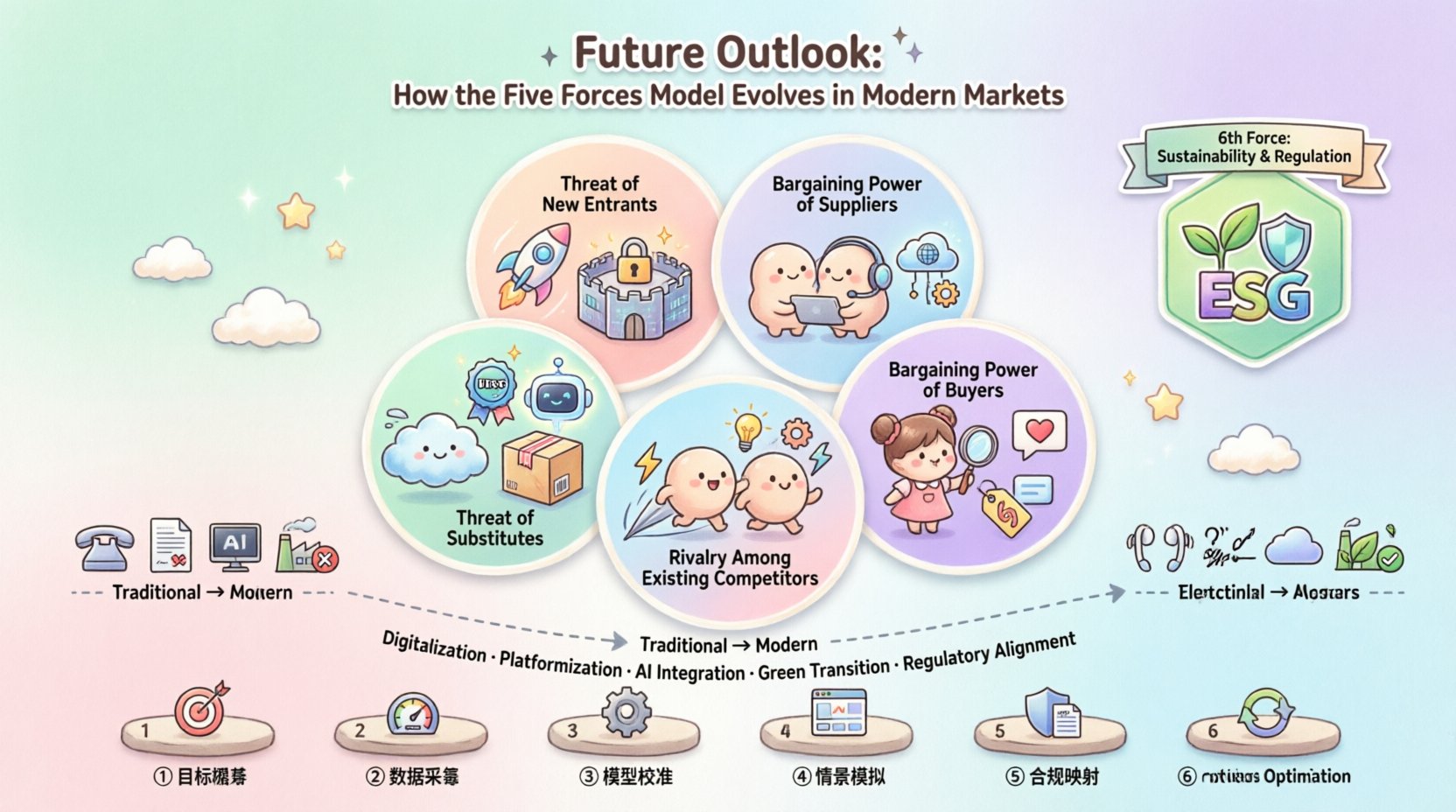
Before diving into the evolution, it is helpful to establish the baseline. Michael Porter identified five fundamental forces that determine the profit potential of an industry:
- Threat of New Entrants: The ease with which competitors can enter the market.
- Bargaining Power of Suppliers: The ability of suppliers to dictate prices and terms.
- Bargaining Power of Buyers: The influence customers have on pricing and quality.
- Threat of Substitute Products or Services: The availability of alternative solutions to meet customer needs.
- Rivalry Among Existing Competitors: The intensity of competition between current players.
In the traditional context, barriers to entry were often capital-intensive or regulatory. Suppliers were often localized, and buyers had limited information. Today, these dynamics are fluid. The digital infrastructure lowers some barriers while raising others, creating a paradoxical landscape for strategists.
🌐 1. Threat of New Entrants: The Digital Paradox
The barrier to entry has become a moving target. Historically, building a manufacturing plant required massive capital. Now, software-based businesses can launch with minimal overhead. However, the nature of “new entrant” threats has changed significantly.
- Lower Capital Requirements: Cloud infrastructure allows startups to scale without owning physical assets. This lowers the financial threshold for market entry.
- Increased Transparency: Information is accessible to everyone. A new competitor can quickly understand market pricing and positioning.
- Data as a Barrier: While capital barriers drop, data accumulation creates new moats. Incumbents with vast datasets can predict trends and personalize offerings better than newcomers.
- Network Effects: Platforms often require a critical mass of users before they become valuable. This creates a high barrier for entrants who cannot quickly gain traction.
For strategists, the question is no longer just “Can they enter?” but “Can they scale and sustain?” The threat of entry is often less about physical capability and more about ecosystem integration and user acquisition costs.
🤝 2. Bargaining Power of Suppliers: Concentration and Disruption
Supplier power traditionally relied on the uniqueness of a resource or the number of available alternatives. In the modern economy, this dynamic has expanded beyond raw materials to include data, talent, and platform access.
Consider the shift in the supply chain:
- Platform Dependency: Many businesses now rely on third-party platforms for distribution. This creates a dependency where the platform holds significant power over pricing and visibility.
- Global Fragmentation: While some sectors are concentrated, others are fragmented. Small, specialized suppliers can now find global buyers through digital marketplaces, reducing the power of any single supplier.
- Open Source and Alternatives: In technology, open-source solutions reduce reliance on proprietary vendors. This increases buyer leverage against traditional software suppliers.
- Talent as a Resource: Human capital is now a critical input. The power of skilled labor suppliers has increased, particularly in specialized technical fields.
Organizations must diversify their supplier base and invest in vertical integration where possible to mitigate risks. Relying on a single cloud provider or a specific logistics partner can expose a business to significant volatility.
🛒 3. Bargaining Power of Buyers: Information and Choice
Buyer power has increased exponentially due to the internet. Customers are more informed, have more choices, and can switch providers with a single click. This shift has fundamentally altered pricing strategies and customer loyalty models.
- Price Comparison: Aggregators and search engines allow customers to compare prices instantly. This compresses margins for providers who cannot differentiate through value.
- Switching Costs: While digital services are often easy to switch, data portability issues can create friction. However, standards for interoperability are improving, lowering these barriers.
- Community Influence: Reviews and social proof now drive purchasing decisions more than traditional advertising. A negative community sentiment can harm a brand faster than ever.
- Personalization Expectations: Customers expect tailored experiences. Generic offerings are easily replaced by competitors who leverage data to understand individual preferences.
To maintain leverage, companies must focus on building loyalty through value-added services, community engagement, and superior customer experience rather than just price.
🔄 4. Threat of Substitute Products: Beyond Direct Competition
Substitutes are not just alternative versions of the same product; they are alternative ways of satisfying a need. This concept has expanded in the digital age to include business model innovations.
Examples of modern substitution include:
- Digital vs. Physical: Streaming services substitute physical media. Video conferencing substitutes business travel.
- Service vs. Ownership: Subscription models substitute outright purchases. Customers prefer access over ownership in many categories.
- Automation vs. Labor: AI-driven tools substitute human labor in certain tasks, changing the cost structure of entire industries.
- Decentralization: Blockchain and decentralized platforms offer alternatives to centralized intermediaries in finance and data management.
Strategists must look beyond the immediate industry. A company in the transportation sector might face competition from remote work technologies. Understanding the underlying customer need is more important than understanding the specific product category.
⚔️ 5. Rivalry Among Existing Competitors: Hyper-Competition
Competition is fiercer and faster than ever. The traditional lifecycle of a product has shortened. What takes years to develop can now be disrupted in months. This has led to a state of hyper-competition.
Key drivers of modern rivalry include:
- Global Reach: Local companies now compete with international players. Geography is less of a barrier.
- Innovation Speed: The pace of technological advancement forces constant iteration. Companies that do not innovate risk obsolescence.
- Platform Wars: Major technology companies compete for ecosystem dominance, often cross-subsidizing services to capture market share.
- Price Wars: Low barriers to entry can lead to aggressive pricing strategies, particularly in e-commerce and digital services.
In this environment, differentiation is key. Cost leadership is difficult to sustain when competitors can undercut prices quickly. Value creation through unique capabilities, brand reputation, and customer relationships becomes the primary defense.
📈 Comparative Analysis: Traditional vs. Modern Dynamics
To visualize the shifts, consider the following comparison of how each force operates today versus the past.
| Force | Traditional Context | Modern Context |
|---|---|---|
| New Entrants | High capital barriers | Low capital, high data barriers |
| Suppliers | Local, resource-based | Global, platform-dependent |
| Buyers | Limited information | Highly informed, empowered |
| Substitutes | Direct product alternatives | Business model disruption |
| Rivalry | Regional, slower cycles | Global, rapid iteration |
🌱 The 6th Force: Sustainability and Regulation
While the original model focuses on five forces, modern analysis often considers an additional dimension: sustainability and regulatory pressure. This is not a replacement for the five forces but an overlay that affects all of them.
- Environmental Impact: Companies face pressure to reduce carbon footprints. This affects supplier choices, manufacturing costs, and consumer perception.
- Data Privacy: Regulations like GDPR impact how companies collect and use customer data, affecting buyer power and competitive advantages.
- ESG Criteria: Investors and customers increasingly evaluate companies based on Environmental, Social, and Governance factors. This influences capital costs and brand loyalty.
Neglecting these factors can lead to reputational damage and regulatory fines, effectively acting as a barrier to entry or a threat to existing players.
🔮 Strategic Implications for Leaders
Applying the Five Forces Model in the modern era requires a shift in perspective. It is no longer a static snapshot but a dynamic tool for continuous monitoring.
- Continuous Monitoring: Market conditions change weekly. Regular updates to the analysis are necessary to stay relevant.
- Ecosystem Thinking: Look beyond direct competitors. Consider partners, complements, and platforms as part of the competitive landscape.
- Agility: Strategies must be flexible. Long-term plans should include scenarios for rapid market shifts.
- Value Creation: Focus on creating unique value rather than just protecting market share. Innovation drives differentiation.
Leaders must also consider the role of technology not just as a tool, but as a fundamental change agent. AI and automation are reshaping cost structures and capabilities. Understanding how these technologies alter the five forces is critical for future-proofing the organization.
🛠️ Implementing the Analysis
To effectively utilize this framework, organizations should follow a structured approach:
- Define the Industry: Clearly scope the market boundaries. This includes geographic and product limitations.
- Gather Data: Collect information on market trends, competitor actions, and customer feedback.
- Assess Each Force: Evaluate the intensity of each force based on current data.
- Identify Opportunities: Look for areas where forces are weak or can be influenced.
- Formulate Strategy: Develop actions to mitigate threats and leverage opportunities.
- Review Periodically: Schedule regular reviews to update the analysis as the market evolves.
This process ensures that the analysis remains a living document rather than a one-time exercise. It allows the organization to adapt to changes as they occur.
🌟 Final Thoughts on Competitive Strategy
The Five Forces Model remains relevant because it addresses the fundamental economics of competition. However, the inputs to that model have changed. The digital age has introduced new variables that must be weighed alongside traditional factors.
Strategic success depends on the ability to see beyond the immediate competition. It requires an understanding of the ecosystem, the technology, and the human elements that drive market behavior. By adapting the framework to modern realities, leaders can navigate uncertainty with confidence.
As markets continue to evolve, the principles of strategic analysis remain constant. The tools may change, but the need for clarity and foresight does not. Organizations that embrace this evolution will be better positioned to thrive in the future landscape.


Comments (0)