![Free eBooks of IT [BooksOfAll]](https://www.booksofall.com/wp-content/uploads/2022/06/booksofall-logo-2.png)
Tags:
Five Forces Model: A Comprehensive Walkthrough for Entrepreneurs
Entering a new market requires more than just a great idea. It demands a clear understanding of the competitive landscape. For entrepreneurs, strategic clarity is the difference between survival and stagnation. One of the most enduring frameworks for this analysis is the Five Forces Model. This tool provides a structured way to assess the profitability and attractiveness of an industry. By examining the competitive dynamics, founders can make informed decisions about resource allocation and positioning.
This guide offers a deep dive into the model. We will explore each force in detail, discuss how to apply the analysis, and highlight common pitfalls to avoid. The goal is to equip you with a robust mental model for evaluating business opportunities without relying on buzzwords or temporary trends.
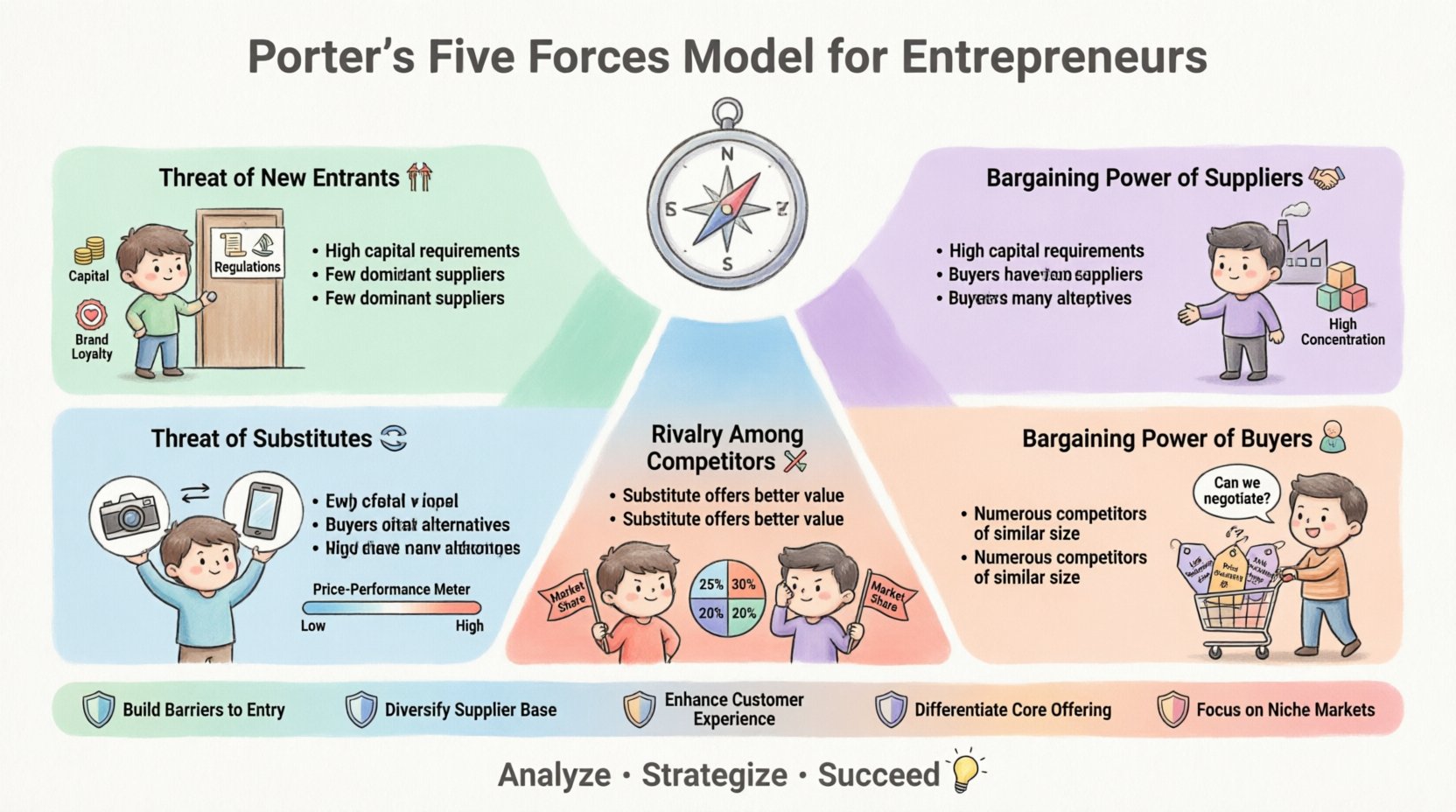
1. Understanding the Framework 🧭
Developed by Michael Porter in 1979, this framework shifts the focus from direct competitors to the broader industry structure. It argues that the profit potential of an industry is determined by five competitive forces. These forces dictate the intensity of competition and the power dynamics within a market.
- Industry Structure: The underlying economics and rules of the game.
- Strategic Positioning: Where a company fits within the value chain.
- Profitability: The ultimate outcome of the competitive interaction.
Unlike a simple SWOT analysis, this model focuses specifically on external market pressures. It helps answer critical questions about barriers to entry, supplier leverage, and customer power. For a startup, understanding these forces early prevents costly missteps in product-market fit.
2. The Five Forces Explained ⚖️
Each force represents a specific type of pressure. A high intensity in any area can erode profitability. Conversely, a low intensity suggests a healthier environment for growth. Let us break down each component.
2.1 Threat of New Entrants 🚪
This force measures how easy or difficult it is for new competitors to enter the market. If entry barriers are low, established players face constant disruption. High barriers protect incumbents and allow for sustained margins.
Key indicators to evaluate include:
- Capital Requirements: How much money is needed to start operations? High capital needs deter small players.
- Regulatory Hurdles: Licenses, permits, and compliance standards can create significant friction.
- Access to Distribution: Can a new player reach customers effectively? Retail shelf space or digital channels are often gatekept.
- Brand Loyalty: Do customers stick with existing providers? Strong brand equity acts as a shield.
- Cost Advantages: Incumbents may have economies of scale that new entrants cannot match immediately.
For example, in the automotive industry, the capital required for manufacturing plants creates a high barrier. In contrast, a digital service might have low startup costs, increasing the threat of new entrants.
2.2 Bargaining Power of Suppliers 🤝
Suppliers can squeeze profitability by raising prices or reducing quality. This power depends on the number of suppliers available and the uniqueness of their products.
Factors influencing supplier power include:
- Concentration: Are there few suppliers or many? Fewer suppliers usually mean more power.
- Switching Costs: How expensive is it to change providers? High costs lock buyers in.
- Substitutability: Can the input be replaced by something else? Unique inputs increase supplier leverage.
- Forward Integration: Can suppliers enter your market? The threat of them becoming competitors adds pressure.
- Importance of Volume: Does the supplier care about your business? If you are a small buyer, your leverage drops.
Consider the semiconductor industry. A few companies control the advanced chip manufacturing process. Device makers must pay the prices set by these suppliers, limiting their own margin potential.
2.3 Bargaining Power of Buyers 👥
Customers demand lower prices and higher quality. When buyers have significant power, they dictate terms. This force is the opposite of supplier power but equally critical.
Buyer power increases when:
- Concentration: A few large buyers purchase most of the volume.
- Price Sensitivity: Buyers are actively looking for cheaper alternatives.
- Standardized Products: If products are identical, buyers switch easily based on price.
- Information Availability: Buyers know the market price and product details.
- Threat of Backward Integration: Can buyers make the product themselves? This threat limits pricing power.
In the B2B software sector, enterprise clients often have high power. They can negotiate bulk discounts and demand specific features, forcing vendors to compete on service rather than price alone.
2.4 Threat of Substitutes 🔄
Substitutes are products from different industries that solve the same problem. They place a ceiling on prices. If a substitute is cheaper or better, customers will switch.
Consider these aspects:
- Price-Performance Ratio: Is the substitute more affordable for similar value?
- Switching Costs: How hard is it for a customer to change habits?
- Perceived Value: Does the customer view the substitute as equivalent?
- Industry Growth: Is the substitute industry growing faster than yours?
A classic example is the travel industry. Airlines face substitution from video conferencing tools for business meetings. The technology offers a cheaper alternative to physical travel, impacting revenue.
2.5 Rivalry Among Existing Competitors ⚔️
This is the most visible force. It involves the intensity of competition between current players. High rivalry leads to price wars, advertising battles, and innovation races.
Intensity rises when:
- Number of Competitors: Many equal-sized rivals create chaos.
- Industry Growth: Slow growth forces companies to fight for market share.
- Fixed Costs: High fixed costs encourage price cutting to cover overhead.
- Differentiation: If products are undifferentiated, competition becomes price-based.
- Exit Barriers: If it is hard to leave the market, companies stay and fight longer.
The airline industry exemplifies high rivalry. Margins are thin, products are similar, and fixed costs are massive. This environment makes profitability difficult without strict cost control.
3. How to Conduct the Analysis 📝
Applying this framework requires data and honest assessment. It is not enough to guess the intensity of each force. You must gather evidence to support your conclusions.
3.1 Data Collection Strategies
- Market Research: Review industry reports, government data, and trade publications.
- Customer Interviews: Ask buyers about their switching costs and pain points.
- Supplier Conversations: Understand supply chain constraints and pricing models.
- Competitor Monitoring: Track pricing changes, marketing spend, and product launches.
- Financial Statements: Analyze public competitors to understand margin structures.
3.2 Scoring the Forces
To make the analysis actionable, assign a level of intensity to each force. Use a scale from Low to High. This helps visualize the overall risk profile.
| Force | Intensity Level (Low/Med/High) | Impact on Profitability |
|---|---|---|
| Threat of New Entrants | High | Reduces long-term margins |
| Bargaining Power of Suppliers | Medium | Increases input costs |
| Bargaining Power of Buyers | High | Pressures selling prices |
| Threat of Substitutes | Low | Limited immediate risk |
| Rivalry Among Competitors | High | Increases marketing spend |
Once scored, you can identify the critical areas. If buyer power is high, your strategy must focus on differentiation or loyalty programs. If entry barriers are low, you must build a moat quickly.
4. Strategic Responses to Each Force 🛡️
Identifying the forces is only the first step. You must formulate a response to mitigate risks. Here are specific actions for each pressure point.
4.1 Countering New Entrants
- Invest in proprietary technology that is hard to replicate.
- Build strong customer relationships and switching costs.
- Secure exclusive distribution agreements early.
- Scale operations to achieve cost advantages.
4.2 Reducing Supplier Power
- Diversify your supplier base to avoid reliance on one partner.
- Negotiate long-term contracts with fixed pricing.
- Consider vertical integration by producing inputs in-house.
- Develop substitute materials or components.
4.3 Mitigating Buyer Power
- Focus on brand building to reduce price sensitivity.
- Create unique features that add value beyond the core product.
- Offer bundled services to increase switching costs.
- Target niche segments where buyers have less leverage.
4.4 Managing Substitutes
- Improve the price-performance ratio of your offering.
- Educate customers on the specific benefits of your solution.
- Innovate continuously to stay ahead of new technologies.
- Monitor emerging trends in adjacent industries.
4.5 Navigating Rivalry
- Differentiate on service rather than product features.
- Focus on a specific segment to reduce direct competition.
- Collaborate with competitors on industry standards where possible.
- Improve operational efficiency to lower costs.
5. Common Pitfalls to Avoid ⚠️
Even experienced strategists make mistakes when applying this model. Awareness of these errors can save time and resources.
- Static Analysis: Markets change. A force that is low today might be high tomorrow. Update your analysis regularly.
- Ignoring the Ecosystem: Focus on the direct industry but also consider the broader value chain.
- Overlooking Substitutes: Don’t just look at direct competitors. Watch for disruptive technologies from other sectors.
- Confusing Segments: An industry might have low rivalry overall but high rivalry in specific segments. Be granular.
- Ignoring Internal Capabilities: The model is external. You must align external analysis with internal strengths.
6. Integrating with Other Tools 🔗
While powerful on its own, this framework works best when combined with other strategic tools. This creates a holistic view of the business environment.
6.1 SWOT Analysis
The Five Forces provide the “Threats” and “Opportunities” for a SWOT analysis. The external pressures you identified feed directly into the external factors of your SWOT matrix. This ensures your strategic planning is grounded in market reality.
6.2 PESTLE Analysis
PESTLE looks at macro-environmental factors (Political, Economic, Social, Technological, Legal, Environmental). The Five Forces focus on industry structure. Using both ensures you do not miss broader shifts that could alter the industry landscape.
6.3 Value Chain Analysis
Once you understand the external forces, look inward. The Value Chain analysis helps identify where you create value. Combining external pressure with internal efficiency leads to sustainable competitive advantage.
7. Real-World Application Examples 🌍
Let us look at how this applies to specific scenarios.
7.1 The Streaming Industry
In streaming, rivalry is intense. Many players compete for the same content and subscribers. However, the threat of new entrants is moderate due to high content licensing costs. Buyer power is high because customers can cancel subscriptions easily. Substitutes include traditional cable, gaming, and social media. The strategy for success here involves original content creation to differentiate.
7.2 The Electric Vehicle (EV) Sector
EV manufacturing faces high capital requirements, deterring some new entrants. However, tech companies are entering the space, increasing rivalry. Supplier power is high due to battery technology constraints. Buyers are becoming more educated, increasing their power. The strategic response involves securing battery supply chains and building a charging network.
8. Dynamic Industries and Future Trends 📈
Not all industries are created equal. Some evolve rapidly, making the Five Forces analysis a snapshot rather than a movie. In dynamic sectors like technology or biotech, the forces shift quickly.
For entrepreneurs in these spaces:
- Conduct analysis quarterly rather than annually.
- Monitor patent filings and R&D spend of competitors.
- Watch for regulatory changes that could alter barriers.
- Be prepared to pivot if a force becomes overwhelmingly hostile.
The goal is agility. A rigid strategy based on old data can lead to failure. Continuous monitoring allows you to adapt your positioning as the landscape shifts.
9. Final Thoughts on Strategic Clarity 🧠
Successful entrepreneurship relies on a clear understanding of the market. The Five Forces Model offers a disciplined approach to this understanding. It moves beyond gut feeling and into structured analysis. By evaluating entry barriers, supplier leverage, buyer power, substitutes, and rivalry, you gain a roadmap for navigating competition.
Use this framework as a living document. Revisit it as you launch products and as the market evolves. The insights gained will inform your pricing, marketing, and product development decisions. This clarity is the foundation of a resilient business.


Comments (0)