![Free eBooks of IT [BooksOfAll]](https://www.booksofall.com/wp-content/uploads/2022/06/booksofall-logo-2.png)
Tags:
Common Mistakes When Applying the Five Forces Framework
Strategic planning requires more than just intuition; it demands a rigorous examination of the competitive landscape. The Five Forces framework, developed by Michael Porter, remains a cornerstone of industry analysis. It provides a structured way to assess the intensity of competition and the profitability potential within a specific market. However, even seasoned strategists fall into traps that render the analysis ineffective. Applying this model correctly requires precision, context, and an understanding of dynamic market forces.
When executed poorly, the framework can lead to false conclusions, wasted resources, and missed opportunities. This guide dissects the most prevalent errors found in industry analysis. By understanding these pitfalls, you can refine your strategic approach and ensure your assessments reflect reality rather than theoretical assumptions.
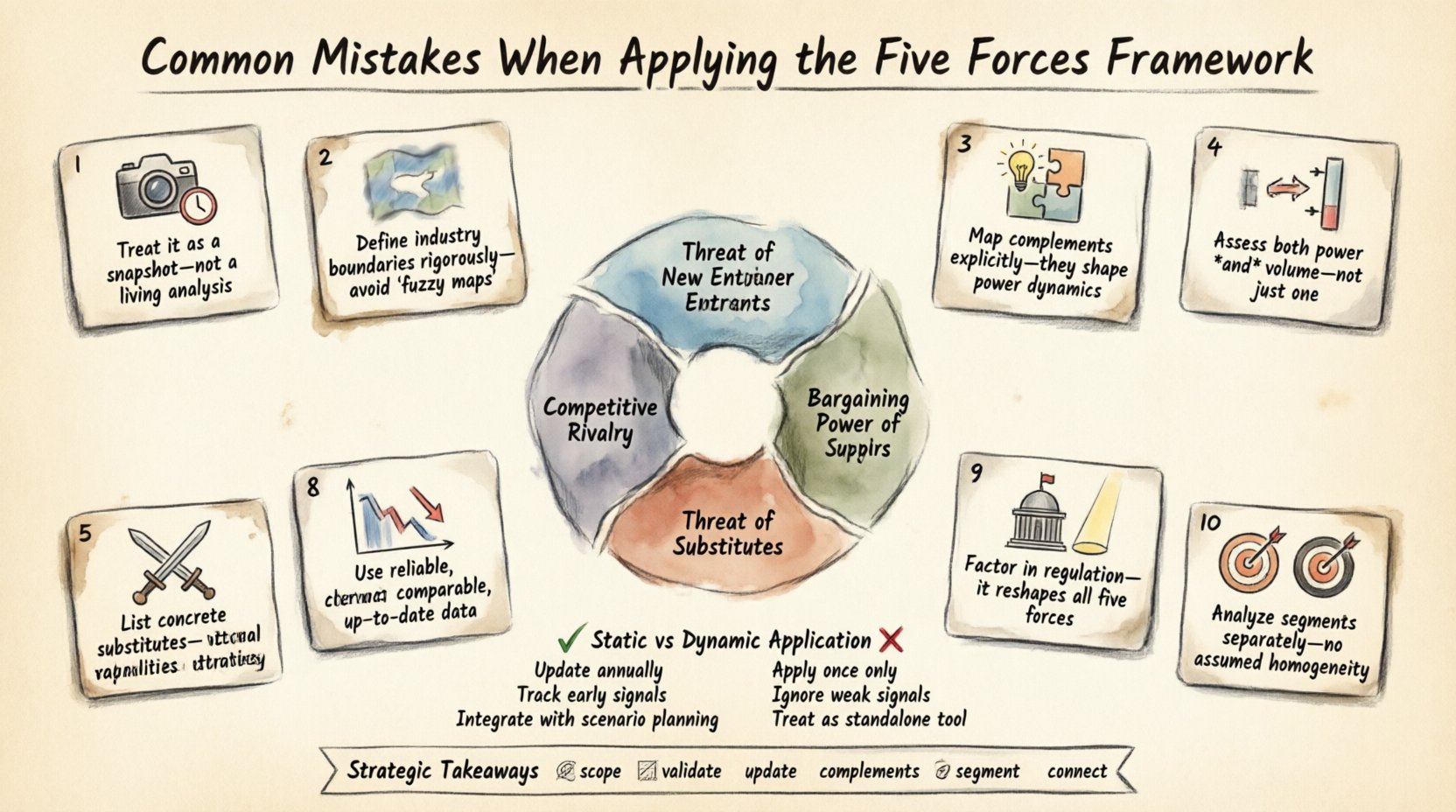
1. Treating the Analysis as a Static Snapshot 📸
One of the most significant errors is viewing the Five Forces as a one-time exercise. Markets are fluid. Technologies shift, consumer behaviors evolve, and regulations change. A static analysis provides a moment in time but fails to capture the trajectory of the industry.
- The Trap: Creating a report once a year and treating it as the definitive truth for the next twelve months.
- The Consequence: Strategies based on outdated data become obsolete before they are fully implemented.
- The Fix: Establish a regular review cycle. Update the analysis quarterly or when major external events occur.
Dynamic analysis accounts for the velocity of change. For example, a rise in raw material costs might not be immediately apparent in a static report but could be predicted through trend monitoring. Integrating real-time data points ensures the framework remains relevant.
2. Misdefining the Industry Boundaries 🗺️
The accuracy of your analysis hinges on how you define the industry. Too broad, and the data becomes diluted. Too narrow, and you miss critical competitive threats. This is often the root cause of flawed strategic insights.
Industry Definition Errors
- Product Focus vs. Need Focus: Defining an industry by the product (e.g., “coffee shops”) rather than the underlying need (e.g., “quick caffeine solutions”) can exclude vital substitutes.
- Geographic Limitations: Assuming a local market when global players have already entered the supply chain.
- Segment Ignorance: Analyzing the “premium” segment while ignoring the “budget” segment, or vice versa, when they influence each other.
To correct this, clearly articulate the scope of the analysis. Document the criteria used to include or exclude competitors. This transparency allows stakeholders to understand the limitations of the data.
3. Overlooking Complementary Products 💡
Porter’s original model did not explicitly include “complements” as a sixth force, though modern interpretations often do. Many analysts neglect how complementary goods affect the value proposition of their primary product.
Consider the automotive industry. The value of a gas-powered car depends on the availability and price of gasoline. If fuel becomes scarce or expensive, the threat of substitutes (electric vehicles) increases dramatically. Ignoring this relationship leads to an incomplete view of demand elasticity.
Complement Impact Checklist
- What other products must be purchased alongside yours?
- How does the price of complements affect the demand for your product?
- Are there technological shifts that make complements obsolete?
- Does the synergy between products create a barrier to entry?
By mapping these relationships, you identify leverage points that competitors might miss. This is particularly relevant in tech ecosystems where hardware and software must work in tandem.
4. Confusing Bargaining Power with Volume 📊
Assessing the bargaining power of buyers and suppliers often relies on volume. A common mistake is assuming that large buyers always hold more power. While volume is a factor, it is not the only determinant.
| Factor | High Power Indicator | Low Power Indicator |
|---|---|---|
| Concentration | Few buyers dominate the market | Fragmented buyer base |
| Switching Costs | Low cost to change suppliers | High cost to change suppliers |
| Information | Buyers know market prices easily | Buyers rely on supplier expertise |
| Threat of Integration | Buyers can make the product themselves | Buyers must buy externally |
Volume alone does not dictate power. A small buyer with unique requirements or low switching costs can exert significant pressure. Conversely, a massive buyer locked into a proprietary system may have limited leverage. Evaluating the underlying dynamics ensures a more accurate power assessment.
5. Misinterpreting Barriers to Entry 🚧
Barriers to entry are often cited as the reason for low competition, but they are frequently misunderstood. Analysts sometimes conflate regulatory hurdles with natural economic barriers.
- Capital Requirements: High upfront costs do not always stop entry if the return on investment is sufficient.
- Regulatory Hurdles: Licenses can be obtained or bypassed through partnerships, reducing the barrier over time.
- Brand Loyalty: This is a psychological barrier. It can be eroded by superior value propositions or aggressive marketing.
- Access to Distribution: In the digital age, this barrier has lowered significantly compared to physical retail.
When evaluating entry threats, consider the *economic* viability for a new entrant, not just the legal or technical difficulty. If a new competitor can enter and still achieve profitability, the barrier is lower than it appears.
6. Neglecting Substitute Products Beyond Direct Competitors ⚔️
A frequent oversight is focusing only on direct competitors while ignoring substitutes. A substitute does not need to be the same product; it only needs to solve the same problem.
For instance, a cinema operator might worry about streaming services. A movie theater might also face competition from home entertainment systems or even video games. These are substitutes for the “entertainment experience,” not just the “movie ticket.” If the analysis only looks at other theaters, the threat from digital media is underestimated.
Substitute Identification Steps
- Identify the core function the customer is paying for.
- List all alternative ways to achieve that function.
- Analyze the price-performance trade-off of these alternatives.
- Assess how the cost of switching between these alternatives changes over time.
Understanding the substitute threat helps in pricing strategy and product development. It forces the organization to compete on value rather than features alone.
7. Failing to Integrate Internal Capabilities 🔗
The Five Forces framework analyzes the external environment. It does not account for internal strengths or weaknesses. A common mistake is using the external analysis in isolation to drive strategy without considering the organization’s ability to execute.
You might identify a low-threat industry, but if your team lacks the resources to capture market share, the opportunity is theoretical. Conversely, a high-threat industry might be navigable if you possess unique capabilities that others lack.
- Resource Alignment: Do you have the talent to support the strategy derived from the analysis?
- Cultural Fit: Does the organizational culture support the required changes?
- Financial Health: Can the company withstand the price wars or capital investments implied by the analysis?
Strategic decisions must bridge the gap between external opportunity and internal reality. The framework provides the “where,” but internal assessment provides the “how.”
8. Data Collection and Quality Issues 📉
Garbage in, garbage out. The quality of the Five Forces analysis depends entirely on the quality of the data used. Relying on anecdotal evidence or outdated reports is a critical failure point.
Data Sources to Prioritize
- Primary Research: Interviews with customers and suppliers.
- Financial Statements: Public filings of competitors.
- Market Reports: Third-party industry studies.
- Regulatory Filings: Patent databases and government records.
Triangulating data from multiple sources reduces the risk of bias. If one source suggests high supplier power, verify it with financial data showing margin compression for the industry.
9. Overlooking the Role of Government and Regulation 🏛️
While Porter’s model focuses on market forces, government intervention can alter the balance of power instantly. Tax incentives, tariffs, and environmental regulations can shift the profitability of an entire sector.
Ignoring policy trends is a strategic blind spot. For example, a shift towards carbon neutrality might increase costs for suppliers in the manufacturing sector, altering the bargaining power dynamic. Analysts must monitor legislative trends as closely as market trends.
10. Assuming Homogeneity Within the Industry 🎯
Industries are rarely uniform. A single industry often contains segments with vastly different profit pools. Analyzing the “industry” as a whole can mask the realities of specific niches.
Consider the airline industry. Some routes are highly profitable, while others bleed money. Some carriers operate on a low-cost model, while others focus on luxury. Aggregating this data dilutes the insight. Segmenting the industry before applying the forces yields sharper results.
Comparison: Static vs. Dynamic Application
| Aspect | Static Application (Common Mistake) | Dynamic Application (Best Practice) |
|---|---|---|
| Frequency | Annual review | Continuous monitoring |
| Data Source | Historical reports | Real-time market signals |
| Scope | Fixed industry definition | Evolving industry boundaries |
| Output | One-time strategy document | Ongoing strategic dashboard |
Strategic Takeaways for Robust Analysis ✅
To avoid these pitfalls, adopt a disciplined approach to the framework. Treat the Five Forces not as a checklist, but as a lens through which to view the market. Here are actionable steps to refine your process.
- Define Scope Explicitly: Document exactly what is included in your industry definition.
- Validate Data: Cross-reference assumptions with multiple independent sources.
- Update Regularly: Schedule specific times to revisit the analysis.
- Include Complements: Add the impact of complementary products to your threat assessment.
- Segment Markets: Analyze sub-segments separately if they differ significantly.
- Connect to Internal Strengths: Always pair external analysis with an internal capability review.
By addressing these common errors, you enhance the reliability of your strategic planning. The goal is not perfection, but clarity. A clear understanding of the competitive forces allows for better decision-making, resource allocation, and risk management.
Remember, the framework is a tool for thinking, not a crystal ball. It structures your thought process, but the insights depend on the rigor of your execution. Avoid shortcuts and superficial assessments. Invest time in the details, and the strategic value will follow.


Comments (0)