![Free eBooks of IT [BooksOfAll]](https://www.booksofall.com/wp-content/uploads/2022/06/booksofall-logo-2.png)
Tags:
Five Forces Model Checklist for Small Business Owners
Strategic planning is not an activity reserved for large corporations with vast resources. Small business owners face unique challenges in their marketplaces, often competing against established giants or agile startups. To survive and grow, understanding the structural profitability of your industry is essential. The Five Forces Model, developed by Michael Porter, provides a structured framework for analyzing the competitive intensity and attractiveness of a market.
This guide offers a detailed checklist to help you evaluate your business environment. By systematically assessing each force, you can identify risks, uncover opportunities, and make informed decisions about where to allocate resources. This is not about predicting the future with certainty, but about understanding the current landscape with clarity.
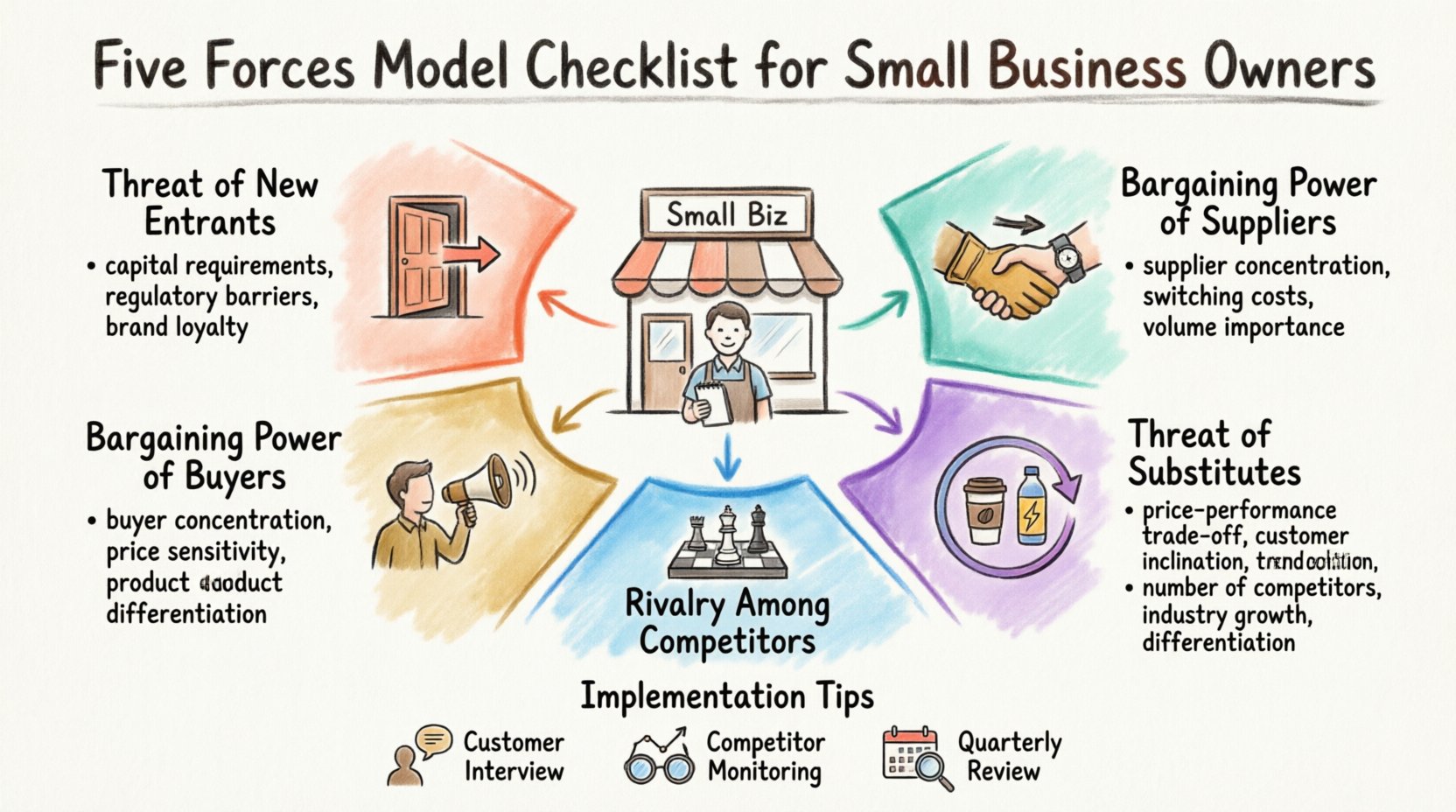
🔍 Understanding the Framework
Porter’s Five Forces is a tool used to analyze the level of competition within an industry. It looks beyond direct competitors to include five distinct forces that shape industry competition. For a small business, these forces often dictate pricing power, profit margins, and long-term viability.
Most small business owners focus heavily on their direct rivals. While important, this view is too narrow. A new technology, a change in supplier costs, or a shift in customer habits can be just as damaging as a competitor’s price cut. This checklist ensures you look at the entire ecosystem.
Why use this checklist?
- Clarity: It breaks down complex market dynamics into manageable components.
- Strategy: It helps align your business model with industry realities.
- Risk Management: It highlights vulnerabilities before they become critical issues.
- Opportunity: It reveals gaps where competitors are weak and you can lead.
📊 Quick Reference: The Five Forces
Before diving into the detailed checklist, review this summary table to understand the core focus of each force.
| Force | Primary Question | Impact on Business |
|---|---|---|
| Threat of New Entrants | How easy is it for others to start competing? | High threat = Lower prices/margins |
| Bargaining Power of Suppliers | How much control do vendors have over costs? | High power = Higher input costs |
| Bargaining Power of Buyers | How much leverage do customers have? | High power = Lower prices demanded |
| Threat of Substitutes | Can customers solve the problem differently? | High threat = Limits pricing power |
| Rivalry Among Competitors | How intense is the competition? | High rivalry = Price wars/marketing costs |
🚀 1. Threat of New Entrants
This force measures how easy it is for new competitors to enter your market. If barriers to entry are low, new players can quickly erode market share and profitability. For small businesses, this is often a critical concern as large corporations can sometimes enter niche markets with significant capital.
Key Factors to Evaluate:
- Capital Requirements: How much money is needed to start? High costs protect incumbents.
- Regulatory Barriers: Are there licenses, permits, or compliance standards that are difficult to meet?
- Access to Distribution: Can a new player easily reach customers, or are channels controlled by existing firms?
- Brand Loyalty: Do customers stick to known names, or are they open to trying new options?
- Cost Advantages: Do you have proprietary technology or exclusive resources that are hard to replicate?
Checklist Questions:
- Is the initial investment to start a similar business low or high?
- Are there legal restrictions that prevent new players from operating?
- Do customers require a long-term commitment to switch providers?
- Is your technology protected by patents or trade secrets?
- How much does it cost for a new competitor to acquire their first 100 customers?
Actionable Insight: If the threat is high, focus on building deep relationships with customers and creating switching costs. If the threat is low, you can invest more in long-term growth without fear of immediate disruption.
🏭 2. Bargaining Power of Suppliers
Your suppliers hold power if they can raise prices or reduce quality without losing your business. This force is particularly relevant for small businesses that may lack the volume to negotiate favorable terms. High supplier power squeezes your profit margins.
Key Factors to Evaluate:
- Supplier Concentration: Is the market dominated by a few large vendors, or are there many options?
- Switching Costs: How difficult and expensive is it to move to a different supplier?
- Importance of Volume: Does your business represent a significant portion of their revenue?
- Product Differentiation: Is your supplier’s input unique, or is it a commodity available everywhere?
- Threat of Forward Integration: Could the supplier decide to become your competitor?
Checklist Questions:
- How many alternative suppliers exist for your key raw materials?
- Are your suppliers dependent on you for a large share of their sales?
- Is there a risk of them raising prices due to their own cost increases?
- Do you have long-term contracts that lock in pricing?
- Are there specific technical requirements that make switching suppliers difficult?
Actionable Insight: Diversify your supply chain. Relying on a single vendor is a risk. Negotiate volume discounts or explore partnerships with other small businesses to aggregate purchasing power.
🤝 3. Bargaining Power of Buyers
Customers have power when they can demand lower prices or higher quality. If your customers have many options and switching is easy, their power is high. This force forces businesses to constantly justify their value proposition.
Key Factors to Evaluate:
- Buyer Concentration: Are you selling to a few large clients or many small individuals?
- Price Sensitivity: Does the price of your product significantly impact the buyer’s decision?
- Product Differentiation: Is your offering unique enough that buyers cannot easily compare it to others?
- Switching Costs: How much effort does it take for a customer to move to a competitor?
- Information Availability: Do buyers have access to information about prices and quality across the market?
Checklist Questions:
- Can customers easily find alternative solutions online?
- Are your customers buying in large volumes that give them leverage?
- Do your customers have the ability to integrate backward (make it themselves)?
- How much of your customer’s total cost does your product represent?
- Is the quality of your product critical to the buyer’s business outcomes?
Actionable Insight: Focus on value-added services that make switching less attractive. Build a community around your brand or offer customization that generic competitors cannot match.
🔄 4. Threat of Substitute Products
Substitutes are products from outside your industry that solve the same problem. They place a ceiling on the prices you can charge. If a substitute becomes cheaper or more convenient, customers will leave even if you lower your prices.
Key Factors to Evaluate:
- Price-Performance Trade-off: Is the substitute cheaper but less effective, or better and more expensive?
- Customer Inclination: Are customers already open to alternative solutions?
- Switching Costs: How much hassle is involved in changing to the substitute?
- Trend Adoption: Is technology or consumer behavior shifting toward the substitute?
Checklist Questions:
- Are there non-traditional solutions solving the same customer problem?
- Is the substitute gaining popularity in the broader market?
- Does the substitute offer a significantly better user experience?
- Are there regulatory changes that make substitutes more attractive?
- How does the total cost of ownership compare to your offering?
Actionable Insight: Monitor adjacent industries. Sometimes the biggest threat comes from a company you do not consider a direct competitor. Adapt your messaging to highlight why your specific solution is superior to the alternative.
⚔️ 5. Rivalry Among Existing Competitors
This force looks at the intensity of competition between current players. High rivalry leads to price wars, increased advertising spend, and product innovation races. It is often the most visible force but should be analyzed in the context of the other four.
Key Factors to Evaluate:
- Number of Competitors: Is the market fragmented or dominated by a few large players?
- Industry Growth: Is the market growing slowly (fighting for share) or quickly (everyone grows)?
- Exit Barriers: Is it hard to leave the industry (e.g., specialized equipment, emotional ties)?
- Differentiation: Are products viewed as commodities, or is there clear distinction?
- Fixed Costs: Are there high fixed costs that pressure firms to fill capacity?
Checklist Questions:
- Are competitors frequently cutting prices?
- Is there high marketing activity in your sector?
- Are there many players of similar size and power?
- Is the industry growing at a slow pace?
- Do competitors offer similar products with little differentiation?
Actionable Insight: Avoid competing solely on price. Differentiate through service, niche focus, or brand reputation. If the market is growing, focus on capturing new customers rather than stealing existing ones.
🛠️ Implementing the Analysis
Completing the checklist is the first step. The real value comes from acting on the insights. Here is how to integrate this analysis into your daily operations.
Data Collection Methods
You do not need expensive market research firms to gather this data. Small business owners can collect intelligence through:
- Customer Interviews: Ask clients why they chose you and what they considered before.
- Competitor Monitoring: Sign up for competitor newsletters and track their pricing changes.
- Supplier Conversations: Ask suppliers about market trends and raw material availability.
- Industry Reports: Look for government data or trade association publications.
- Social Listening: Monitor online discussions about your industry pain points.
Strategic Adjustments
Once you have scored each force (Low, Medium, High threat), adjust your strategy accordingly.
- High Supplier Power: Invest in supplier relationships or find alternative sources.
- High Buyer Power: Increase product differentiation or loyalty programs.
- High New Entrant Threat: Build barriers through patents or exclusive partnerships.
- High Rivalry: Focus on a niche segment where competition is weaker.
🔄 Review Cycles
The business environment is dynamic. A force that is low today could be high tomorrow. Establish a regular review schedule for this checklist.
- Quarterly Review: Check for minor shifts in pricing or supplier terms.
- Annual Deep Dive: Re-evaluate all five forces with fresh data.
- Event-Driven Review: Update immediately after major industry news, regulation changes, or economic shifts.
Consistency is key. A one-time analysis provides a snapshot, but regular analysis tracks the trend. This helps you stay ahead of market shifts rather than reacting to them after the damage is done.
🚫 Common Pitfalls to Avoid
Even with a solid checklist, errors can occur during the analysis process. Be aware of these common mistakes.
- Overlooking Substitutes: Many businesses ignore substitutes because they do not look like competitors. Remember, the threat is about the customer’s need, not just the product category.
- Assuming Static Conditions: Do not treat the forces as permanent. Technology and regulation change rapidly.
- Ignoring Internal Capabilities: The forces describe the industry, but your ability to respond depends on your internal strengths. Align the analysis with your resources.
- Analysis Paralysis: Do not get stuck in endless research. Gather enough data to make a decision, then act.
📈 Final Thoughts
Using the Five Forces Model Checklist provides a disciplined approach to understanding your business context. It moves you away from guesswork and toward evidence-based strategy. By acknowledging the pressures from suppliers, buyers, entrants, substitutes, and rivals, you can build a more resilient organization.
Small business owners have the advantage of agility. While large corporations struggle to pivot, you can adapt quickly to the insights gained from this analysis. Use this tool to navigate uncertainty, protect your margins, and identify the path to sustainable growth.
Start with the checklist today. Review one force at a time. Gather your data. Make your decisions. The market will continue to change, but your preparation will remain constant.


Comments (0)