![Free eBooks of IT [BooksOfAll]](https://www.booksofall.com/wp-content/uploads/2022/06/booksofall-logo-2.png)
Tags:
Real-World Case Studies of the Five Forces in Action
Strategic planning requires a clear understanding of the competitive landscape. One of the most enduring frameworks for this analysis is Michael Porter’s Five Forces model. It provides a structured approach to evaluating the intensity of competition within an industry. This guide examines how these forces manifest in actual business environments. We will explore specific industries to understand how threat levels shift and impact profitability.
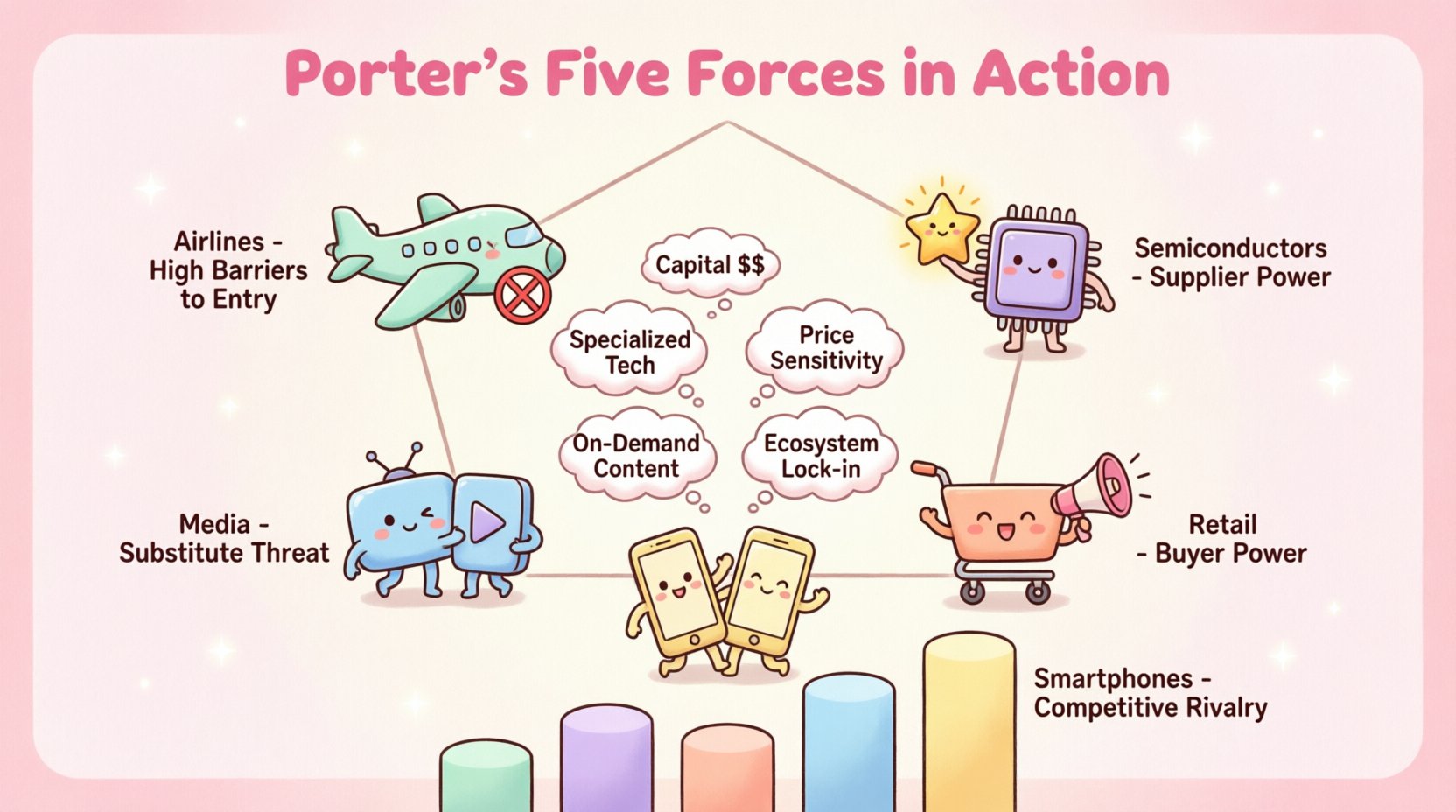
🔍 Understanding the Framework
Before diving into specific examples, it is essential to define the five components. Each force represents a factor that influences the potential for profit. They are not static; they evolve with technology, regulation, and consumer behavior.
- Threat of New Entrants: The ease with which new competitors can enter the market.
- Bargaining Power of Suppliers: The ability of suppliers to drive up prices.
- Bargaining Power of Buyers: The ability of customers to drive down prices.
- Threat of Substitute Products: The availability of alternative solutions to the core product.
- Rivalry Among Existing Competitors: The intensity of competition between current players.
These forces combine to determine the overall attractiveness of an industry. A high intensity generally means lower profitability. Conversely, a low intensity suggests room for higher margins.
✈️ Case Study 1: The Airline Industry (Threat of New Entrants)
The commercial aviation sector offers a classic example of high barriers to entry. While the idea of flying sounds simple, the operational reality is complex. Established carriers benefit from significant economies of scale that new players struggle to match.
Key Dynamics
- Capital Requirements: Purchasing aircraft involves billions of dollars. Leasing is an option, but creditworthiness is a major hurdle.
- Regulatory Hurdles: Safety certifications and international flight rights are difficult to obtain quickly.
- Brand Loyalty: Frequent flyer programs create a sticky environment for passengers.
- Distribution Channels: Established airlines have preferred access to major travel agencies and booking platforms.
Despite these barriers, low-cost carriers have entered the market successfully. They achieved this by stripping away non-essential services. They operate from secondary airports to reduce landing fees. They utilize a single type of aircraft to lower maintenance costs. This strategy proves that while entry is hard, it is not impossible if the business model is radically different.
📱 Case Study 2: Semiconductor Manufacturing (Supplier Power)
In the technology sector, the supply chain is critical. The manufacturing of chips is an extreme example of supplier power. Only a handful of companies possess the technology to produce the most advanced processors. This scarcity gives them significant leverage.
Key Dynamics
- Concentration: The industry is dominated by a few key manufacturers. If one faces a disruption, the entire ecosystem suffers.
- Specialized Equipment: The machinery required for fabrication is expensive and often sourced from a single vendor.
- Switching Costs: Changing foundries requires retooling entire production lines. This takes months and significant investment.
- Proprietary Technology: Patents and trade secrets protect the intellectual property of suppliers.
For companies designing their own chips, this dynamic creates vulnerability. They must negotiate long-term contracts to secure capacity. Price increases are common when demand outstrips supply. This forces buyers to diversify their sourcing strategies. Some choose to invest directly in manufacturing capacity to gain more control.
🛒 Case Study 3: Supermarket Retail (Buyer Power)
The grocery and retail sector is characterized by high buyer power. Customers have many options for purchasing food and household goods. Switching stores costs them very little in terms of time or money.
Key Dynamics
- Price Sensitivity: Many products are commodities. A difference of a few cents drives customers to a different aisle.
- Information Availability: Price comparison apps allow shoppers to evaluate costs instantly.
- Low Switching Costs: A loyalty card is easy to cancel. There is no contract binding the customer.
- Volume Concentration: Large chains negotiate hard with suppliers because of their purchasing volume.
Retailers respond by building private label brands. These products offer higher margins and unique differentiation. They also invest in loyalty programs to create data-driven personalization. Digital integration helps them offer convenience that physical stores cannot match. However, the power ultimately lies with the consumer. If prices rise too high, they simply leave.
📺 Case Study 4: Traditional Media vs. Streaming (Substitutes)
The entertainment industry faced a massive shift when streaming services emerged. This is a prime example of the threat of substitutes. Consumers no longer need to wait for scheduled broadcasts. They can access content on demand.
Key Dynamics
- Convenience: Streaming allows viewing anytime, anywhere, on any device.
- Cost: Multiple subscriptions are often cheaper than a full cable package.
- Content Quality: Original programming from streaming platforms competes with traditional studio output.
- Fragmentation: Content is spread across many services, increasing the complexity for users.
Traditional broadcasters saw their subscriber base decline rapidly. Ad revenue followed the audience. In response, many media companies launched their own streaming platforms. This transition required significant capital investment. It also forced a change in how content is produced and distributed. The threat of substitutes did not disappear; it evolved into a new form of competition.
📱 Case Study 5: Global Smartphone Market (Rivalry)
The smartphone industry is one of the most competitive markets in the world. Several major players vie for market share in a saturated environment. Innovation cycles are short, and margins can be thin.
Key Dynamics
- Market Saturation: Most consumers already own a smartphone. Growth comes from upgrades, not new users.
- Product Differentiation: Hardware features are becoming similar. Software ecosystems become the differentiator.
- Price Wars: Competition in emerging markets often leads to aggressive pricing.
- Speed of Innovation: Companies must release new models annually to maintain relevance.
Leaders maintain profitability through ecosystem lock-in. Services like cloud storage and app stores generate recurring revenue. Premium brands focus on high-margin hardware. Budget brands compete on volume and supply chain efficiency. The rivalry is intense, pushing all players to constantly improve their offerings. This keeps prices accessible but limits profit potential for mid-tier brands.
📊 Comparative Analysis of Industry Forces
The following table summarizes how the forces vary across the industries discussed. This helps visualize the strategic challenges in each sector.
| Industry | Entrants | Suppliers | Buyers | Substitutes | Rivalry |
|---|---|---|---|---|---|
| Airlines | High Barrier | Medium | High | Medium | Very High |
| Semiconductors | Very High | Very High | High | Low | High |
| Retail | Medium | Medium | Very High | Medium | High |
| Media/Streaming | Medium | Medium | Medium | Very High | High |
| Smartphones | Medium | High | High | Medium | Very High |
Understanding these variables allows leaders to anticipate changes. It moves the conversation from reaction to strategy. Companies can position themselves to mitigate risks before they impact the bottom line.
🚀 Strategic Implications for Modern Leaders
Applying this framework requires ongoing monitoring. Markets are not static. A force that is weak today might become strong tomorrow. Leaders must look beyond the immediate competitors.
Adapting to Change
- Monitor Regulatory Shifts: Laws regarding data privacy or antitrust can alter supplier and buyer power overnight.
- Track Technology: New manufacturing techniques can lower barriers to entry.
- Assess Consumer Trends: Sustainability and ethical sourcing are becoming new battlegrounds for buyer preference.
- Evaluate Partnerships: Collaborations can reduce rivalry and share the burden of innovation.
Strategy is not a one-time exercise. It is a continuous process of assessment. Regular reviews ensure that the business remains aligned with the current market reality.
⚖️ Limitations in a Digital Economy
While powerful, the model has limitations in today’s interconnected world. Digital platforms often blur the lines between industries. A company might be a competitor in one area and a partner in another.
Considerations
- Ecosystems: Large tech companies operate across multiple industries simultaneously. This makes defining the industry boundaries difficult.
- Network Effects: The value of a product increases as more people use it. This dynamic is not fully captured in the original framework.
- Speed of Change: The framework was designed for slower-moving industries. Digital disruption happens faster than traditional analysis cycles.
These factors suggest the model should be used as a starting point. It should be supplemented with other analytical tools. This provides a more complete picture of the competitive environment.
📈 Final Thoughts on Competitive Analysis
Porter’s Five Forces remains a vital tool for strategic planning. It forces leaders to look outside their own organization. It highlights vulnerabilities that internal metrics might miss. By studying real-world examples, we see how these forces interact in practice.
Success depends on accurate assessment and timely action. Companies that understand their industry dynamics are better positioned to navigate uncertainty. They can allocate resources where they matter most. They can build moats that protect their market position. This analysis is not about predicting the future with certainty. It is about preparing for the possibilities that arise.
Use this framework to question assumptions. Challenge the status quo. Identify where power lies and where it is shifting. This disciplined approach to market analysis provides a foundation for sustainable growth.


Comments (0)