![Free eBooks of IT [BooksOfAll]](https://www.booksofall.com/wp-content/uploads/2022/06/booksofall-logo-2.png)
Tags:
How to Analyze Industry Competition Using the Five Forces
Understanding the competitive landscape is fundamental to sustainable business growth. When entering a market or refining a strategy, intuition alone is insufficient. You need a structured framework to deconstruct the forces shaping your industry’s profitability. This guide details how to analyze industry competition using the Five Forces model, providing a clear path to assessing market dynamics and identifying strategic opportunities.
The Five Forces framework, developed by Michael Porter in 1979, remains one of the most robust tools for strategic planning. It moves beyond simple competitor tracking to examine the structural economic characteristics of an industry. By evaluating these five distinct pressures, organizations can determine the intensity of competition and the potential for long-term value creation.
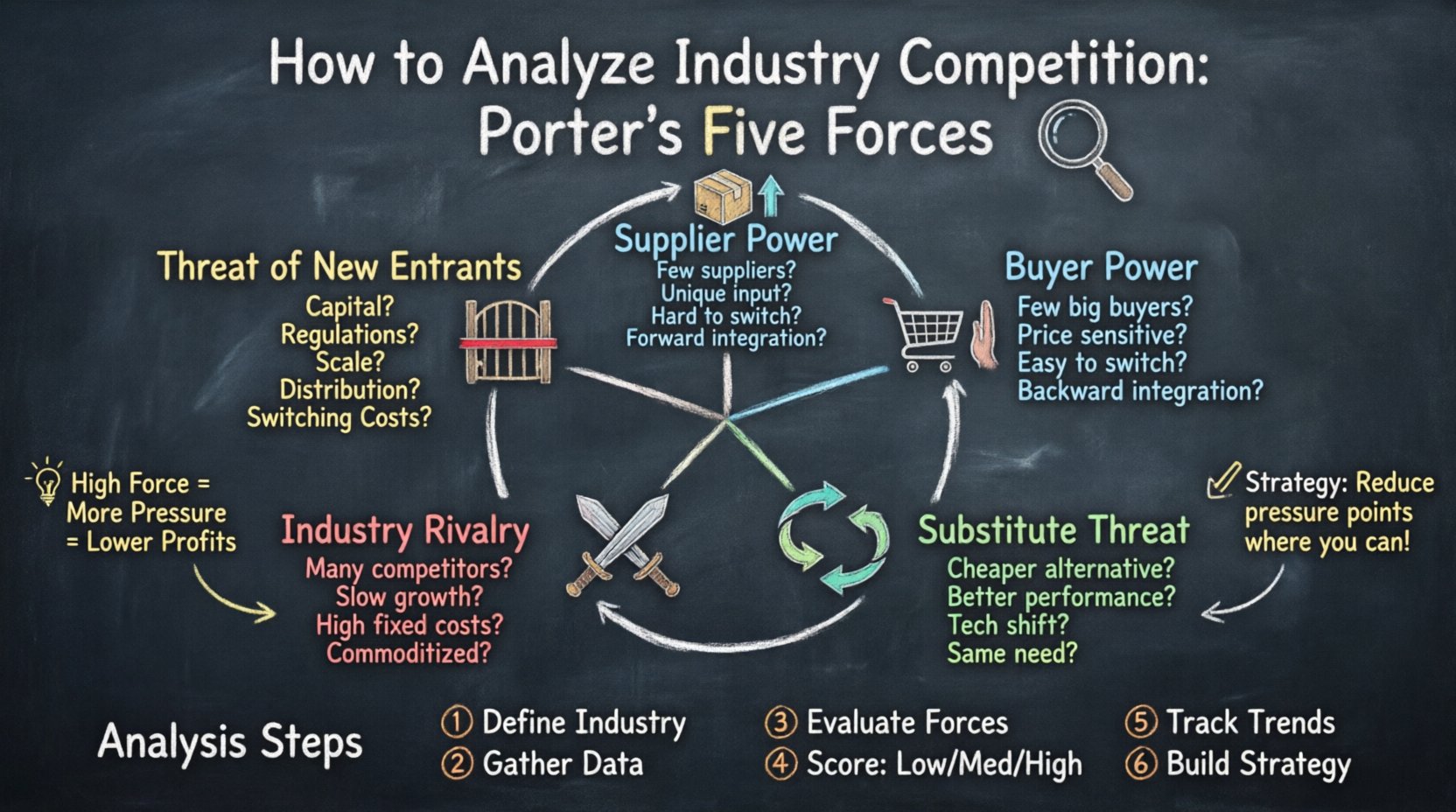
Understanding the Framework 🔍
At its core, this analysis assesses the attractiveness of an industry. It does not look at a single company, but rather the entire ecosystem in which that company operates. The model posits that the five forces collectively determine the ultimate profit potential of an industry.
- Industry Profitability: The ability of firms to generate returns above their cost of capital.
- Structural Factors: The underlying economics that dictate pricing power and cost structures.
- Strategic Positioning: How a firm can position itself to withstand these pressures.
When these forces are intense, competition is fierce, margins are thin, and investment becomes risky. When they are weak, companies can enjoy higher margins and more stable growth. The goal of this analysis is to identify where the pressure points lie.
Step-by-Step Analysis Process 🛠️
Conducting a Five Forces analysis requires a systematic approach. It involves gathering data, evaluating intensity, and synthesizing findings into actionable insights. Follow this process to ensure a comprehensive assessment.
- Define the Industry: Be specific. Are you analyzing the global smartphone market, or the budget smartphone sector in Southeast Asia? Scope matters.
- Gather Data: Collect information on market size, growth rates, and key players.
- Evaluate Each Force: Assess the strength of each of the five forces individually.
- Score Intensity: Determine if each force is Low, Medium, or High.
- Identify Trends: Consider how these forces are changing over time.
- Formulate Strategy: Adjust your business model based on the findings.
Force 1: Threat of New Entrants 🚪
This force measures how easy or difficult it is for new competitors to enter your market. High barriers to entry protect existing players, while low barriers invite saturation and price wars.
Key Indicators to Assess
- Capital Requirements: Does starting a business in this sector require massive investment in factories, technology, or inventory?
- Regulatory Hurdles: Are there licenses, patents, or compliance standards that restrict access?
- Economies of Scale: Can established players produce at a lower cost per unit than a new entrant?
- Access to Distribution: Are shelf space or sales channels controlled by incumbents?
- Customer Switching Costs: How much does it cost for a customer to switch from an existing brand to a new one?
If barriers are high, the threat is low. If the market is open to anyone with a basic idea, the threat is high. This directly impacts your pricing power and market share stability.
Force 2: Bargaining Power of Suppliers 📦
Suppliers can squeeze profitability by raising prices or reducing the quality of purchased goods and services. This force examines the leverage suppliers hold over your organization.
Key Indicators to Assess
- Supplier Concentration: Are there few suppliers dominating the market, or many small ones?
- Uniqueness of Product: Is the supplier’s input a commodity, or is it specialized and differentiated?
- Switching Costs: Is it expensive or difficult to switch to a different supplier?
- Forward Integration: Can the supplier easily enter your industry and become a competitor?
- Importance of Volume: Does your business represent a significant portion of their revenue?
When suppliers have high power, they can dictate terms, increasing your costs and lowering your margins. Diversifying your supply chain is often the primary mitigation strategy here.
Force 3: Bargaining Power of Buyers 🛒
Buyers exert pressure by demanding lower prices, higher quality, or more service. This force evaluates how much leverage your customers have in the transaction.
Key Indicators to Assess
- Buyer Concentration: Do you have many small customers, or a few large ones?
- Price Sensitivity: Is the product a commodity where price is the main differentiator?
- Switching Costs: Can customers easily move to a competitor without penalty?
- Backward Integration: Can the buyer easily produce the product themselves?
- Availability of Information: Do customers know the market price and alternatives?
High buyer power forces companies to compete on price and service, often eroding profitability. Building brand loyalty and creating high switching costs are common defenses.
Force 4: Threat of Substitute Products 🔄
Substitutes are products or services from outside the industry that satisfy the same need. They place a ceiling on prices and profits.
Key Indicators to Assess
- Price-Performance Ratio: Are substitutes cheaper or perform better?
- Switching Propensity: How easily can customers switch to the alternative?
- Trends: Are there technological shifts making your product obsolete?
- Perceived Value: Do customers view the substitute as equally effective?
A classic example is video streaming replacing physical DVD rentals. Even if your industry is profitable, the existence of a viable substitute limits how high you can price your offering.
Force 5: Rivalry Among Existing Competitors ⚔️
This is often the most visible force. It measures the intensity of competition between established players in the industry.
Key Indicators to Assess
- Number of Competitors: Is the market fragmented or concentrated?
- Industry Growth: Is the market growing slowly, forcing players to fight for market share?
- Fixed Costs: Are there high fixed costs driving firms to lower prices to utilize capacity?
- Product Differentiation: Are products commoditized, or are they unique?
- Exit Barriers: Is it difficult and expensive to leave the industry?
High rivalry leads to advertising wars, price cuts, and new product introductions, all of which increase costs and reduce returns.
Summary of Competitive Forces 📊
The table below summarizes the key questions to ask for each force to determine its intensity.
| Force | Key Question | High Intensity Indicator |
|---|---|---|
| New Entrants | How easy is it to enter? | Low capital, low regulation |
| Suppliers | Can they raise prices? | Single source, specialized input |
| Buyers | Can they demand lower prices? | Large volume, low switching costs |
| Substitutes | Can they replace the product? | Cheaper alternatives, high tech shift |
| Rivalry | Is competition fierce? | Slow growth, high exit barriers |
Gathering Data Without Tools 📝
Conducting this analysis does not require expensive software. Strategic intelligence comes from diverse information sources. Rely on primary and secondary research methods to build a clear picture.
- Public Financial Reports: Analyze 10-K filings and annual reports of public competitors to understand cost structures and margins.
- Industry Trade Associations: These organizations often publish white papers, market size data, and trend forecasts.
- Customer Interviews: Direct conversations reveal switching costs, satisfaction levels, and price sensitivity.
- Supplier Conversations: Speak with vendors to understand input costs and availability.
- News and Media: Track press releases regarding mergers, new product launches, and regulatory changes.
Organize this data into a central repository. Look for patterns and contradictions. Consistency across multiple sources increases the reliability of your conclusions.
Turning Insights Into Action 🚀
An analysis is only as good as the strategy it informs. Once you understand the forces, you must adapt your business model to navigate them effectively.
- Reduce Supplier Power: Negotiate long-term contracts, find alternative sources, or integrate backward.
- Reduce Buyer Power: Differentiate through branding, increase switching costs, or create loyalty programs.
- Defend Against Entrants: Invest in patents, build brand loyalty, or secure exclusive distribution channels.
- Monitor Substitutes: Innovate continuously to stay ahead of alternative solutions.
- Manage Rivalry: Focus on niche segments where competition is less intense.
Strategy is about making choices. You cannot win against all forces simultaneously. Prioritize the forces that impact your bottom line the most and allocate resources accordingly.
Common Pitfalls to Avoid ⚠️
Even with a solid framework, errors in execution can lead to flawed strategies. Be aware of these common mistakes.
- Static Analysis: The market is not static. Forces change over time. Revisit the analysis regularly.
- Ignoring Complements: Products that enhance your value (complements) can be as important as substitutes.
- Defining the Industry Too Broadly: If you define the market too wide, the analysis becomes useless. Be specific.
- Overlooking Internal Capabilities: Your ability to withstand pressure depends on your internal strengths, not just the external forces.
- Confirmation Bias: Do not look only for data that supports your preferred strategy. Seek disconfirming evidence.
Final Strategic Synthesis 🧩
Applying the Five Forces model provides a disciplined way to evaluate the competitive environment. It shifts the focus from internal capabilities alone to the external economic realities of the market.
When you combine this analysis with an understanding of your own internal strengths, you create a comprehensive strategic picture. You can identify where the value lies, where the risks are, and how to position your organization for sustainable success.
Remember that this is a tool for thinking, not just a checklist. The insights gained should drive decision-making at the highest level, influencing investment, pricing, and operational priorities.
By regularly assessing these forces, you maintain a clear view of the battlefield. This awareness allows for proactive adjustments rather than reactive scrambling when market conditions shift.


Comments (0)