![Free eBooks of IT [BooksOfAll]](https://www.booksofall.com/wp-content/uploads/2022/06/booksofall-logo-2.png)
Tags:
Five Forces Model: A Beginner’s Step-by-Step Tutorial
Understanding the competitive landscape is critical for any organization aiming for long-term success. Whether you are launching a new venture or refining an existing strategy, knowing the forces at play within your industry provides clarity. This guide explores the Porter’s Five Forces Model, a framework designed to analyze industry attractiveness and profitability. We will break down each component, walk through the application process, and highlight common mistakes to avoid. 🧐
Developed by Michael Porter in 1979, this model remains a cornerstone of strategic management. It moves beyond simple competitor analysis to examine the structural dynamics of an industry. By evaluating these five specific forces, you can determine the intensity of competition and the potential for profit. This tutorial is designed for beginners who want to grasp the fundamentals without getting lost in jargon. Let us begin. 🚀
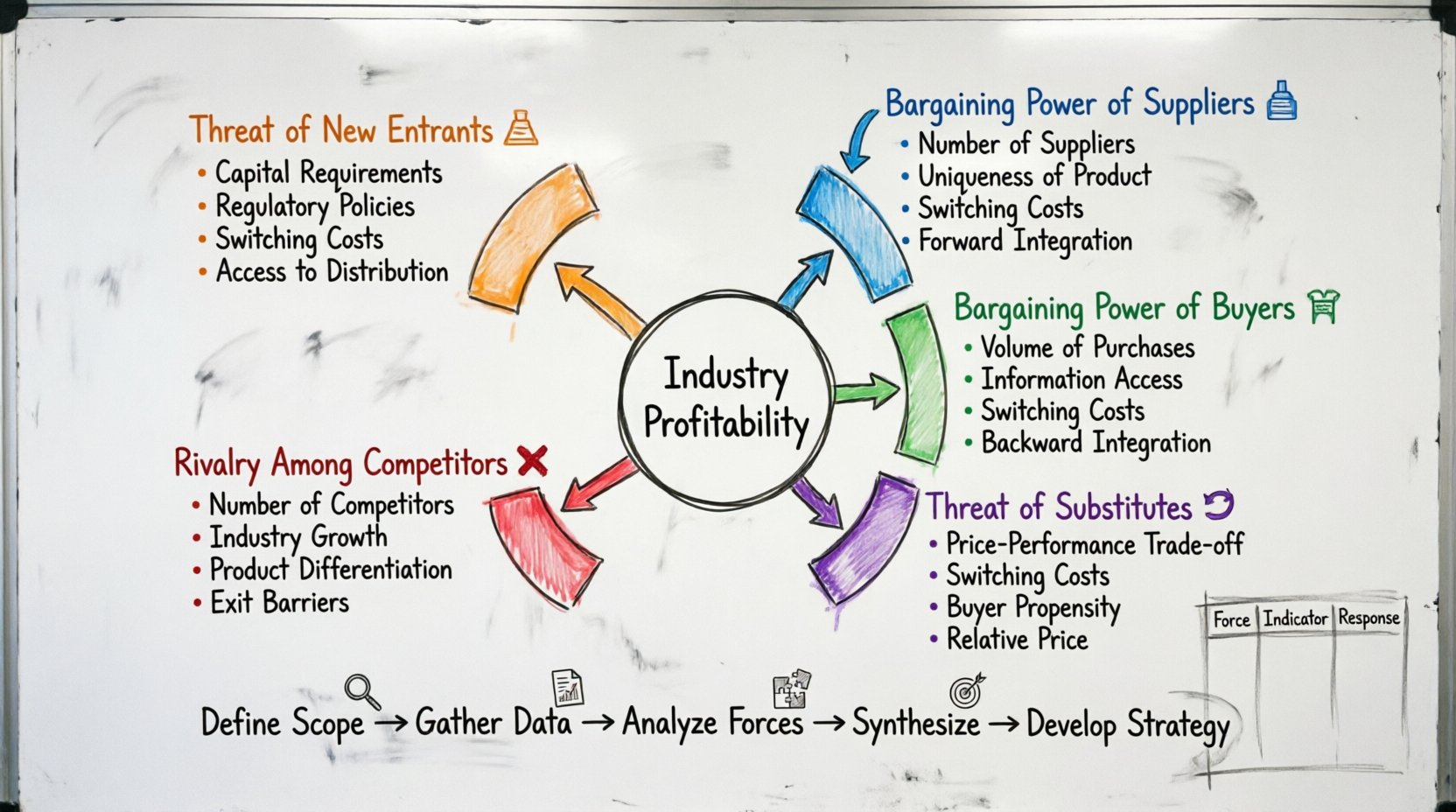
What is the Five Forces Model? 🤔
The Five Forces Model is a framework used to analyze the competitive environment of a business. It suggests that the profitability of an industry depends on five distinct forces. These forces determine the intensity of competition and the profit potential. If these forces are strong, industry profitability is low. If they are weak, profitability is high.
This framework helps organizations understand where power lies in a business situation. It helps identify strengths and weaknesses, as well as opportunities and threats. The goal is not just to look at direct competitors, but to look at the broader ecosystem that influences pricing, costs, and demand.
Why Use This Framework?
- Strategic Planning: It aids in making informed decisions about entering or exiting markets.
- Resource Allocation: It helps direct resources toward areas with the highest return.
- Risk Assessment: It highlights external threats that could undermine performance.
- Competitive Advantage: It reveals where a company can differentiate itself.
The Five Forces Explained 🔍
To apply this model effectively, you must understand each force individually. Below is a detailed breakdown of each component, including the key questions to ask and the factors that influence them.
1. Threat of New Entrants 🚧
This force measures how easy or difficult it is for new competitors to enter the market. If entry is easy, established companies face constant pressure from new rivals. If entry is hard, existing companies can maintain higher prices and profits.
- Capital Requirements: High startup costs create barriers. For example, manufacturing requires significant investment.
- Regulatory Policies: Government licenses or patents can restrict entry.
- Switching Costs: If customers find it hard to switch to a new provider, entry is harder.
- Access to Distribution: Securing shelf space or online visibility can be a hurdle.
2. Bargaining Power of Suppliers 💼
Suppliers can exert power by raising prices or reducing quality. This force examines how much control suppliers have over the cost of inputs. If suppliers are few and powerful, they can squeeze the industry’s profit margins.
- Number of Suppliers: Fewer suppliers mean higher power.
- Uniqueness of Product: If the input is unique, switching is difficult.
- Switching Costs: High costs to change suppliers increase their power.
- Forward Integration: If suppliers can produce the final product themselves, they threaten the industry.
3. Bargaining Power of Buyers 🛒
Buyers (customers) have power when they can demand lower prices or higher quality. This force looks at how much influence customers have on pricing and terms. High buyer power often leads to reduced profitability.
- Volume of Purchases: Large buyers have more leverage.
- Availability of Information: Informed customers can compare prices easily.
- Switching Costs: Low costs for customers to switch brands increase their power.
- Backward Integration: If buyers can make the product themselves, they threaten suppliers.
4. Threat of Substitute Products 🔄
Substitutes are products from outside the industry that satisfy the same need. If a substitute is cheaper or better, it limits the price industry players can charge. This force is often overlooked but is crucial for long-term viability.
- Price-Performance Trade-off: Substitutes must offer better value.
- Switching Costs: If customers can switch easily, the threat is higher.
- Buyer Propensity to Substitute: Some industries have a culture of switching.
- Relative Price: If substitutes are significantly cheaper, they pose a risk.
5. Rivalry Among Existing Competitors ⚔️
This is the most visible force. It examines the intensity of competition between current players. High rivalry leads to price wars, advertising battles, and innovation races, often reducing profits for everyone.
- Number of Competitors: More competitors increase rivalry.
- Industry Growth: Slow growth forces companies to fight for market share.
- Product Differentiation: Commodity products lead to price competition.
- Exit Barriers: High costs to leave the industry keep players fighting.
Step-by-Step Implementation Guide 📝
Now that you understand the theory, let us move to the practical application. Follow these steps to conduct a thorough analysis for your specific situation. This process requires research, data gathering, and critical thinking.
Step 1: Define the Industry Scope 📏
The first step is to clearly define the industry you are analyzing. A scope that is too broad will yield vague results. A scope that is too narrow may miss critical threats.
- Identify the specific market segment.
- Define the geographic boundaries.
- List the primary products or services involved.
Step 2: Gather Data and Information 📂
You cannot analyze what you do not understand. Collect data from various sources to ensure accuracy.
- Read industry reports and financial statements.
- Interview internal stakeholders and sales teams.
- Analyze customer feedback and complaints.
- Review competitor marketing materials.
Step 3: Analyze Each Force Individually 🧩
Work through each of the five forces one by one. Rate the intensity as High, Medium, or Low. Support your rating with the data you collected.
- For New Entrants, list the barriers to entry you found.
- For Suppliers, count how many sources exist for key materials.
- For Buyers, assess how price-sensitive your customers are.
- For Substitutes, identify alternative solutions customers use.
- For Rivalry, observe the frequency of price changes or promotions.
Step 4: Synthesize the Findings 🧠
Once all forces are analyzed, look at the aggregate picture. Where are the vulnerabilities? Where are the opportunities? This synthesis helps identify the overall attractiveness of the industry.
Step 5: Develop Strategic Recommendations 💡
Finally, translate the analysis into action. Use the insights to inform your strategy.
- If supplier power is high, consider vertical integration.
- If buyer power is high, focus on loyalty programs.
- If rivalry is intense, seek differentiation.
- If substitutes are a threat, improve the value proposition.
Summary Table of Forces 📊
The following table provides a quick reference for the key indicators associated with each force. Use this to check your analysis.
| Force | High Impact Indicator | Strategic Response |
|---|---|---|
| New Entrants | Low barriers to entry | Build strong brand loyalty |
| Suppliers | Few suppliers, unique inputs | Diversify supply chain |
| Buyers | High price sensitivity | Add value beyond price |
| Substitutes | Low switching costs | Innovate continuously |
| Rivalry | Many competitors, slow growth | Focus on niche markets |
Common Pitfalls to Avoid ⚠️
Even with a solid framework, errors can occur during the analysis process. Being aware of these common mistakes will help you produce a more accurate assessment.
Confusing Industry with Company
A frequent error is focusing too much on the specific company rather than the industry structure. The model is about the environment, not just one player’s internal strengths. Ensure you are looking outward.
Ignoring Substitute Products
Many analysts forget to look outside the industry. Substitutes often come from unexpected sectors. For example, video conferencing substituted for business travel, not just other travel companies.
Static Analysis
Industries change over time. A force that is low today might be high in five years. Treat this analysis as a snapshot in time. Regularly update your findings to stay relevant.
Overlooking Global Trends
Local analysis may miss global shifts. Technology, regulation, and economic conditions often cross borders. Always consider the broader context.
Quantifying Without Qualifying
Numerical data is useful, but qualitative factors matter too. Brand reputation and culture influence buyer power. Do not rely solely on spreadsheets.
Case Study: The Smartphone Industry 📱
Let us apply this framework to the smartphone industry to see how it works in practice. This example illustrates how the forces interact in a mature market.
Threat of New Entrants
Low. The capital required for R&D and manufacturing is massive. Supply chains are complex and dominated by established players.
Bargaining Power of Suppliers
Medium. While there are many chip manufacturers, high-end components are limited. This gives some leverage to suppliers like Qualcomm or TSMC.
Bargaining Power of Buyers
High. Customers have many choices and switching costs are low. They can compare specs and prices instantly online.
Threat of Substitutes
Medium. Tablets and wearables offer some functionality, but phones remain the primary device. However, tech evolution could change this.
Rivalry Among Competitors
High. Companies like Apple, Samsung, and Xiaomi compete aggressively on features and price. Marketing spend is extremely high.
Frequently Asked Questions ❓
Here are answers to common questions regarding the Five Forces Model.
Who created this model?
Michael Porter, a professor at Harvard Business School, introduced this framework in his 1979 article.
How often should I perform this analysis?
Conduct it annually or whenever there is a significant market shift, such as a new regulation or technology.
Can I use this for non-profit organizations?
Yes. While profitability is the focus, the model helps understand resource constraints and competitive pressures for any organization.
Is this model still relevant today?
Absolutely. While digital transformation has changed how industries operate, the fundamental dynamics of competition remain.
What if the forces contradict each other?
This is common. You must weigh the relative importance of each force based on your specific business context.
Does this replace SWOT analysis?
No. They complement each other. Five Forces analyzes the external environment, while SWOT looks at internal strengths and weaknesses alongside external factors.
Final Thoughts on Strategic Analysis 🎯
Conducting a Five Forces analysis is a rigorous exercise. It requires honesty about market conditions and a willingness to acknowledge threats. The value lies in the clarity it brings to complex situations. By understanding these forces, you can make decisions that position your organization for resilience.
Remember that no strategy is static. The landscape shifts, and your analysis must evolve with it. Use this tutorial as a foundation, but always supplement it with real-world data and industry expertise. Strategic planning is a continuous process, not a one-time event.
Start your analysis today. Gather your data, map the forces, and identify where you stand. The insights you gain will guide your path forward with confidence and precision. Good luck with your strategic planning. 🌟


Comments (0)