![Free eBooks of IT [BooksOfAll]](https://www.booksofall.com/wp-content/uploads/2022/06/booksofall-logo-2.png)
Tags:
The Complete Guide to Mastering the Five Forces Model
Strategic planning requires a clear view of the competitive landscape. The Five Forces Model provides a structured framework for analyzing the profitability and attractiveness of an industry. Developed by Michael Porter, this tool helps organizations identify where power lies in a business situation. It moves beyond simple competitor tracking to examine the underlying economic drivers of competition.
Understanding these dynamics allows leaders to make informed decisions about where to position their organization. This guide details each force, explains how to conduct the analysis, and discusses practical applications. By examining these factors, businesses can better protect their margins and identify new opportunities.
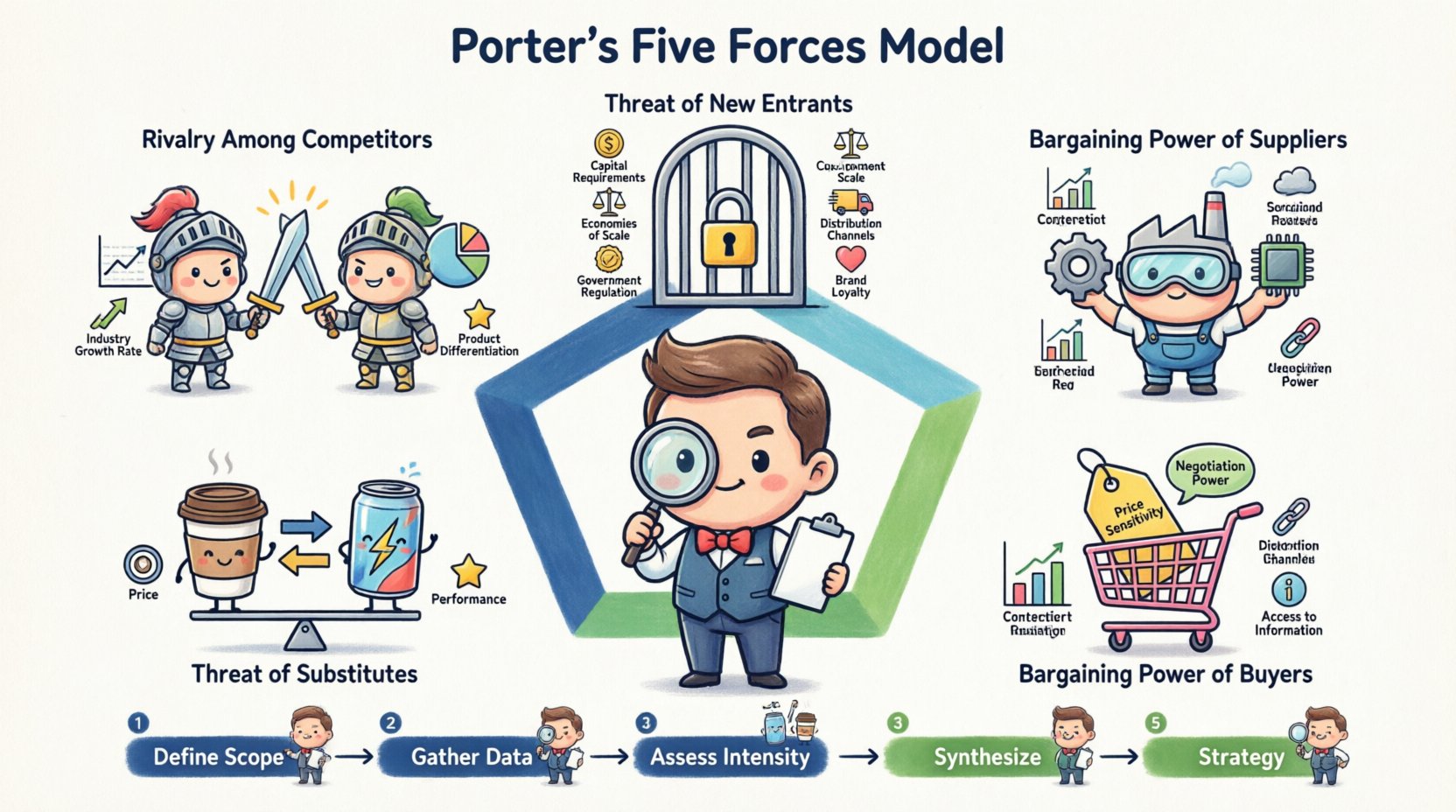
Origins of the Framework 📜
Michael Porter introduced this concept in his 1979 article, How Competitive Forces Shape Strategy, published in the Harvard Business Review. The core premise is that the intensity of competition depends on five specific forces. These forces determine the ultimate profit potential of an industry.
Unlike traditional analysis that focuses solely on direct rivals, this model looks at the broader ecosystem. It considers the pressure coming from upstream suppliers and downstream buyers. It also accounts for the threat of new players entering the market and alternative solutions that satisfy the same customer need. This holistic view is essential for long-term strategic planning.
The Five Forces Explained ⚖️
Each force represents a specific type of pressure that affects industry profitability. To conduct a thorough analysis, you must assess the intensity of each force. The combined effect of these pressures determines the overall competitive environment.
1. Threat of New Entrants 🚪
This force measures how easy or difficult it is for new competitors to enter the market. If barriers to entry are low, existing companies face constant pressure to maintain market share. High barriers protect incumbents from new competition.
- Capital Requirements: Industries requiring significant investment in facilities or technology deter new players.
- Economies of Scale: If established firms produce at a lower cost per unit, new entrants struggle to compete on price.
- Regulatory Barriers: Government licenses, patents, or safety standards can restrict entry.
- Access to Distribution Channels: Securing shelf space or sales networks can be a major hurdle for newcomers.
- Brand Loyalty: Strong customer attachment to existing brands makes it hard for new names to gain traction.
2. Bargaining Power of Suppliers 🏭
Suppliers can exert pressure by raising prices or reducing quality. This power is significant when they have few alternatives to sell to. In such cases, suppliers capture more value from the industry chain.
- Supplier Concentration: Few suppliers serving many buyers increases supplier power.
- Switching Costs: If changing suppliers is expensive or technically difficult, buyers are locked in.
- Product Differentiation: Unique or specialized inputs give suppliers leverage over buyers.
- Threat of Forward Integration: If suppliers can easily make the product themselves, they hold more power.
- Importance of Volume: If the supplier depends heavily on the buyer, their power decreases.
3. Bargaining Power of Buyers 🛒
Buyers can drive prices down by demanding better terms. This power increases when buyers are large, concentrated, or can easily switch to alternatives. High buyer power squeezes industry margins.
- Buyer Concentration: A few large buyers purchasing from many small sellers have significant leverage.
- Price Sensitivity: If the product is a significant portion of the buyer’s costs, they will negotiate aggressively.
- Availability of Information: Informed buyers can compare prices and features more effectively.
- Threat of Backward Integration: If buyers can produce the product themselves, they can threaten to do so.
- Standardized Products: When goods are undifferentiated, buyers switch based on price alone.
4. Threat of Substitute Products 🔄
Substitutes are products from outside the industry that fulfill the same need. They place a ceiling on prices because customers can switch if prices rise too high. This force is often overlooked but is critical for pricing strategy.
- Relative Price-Performance: If a substitute offers better value, it limits pricing power.
- Switching Costs: Low costs for customers to change to a substitute increase the threat.
- Buyer Propensity to Substitute: Some customers are naturally more open to trying different solutions.
- Availability of Substitutes: A wide range of alternatives increases the competitive pressure.
- Perceived Quality: If the substitute is viewed as a viable alternative, the threat is high.
5. Rivalry Among Existing Competitors ⚔️
This force represents the intensity of competition between current firms in the industry. High rivalry leads to price wars, advertising battles, and innovation races. It is often the most visible aspect of competition.
- Number of Competitors: Many equally balanced firms increase rivalry.
- Industry Growth Rate: Slow growth forces firms to fight for market share from each other.
- Exit Barriers: High costs to leave the industry keep struggling firms in the market, increasing supply.
- Differentiation: Lack of product differentiation leads to price-based competition.
- Fixed Costs: High fixed costs create pressure to fill capacity, often driving down prices.
Comparative Overview of the Forces 📊
Visualizing the forces helps in identifying which areas require the most attention. The table below summarizes the key drivers for each force.
| Force | Key Driver | Strategic Implication |
|---|---|---|
| New Entrants | Barriers to Entry | Build moats via patents or scale |
| Suppliers | Concentration & Switching Costs | Diversify supply chain |
| Buyers | Concentration & Sensitivity | Increase switching costs for clients |
| Substitutes | Value Proposition | Focus on unique benefits |
| Rivalry | Market Growth & Structure | Find niche or differentiate |
Conducting the Analysis Step-by-Step 📝
Implementing this framework requires a disciplined approach. It involves gathering data, assessing intensity, and deriving strategic actions. There is no software solution required to begin; the process relies on logical deduction and market research.
Step 1: Define the Industry Scope
Before analyzing, you must clearly define what constitutes the industry. A broad definition might miss critical dynamics, while a narrow one might exclude relevant substitutes. For example, if analyzing coffee shops, is the industry just cafes, or does it include convenience store coffee and home brewing equipment?
- Identify the specific product or service being analyzed.
- Map out the boundaries of the market.
- Identify the primary customer segment.
Step 2: Gather Industry Data
Information gathering is the foundation of the analysis. You need data on market size, growth rates, and competitor behavior. Sources can include public reports, trade associations, and customer feedback.
- Collect financial data from public filings.
- Review industry reports from research firms.
- Conduct interviews with suppliers and buyers.
- Monitor competitor pricing and marketing moves.
Step 3: Assess the Intensity of Each Force
For each of the five forces, determine whether the intensity is low, medium, or high. This assessment should be supported by the data collected in the previous step. Be objective and avoid assumptions.
- High Intensity: The force significantly impacts profitability.
- Medium Intensity: The force has some impact but is manageable.
- Low Intensity: The force poses little threat to the current business model.
Step 4: Synthesize Findings
Combine the assessments to understand the overall industry attractiveness. A high intensity in multiple forces suggests a challenging environment with lower average returns. A low intensity environment offers better opportunities for profitability.
- Identify the strongest pressures.
- Look for correlations between forces.
- Determine the overall margin potential.
Step 5: Formulate Strategy
Use the insights to guide strategic decisions. The goal is to position the organization to withstand the strongest forces or to influence them in your favor.
- Develop cost leadership strategies if price pressure is high.
- Focus on differentiation if buyer power is strong.
- Invest in barriers if new entry is a threat.
- Build relationships to reduce supplier dependency.
Practical Application: An Industry Example 🏢
To illustrate the utility of this framework, consider the commercial airline industry. This sector is often cited due to its complex competitive dynamics.
- Rivalry: Extremely high. Many carriers compete on price and routes.
- Supplier Power: High. The market is dominated by two major manufacturers for aircraft.
- Buyer Power: High. Customers can easily compare prices online and switch airlines.
- Threat of New Entrants: Low. High capital costs and regulatory hurdles create barriers.
- Substitutes: Medium. High-speed trains or video conferencing can replace short-haul travel.
In this scenario, profitability is often low due to the combination of high rivalry and high supplier power. Airlines often focus on loyalty programs to increase switching costs for buyers and improve margins.
Limitations and Considerations ⚠️
While powerful, this framework is not a perfect solution for every situation. Understanding its limitations ensures it is used effectively.
- Static Nature: The model provides a snapshot in time. It does not account for rapid technological changes.
- Industry Boundaries: In modern digital markets, industry lines are often blurred. Substitutes may come from unexpected sectors.
- Internal Focus: The model looks outward. It does not account for a company’s internal strengths or weaknesses.
- Assumption of Profit Maximization: It assumes firms want to maximize profit, which may not always be the strategic goal.
- Complementors: The original model did not explicitly include partners who add value to the product. This is sometimes added as a sixth force.
Integrating with Other Tools 🧩
For a comprehensive strategic view, combine this analysis with other frameworks. Using multiple tools provides a more rounded perspective.
SWOT Analysis
The Five Forces analysis feeds directly into the Opportunities and Threats sections of a SWOT analysis. The internal strengths and weaknesses are then matched against these external pressures.
PESTLE Analysis
PESTLE examines macro-environmental factors like political, economic, social, technological, legal, and environmental influences. These factors often drive the changes in the Five Forces over time.
Value Chain Analysis
Once the external forces are understood, use Value Chain Analysis to identify where the organization creates value internally. This helps in determining how to respond to the external pressures.
Common Pitfalls to Avoid 🚫
Even experienced strategists can make mistakes when applying this model. Being aware of common errors helps maintain the integrity of the analysis.
- Confusing Industry with Company: Do not analyze your own company as a force. Focus on the industry structure.
- Ignoring Global Dynamics: Local markets are increasingly connected to global supply chains and competitors.
- Overlooking Disruption: New business models can render traditional barriers obsolete quickly.
- Relying on Historical Data: Past performance does not guarantee future industry structures.
- Neglecting Customer Needs: Forces are driven by customer preferences. Ignoring this leads to inaccurate assessments.
Final Thoughts on Strategic Analysis 🎯
Strategic planning is an ongoing process rather than a one-time event. The Five Forces Model remains a cornerstone of industry analysis due to its clarity and depth. By regularly revisiting these forces, organizations can adapt to changing market conditions.
Effective strategy requires both external awareness and internal alignment. This tool provides the external map, but the organization must navigate the terrain. A disciplined approach to understanding competitive pressures leads to better resource allocation and sustainable growth.
Start by defining your industry clearly. Gather accurate data. Assess the forces objectively. Then, develop strategies that position your organization to thrive within these constraints. The goal is not just to survive competition but to shape the environment in which you operate.


Comments (0)